




















































The Quiet Discipline of My Father
Ten years have now passed since his execution. Another ten will pass. Then another. Generations will arrive knowing his name only through history books, political arguments, or fading photographs. Time inevitably erodes public memory.
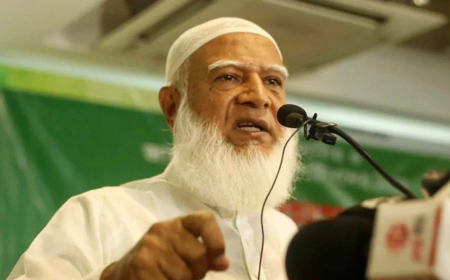
Ten years ago, on May 11, the Bangladesh state under the autocratic regime of Sheikh Hasina, executed my father, Motiur Rahman Nizami.
Time has moved forward with its usual indifference. Governments have changed. Children have grown older. Entire political conversations have risen and collapsed. But grief does not obey calendars.
A decade later, there is still not a single day when his memory does not return to me in some quiet, unannounced way ... in the middle of prayer or in a passing conversation. Or even in the sight of a white panjabi folded neatly on a chair.
My father has left behind something very special ... the memory of how he treated people.
Over the years, I have met hundreds who knew him personally. They came from every imaginable background, professors and laborers, businessmen and students, politicians and farmers, rickshaw pullers and scholars, villagers from distant corners of Bangladesh and expatriates living thousands of miles away.
Many disagreed with him politically. Many did not share his worldview. Yet their stories carried a striking similarity. Almost every conversation eventually arrived at the same conclusion. He was kind.
Not performatively kind. Not strategically polite in the way public figures often learn to be. His kindness was quieter than that, almost instinctive. People would tell me that whenever they spoke to him, he gave them his full attention, as though nothing else around him mattered.
Even in crowded rooms, even in moments when dozens waited to speak with him, he possessed a rare ability to make a single person feel heard.
In this age where most people listen only long enough to prepare their own response, my father listened to understand.
That quality is harder to appreciate now because genuine attentiveness has become so scarce. Modern life rewards interruption. It rewards speed and outrage. Conversations have become competitions for dominance rather than opportunities for understanding.
But he belonged to a different temperament altogether. He never seemed in a hurry to prove himself. What still astonishes me is how little ego survived inside a man who had achieved so much.
As a young leader, he became the last central president of the All Pakistan Islami Jamiat-e-Talaba, then one of the largest student organizations in the subcontinent. For someone from East Pakistan to rise to that position carried enormous symbolic significance.
Yet after the birth of Bangladesh in 1971, and after returning in 1973 under immense uncertainty and personal risk, he quietly immersed himself in organizational work in remote areas of Rajshahi district in northern Bangladesh.
There were no demands for status. No complaints about recognition. No expectation that his earlier accomplishments entitled him to comfort or prominence. He simply worked. Patiently. Consistently. And without spectacle.
That kind of humility feels increasingly rare now. We are all obsessed with visibility. Everyone wants leadership before sacrifice and influence before discipline. People chase titles with astonishing hunger while avoiding the burdens those titles require.
My father believed the opposite: That dignity came from remaining sincere when nobody noticed at all.
Whenever I read the verse from Surah Al-Furqan: “The servants of the Most Merciful are those who walk humbly upon the earth, and when the ignorant address them harshly, they say, ‘Peace’” -- I immediately think of him. He seemed to organize his entire emotional life around that principle.
He had an almost unnatural resistance to provocation. As a child, I used to marvel at it. I watched people insult him publicly, mock him, bait him into anger. Yet he rarely reacted in the way most people would.
Instead, he would smile gently, remain silent, or quietly say “Salam.” Sometimes I joke to myself that it was as if he walked through life wearing invisible noise-canceling headphones. He simply refused to surrender his inner composure to other people’s chaos.
As a boy, I occasionally sat in the visitors’ gallery of Parliament and watched him speak. The atmosphere was often hostile ... shouting, interruptions, deliberate attempts to drown him out. Yet he remained remarkably calm.
I still remember one moment vividly. Amid the disorder, he addressed the Speaker with complete composure and said: “Mr. Speaker, please keep my microphone on. I can handle the chaos.”
At the time, I admired it as confidence. Later, I understood it as discipline.
I remember another moment from before the 1996 parliamentary elections during a televised question-and-answer program. The late Annisul Huq repeatedly tried to provoke my father with mocking questions about Jamaat-e-Islami, asking whether dancers would be forced to perform wearing burqas if the party came to power.
Most politicians would have reacted defensively or lashed back. My father did neither. He ignored the provocation entirely and continued discussing what he believed were the country’s real problems. He spoke as though the insult had never even been uttered.
Looking back, I realize how unusual that was. Today, public discourse survives on outrage. Entire careers are built on theatrical conflict. But he understood something many people never learn: not every insult deserves your attention.
Silence, in the right moment, can be a form of strength.
Despite his demanding public life, he noticed everything around him ... tiny details most people would miss entirely.
He almost always wore white panjabi and pajama, yet somehow he could immediately tell which pajama belonged with which panjabi. If we mixed them up while organizing his clothes, he noticed instantly and expressed mild disappointment.
To this day, I genuinely do not understand how he differentiated between two nearly identical white outfits.
As a child, one of my favorite rituals was helping him remove his shoes and socks when he returned home at night. Somehow, unbelievably, he knew which sock belonged on which foot. If I accidentally switched them, he noticed immediately.
These are such small memories. Almost laughably small. Yet grief transforms ordinary details into sacred artifacts. The things that once seemed insignificant become the very things you would give anything to experience one more time.
I can still picture another scene from around 1989. I was perhaps twelve years old. We were playing cricket inside the house with a tennis ball. Eventually, we shattered a glass window. Panicked, we attempted a cover-up worthy of incompetent criminals, placing a chair in front of the broken pane as camouflage.
The moment my father entered the room, he noticed. Immediately.
He was not pleased. At the time, we were terrified. Today, the memory makes me smile because it captures something so characteristic about him: almost nothing escaped his attention.
He also possessed a subtle sense of humor, delivered so gently that you sometimes missed it if you were not paying close attention.
One morning during breakfast, my mother was visibly upset and expressing her frustration. I remember waiting for my father to respond seriously. Instead, he smiled calmly and said: “I’m just testing how hot the pan is.”
That was his way. He could diffuse tension without humiliating anyone. He understood that humor did not need to be loud to be effective.
At home, he expected discipline from us, but he was deeply careful never to inflate our egos. Praise from him was measured. He wanted his children to remain grounded regardless of education, achievement, or status.
Years later, during 2005 and 2006, I was teaching at North South University. One of my students, the daughter of the then Planning Secretary, happened to meet my father at a wedding and introduced herself proudly as my student.
My father smiled and responded with complete seriousness: “Can he actually teach anything?”
The student later told me the story while laughing uncontrollably.
That was exactly who he was. He never boasted about his children. Never advertised our accomplishments. But beneath that restraint was immense love and constant prayer. He wanted us not simply to succeed, but to become decent human beings.
One memory, however, still overwhelms me whenever I revisit it.
The day I defended my PhD dissertation and officially earned my doctorate, I immediately called my mother. She broke down crying and said: “Your Abbu would be so happy. Let me send him the news in jail.” Later, I learned what happened afterward.
When he heard the news, he became so overjoyed that he requested sweets be sent to the prison. Then, with his own hands, he distributed those sweets among the inmates around him.
Every time I think about that moment, I feel a kind of helpless ache that language cannot fully contain. There are losses that never become intellectually manageable. No amount of time reorganizes them into something neat.
I still wish, with the irrational intensity of grief, that I could embrace him one more time. I wish I could kiss his forehead once more. But perhaps this world was never designed to fulfill every longing. Perhaps some reunions are deliberately postponed for the next life.
So we continue to pray.
Ten years have now passed since his execution. Another ten will pass. Then another. Generations will arrive knowing his name only through history books, political arguments, or fading photographs. Time inevitably erodes public memory.
But character leaves a different kind of inheritance.
Long after power disappears, people remember how you made them feel. They remember whether you treated them with dignity when you had every opportunity not to. They remember patience. They remember gentleness. They remember grace.
That is the legacy my father left behind.
And unlike monuments or slogans, that kind of legacy does not disappear easily.
Dr Mohammad Nakibur Rahman is a professor of Finance at the University of North Carolina and the US spokesperson for Jamaat-e-Islami Bangladesh.