
































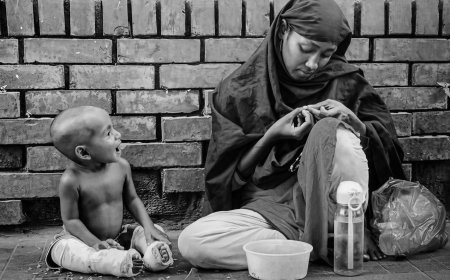


































The Extremely Sustainable Lifestyle of the Burnt-Out Feminist
Though the International Brotherhood of Mediocre Men appears to be doing a competent job of setting the world on literal fire, feminists remain the preferred explanation for why everything is burning.

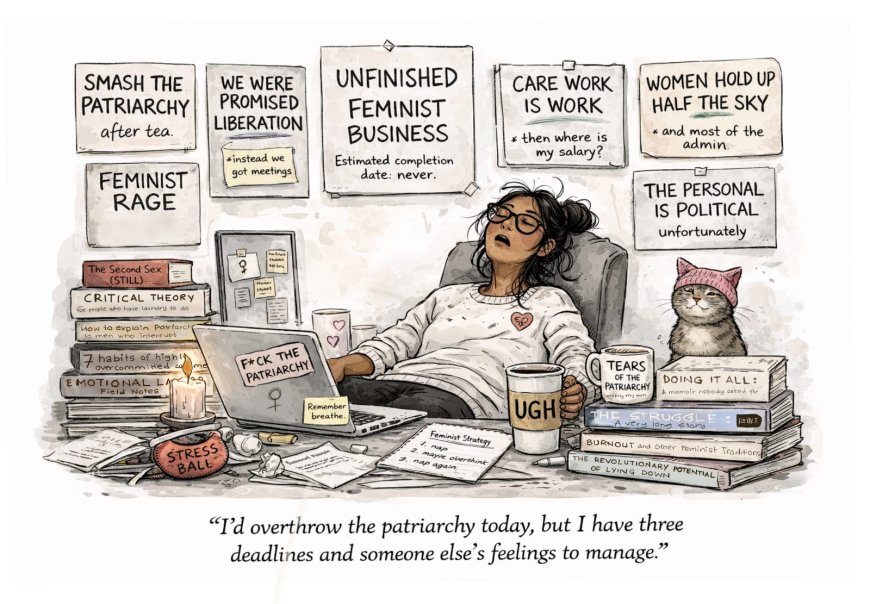
There has been much discussion in recent years about sustainability. Sustainable agriculture. Sustainable energy. Sustainable development. Sustainable fabrics made from recycled sadness.
Less attention has been paid to one of the most remarkable sustainability experiments of the modern era: The burnt-out feminist.
For decades now, societies across the world have relied on a small but determined population of women who continue to produce outrage, analysis, strategy, care work, and meeting notes at levels that appear to defy basic biological limits -- usually with very little sleep, inconsistent pay, and the constant background noise of men explaining things.
Unlike many sustainability projects, this one appears to run indefinitely despite being chronically underfunded and dangerously close to collapse.
Scientists are baffled.
The Energy Source
Like all sustainable systems, the burnt-out feminist runs on renewable energy.
Primary fuel sources include: Righteous anger, group chats with other exhausted women, strong tea, and the faint but persistent belief that human beings might one day learn to behave.
This energy system is considered extremely efficient. It can power entire movements, sustain community networks, and occasionally hold fragile democracies together.
Unfortunately, it also has a tendency to collapse spectacularly every few years, at which point the feminist must lie face down for several days while society continues asking if she could “just join one more meeting.”
The Care Work Economy
One of the most remarkable features of the burnt-out feminist lifestyle is the amount of care work it produces.
At home, the feminist discovers she has been quietly appointed Chief Operations Officer of Human Life. She remembers birthdays, doctor appointments, grocery lists, emotional crises, and which family member is currently not speaking to which other family member.
Her partner is often deeply supportive and occasionally willing to help, once provided with a clear logistical briefing and the location of the kitchen. This arrangement is known as equality.
At work, the same feminist performs an equally essential role. She mediates conflicts, mentors younger colleagues, organizes collective efforts, and ensures the entire project does not collapse into chaos.
These tasks are widely acknowledged to be critical to the functioning of organizations. They are also widely ignored when promotions are discussed.
Meanwhile, somewhere across the meeting table, a man is confidently presenting a strategic framework consisting largely of ideas developed by women and arranged in bullet points. This is known as leadership.
Society explains this imbalance through a charming theory: Women are simply naturally better at caring. Men, on the other hand, are portrayed as capable visionaries who occasionally forget where the dishwasher is.
The theory has many advantages. It transforms a massive structural distribution of labour into a personality trait, and allows the system to continue functioning without anyone feeling particularly responsible for it.
After all, care work is invisible by design. If it is done well, nothing explodes. Entire ecosystems of family life, workplaces, and political organizing quietly rely on the same exhausted group of women who remember everything.
And the burnt-out feminist occasionally pauses to consider a small but intriguing question: If women stopped doing all of this for just one week, would the world collapse… or would it finally notice who has been holding it together all along?
The Meeting Survival Protocol
The burnt-out feminist inevitably attends many meetings. Some are useful. Others are what scientists call “meetings that could have been emails.”
These gatherings serve an important institutional function. They allow organizations to demonstrate deep commitment to change while ensuring that change proceeds at a comfortable and manageable pace.
The feminist notices that the same question appears regularly: “What do women think about this?”
This is an interesting question. Women, as it turns out, are not a small advisory committee but approximately half of the human population.
Nevertheless, the feminist takes a breath and responds carefully.
“Perhaps we should consider structural factors.” “Let’s centre the people most affected.”
These statements are extremely useful. They allow the meeting to continue for an additional forty-five minutes while giving the impression that meaningful progress has been made.
At some stage the discussion will shift toward “next steps.” This is the moment when the feminist will be invited to:
- join a working group
- draft a concept note
- prepare a framework
- or organize another meeting to discuss the outcomes of the current meeting
It is important to understand that this is how many bold social transformations begin their journey toward becoming PDF documents.
The Institutional Absorption Process
Movements often begin with urgency.
People gather in streets, community halls, or university campuses. They speak plainly about injustice and demand change. This phase is energetic and occasionally frightening for established systems. Fortunately, institutions have developed an elegant response known as The Absorption Process.
First, the language of the movement is welcomed. Words such as empowerment, inclusion, and intersectionality are warmly invited into policy papers, strategic frameworks, and conference banners.
Next comes the workshop.
Then the consultation.
Then the multi-stakeholder dialogue.
Eventually the original demand for transformation becomes a panel discussion. This outcome is considered a success.
Feminists Meeting Feminists
Feminists themselves hold many meetings.
These are slightly different.
They begin with urgency and a shared understanding that the world is, in fact, quite broken.
The discussions are often passionate. Sometimes they are brilliant. Sometimes they are exhausting. Occasionally they involve three hours of debate over the wording of a paragraph that will eventually be read by approximately twelve people.
At some point, the conversation shifts from the external problem -- patriarchy, capitalism, authoritarianism, planetary collapse -- to the internal architecture of the meeting itself.
The agenda now expands to include important questions such as: Who is being centred in this conversation? Who has not yet spoken? Who has the legitimacy to speak on behalf of whom?
These are serious questions.
They arise from a sincere effort to build movements that do not reproduce the hierarchies they are trying to dismantle. Unfortunately, they also have the curious ability to generate entire ecosystems of discussion.
Soon the group is debating representation, positionality, power, voice, accountability, privilege, language, and whether the meeting structure itself may be subtly reproducing patriarchal authority.
At this stage, the feminist may look down at the original agenda and notice that the revolution has quietly slipped to item number seven.
The International Brotherhood of Mediocre Men
While the burnt-out feminist holds the emotional scaffolding of several collapsing systems together, the world outside continues to be managed by a remarkable institution. This institution is known as The International Brotherhood of Mediocre Men.
The Brotherhood operates across borders, industries, and political systems. Its members may be found in parliaments, boardrooms, television studios, and occasionally on panels about women’s leadership.
The Brotherhood’s greatest strength is its unwavering belief that it should remain in charge of things. Despite centuries of wars, financial collapses, environmental disasters, and political crises, members have shown remarkable resilience in maintaining this belief.
Meanwhile, the burnt-out feminist watches the news, wondering whether the entire global governance system might actually be a slightly chaotic group project in which the least prepared students somehow ended up presenting the final report.
It is an unsettling thought.
Fortunately, the feminist does not have much time to dwell on it. There is a concept note due tomorrow.
The Feminist Accountability Mechanism
Though the International Brotherhood of Mediocre Men appears to be doing a competent job of setting the world on literal fire, feminists remain the preferred explanation for why everything is burning.
Observers often ask a simple question: “Where are the feminists?”
The question tends to arise during moments of social crisis, political upheaval, or particularly egregious acts of misogyny. It carries the tone of a disappointed customer at a public service counter. Excuse me, I ordered gender equality three decades ago. Why has it not yet arrived?
Meanwhile, the burnt-out feminist may be: Organizing a protest; supporting survivors; writing a report; facilitating a meeting; explaining patriarchy for the 17th time this week; caring for a child; mediating a conflict; or lying face down for fifteen minutes attempting to recover from the previous week. None of this appears to count.
The Sustainability Question
Eventually the burnt-out feminist lies down for a moment. She decides that she will no longer attend the meeting, draft the report, explain the issue, or hold together systems that appear determined to collapse on their own.
For several peaceful minutes this feels like an excellent decision. And then the world does something so spectacularly unreasonable that the entire system powers up again.
Which is perhaps the most renewable energy source we have discovered so far.
Sushmita S Preetha is a writer, researcher and organizer.