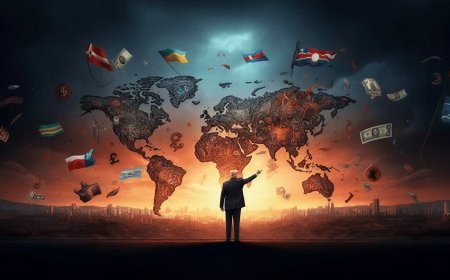






































































Is Washington Fighting Yesterday’s War Against Tomorrow’s Superpower?
China leads in AI publication volume, citations, patent output and industrial robot installations, while the US retains advantages in notable model development, high-impact patents and investment.
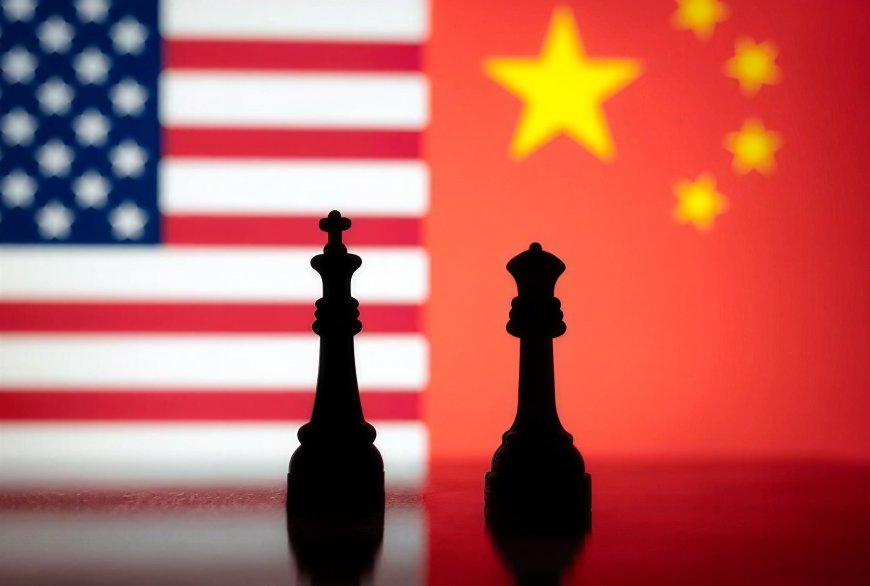
The United States remains the world’s most powerful military power, but China is steadily narrowing the gap in military capability, technology, and industrial capacity.
According to estimates, China has around two million active military personnel, compared with roughly 1.3-1.4 million in the US. Yet military strength cannot be measured by manpower alone.
The US retains significant advantages in global power projection, logistics, overseas bases, alliance networks, nuclear deterrence, and capabilities across air, sea, space and cyber domains.
The US also maintains the world’s largest defence budget by a considerable margin and operates 11 aircraft carrier groups.
China, meanwhile, has the world’s largest standing army and has invested heavily in naval expansion, missiles, space capabilities, cyber warfare and other technologies designed to make US military operations in the Western Pacific increasingly costly.
Military strength, however, is relative, contextual, and evolving. The critical issue is not simply the number of personnel or sophistication of weapons, but the ability to project power, sustain operations and achieve objectives at the time and place of choosing.
The ongoing US-Israeli war with Iran illustrates the limits even a vastly superior military power can face when confronting a determined regional adversary. The conflict has also placed additional pressure on US military readiness and global deployments.
The US interventions of the past several decades have been enormously costly. The Vietnam War cost about USD 168 billion in then-year dollars, equivalent to roughly USD 1.1 trillion today.
US war-related appropriations for Afghanistan and Iraq also ran into hundreds of billions of dollars. These figures, however, do not fully capture the long-term economic, social, and human costs.
The interventions consumed enormous resources while leaving Afghanistan and Iraq facing prolonged political and security challenges. The US eventually withdrew from both theatres after bringing its major military missions to an end, but neither intervention produced the durable stability originally envisaged.
Meanwhile, the cost of maintaining global military primacy continues to rise. The Trump Administration’s FY2027 budget request seeks just over USD 1.5 trillion for national defence, including USD 1.45 trillion for the Department of War -- a 44% increase over FY2026.
Such spending inevitably raises questions about the opportunity costs for domestic priorities, including education, healthcare, infrastructure and social protection.
While Washington remains deeply engaged in projecting military power and influence across the world, China is steadily narrowing the technological and industrial gap.
The competition is particularly intense in artificial intelligence, robotics, electric vehicles, advanced manufacturing and semiconductors.
China is already the world's manufacturing powerhouse. Its industrial ecosystem gives it a major advantage in converting technological innovation into mass production. This is particularly evident in electric vehicles and batteries.
In 2025, China produced about 16 million electric cars -- nearly 75% of global production -- and accounted for more than 80% of global battery-cell production.
Its lead in robotics is equally significant. China accounted for 54% of all industrial robots installed globally in 2024, with about 295,000 installations, and its operational stock exceeded two million units.
Artificial intelligence is perhaps the most consequential arena. It would be premature to conclude that China has overtaken the US. The United States continues to lead in private AI investment and the development of notable frontier models.
Yet the gap has narrowed dramatically. Stanford’s 2026 AI Index reports that US and Chinese models have repeatedly traded the lead since early 2025, with the performance gap between the leading models effectively closing.
China leads in AI publication volume, citations, patent output and industrial robot installations, while the US retains advantages in notable model development, high-impact patents and investment.
The semiconductor contest is equally strategic. US restrictions have constrained China’s access to the most advanced chips and semiconductor-manufacturing equipment, but Beijing continues to invest heavily in developing indigenous capabilities.
The struggle over semiconductors demonstrates that technological power is increasingly inseparable from national security.
The financial contrast is also striking, although the figures measure different things. US federal debt surpassed USD 40 trillion in August 2026, while China holds foreign-exchange reserves of more than USD 3 trillion.
The two figures are not directly comparable -- US debt is a liability, whereas foreign-exchange reserves are assets -- but they illustrate different dimensions of the two countries’ financial positions.
China, therefore, does not necessarily need to surpass the United States militarily to alter the global order. If it can narrow the technological gap, expand its industrial capacity, control critical supply chains and make US power projection increasingly costly, the balance of global power could shift without a conventional great-power war.
For developing countries such as Bangladesh, this emerging US-China technological competition could create both opportunities and challenges.
China has long been an important economic and trading partner of Bangladesh, and its technological rise could provide opportunities in digital infrastructure, artificial intelligence, advanced manufacturing, renewable energy, electric mobility and other emerging sectors.
Bangladesh may therefore increasingly look to China as an important technological partner while maintaining strong economic, technological and strategic engagement with the United States and other major powers.
Rather than choosing one side, Bangladesh's greater advantage would lie in strategic flexibility -- avoiding excessive dependence on any single power and leveraging US-China competition to diversify technology, investment, markets and expertise.
The emerging contest is thus no longer simply a struggle between two military powers. It is increasingly a competition over who will shape the technologies, industries and supply chains of the 21st century.
For Washington, the challenge is to maintain technological leadership while managing the enormous costs of global military commitments. For countries like Bangladesh, the challenge is to navigate this contested order wisely and turn great-power competition into an opportunity for national development.
Brigadier General Mustafa Kamal Rusho (Retd), is a Research Director in Osmani Centre for Peace and Security Studies (OCPASS).