











































































Bangladesh Bank Reaches a Crossroads
Bangladesh is not on the verge of collapse, but it remains fragile. During periods of economic uncertainty, central banks must stay above politics. When monetary authority appears negotiable, inflation expectations shift, currency stability drops, and fiscal discipline weakens.


The abrupt removal of the governor has turned a policy debate into a key test of central bank independence and economic credibility.
Bangladesh’s economy is at a critical juncture. Inflation remains high, the banking sector faces structural challenges, reserves require careful management, and the new government is under pressure to deliver on ambitious electoral promises. In this environment, institutional stability isn’t optional; it’s vital.
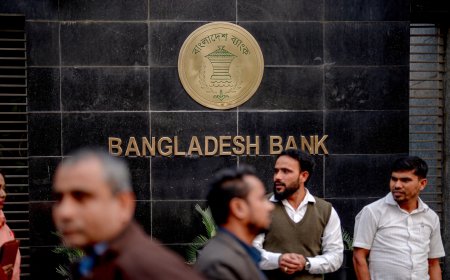
The recent removal of Bangladesh Bank Governor Dr. Ahsan H. Mansur and the appointment of a politically connected CPA and garments entrepreneur with no prior central banking experience have thus raised serious concerns among financial experts, investors, and policy analysts both domestically and internationally.
This is not just a personnel reshuffle; it is a moment that tests who holds the power over monetary authority in Bangladesh.
Merit, Method, and Meaning
The veteran editor of Bangladesh’s top English newspaper, Mr. Mahfuz Anam, based the episode on three criteria: merit, method, and meaning. By that measure, the controversy intensifies.
Based on merit, the office of the central bank governor ranks among the most technically demanding positions in economic governance. It demands expertise in monetary transmission, liquidity management, exchange rate policies, reserve adequacy metrics, and banking supervision.
During his 18-month tenure, Dr. Mansur managed a shift toward a more market-based exchange rate, assisted in stabilizing the taka, enhanced regulatory oversight of distressed banks, and helped increase gross reserves from approximately $25 billion to $35 billion.
His successor may have professional accomplishments elsewhere, but he lacks comparable central banking experience. Even more troubling is the disclosure that his own loan was rescheduled as recently as December of last year. In a financial system where non-performing loans are a persistent and politically sensitive issue, such a background complicates perceptions of enforcement credibility.
The question is not personal. It is institutional.
This method has also faced criticism. According to the senior editor’s account, the outgoing governor reportedly learned of his removal through the media and left without prior consultation.
An adviser was allegedly mobbed and expelled from central bank premises by disgruntled staff.
Even if the decision was legally within the government’s authority, the way it was carried out risks sending the message that a vital economic institution can be abruptly reshaped under pressure.
Then comes the question of purpose. Why remove the governor when the new administration is still strengthening its economic team? Why destabilize leadership when global markets are highly sensitive to signals of policy stability?
The timing amplifies uncertainty.
Why Autonomy Matters
This episode focuses on a long-standing debate about the Bangladesh Bank’s independence. Proposals to grant it more statutory autonomy have circulated for over ten years. The reasoning is straightforward: monetary policy functions best when guided by a clear mandate (usually price stability) and is shielded from daily political interference.
Autonomy does not mean a lack of accountability. It signifies rule-based governance. An independent central bank sets interest rates, regulates banks, and manages reserves based on macroeconomic goals rather than election cycles.
From Dani Rodrik to Raghuram Rajan, mainstream economists argue that credible monetary policy depends on institutional independence. Countries with stronger central bank autonomy tend to experience lower average inflation and more stable currency performance.
India’s Reserve Bank functions within a statutory inflation-targeting framework. The European Central Bank maintains substantial insulation across various sovereign governments. South Korea’s central bank has upheld macroeconomic stability through well-defined legal mandates.
Autonomy doesnt eliminate risk, but it sets boundaries.
The Political Economy of Monetary Capture
Finance ministries worldwide are tempted to keep influence over central banks. Control makes it easier to fund deficits, target lending, and provide short-term stimulus during politically sensitive times. However, this flexibility often carries long-term costs.
Turkey’s central bank lost credibility due to ongoing political pressure to keep interest rates low. Sri Lanka’s monetization of deficits led to a sovereign crisis. Argentina’s politicized monetary authority caused long-term inflation and repeated currency crashes.
Bangladesh is not experiencing hyperinflation, but it faces vulnerabilities: high inflation, banking fragility, and sensitivity in external balance. In such a setting, even the perception of politicized monetary leadership can unsettle markets.
Replacing a governor known internationally for macro-stabilization efforts with a politically affiliated figure lacking a central banking background sends a signal -- intended or not -- that policy direction may be shifting.
Markets seldom wait for clarification.
Supervision, Stability, and the Stakes of Leadership
The country’s banking system has long struggled with crony lending, capital flight, and weak governance. During Dr. Mansur’s tenure, boards of at least eleven troubled banks were restructured. Monetary tightening was implemented to control inflation expectations.
International observers credited him with restoring confidence during a turbulent period. The respected editor who analyzed the episode warned that appointing a politically active figure to such a sensitive position risks blurring the lines between fiscal authority and monetary oversight. The concern is not just about competence but about independence of judgment.
If the governor is seen as politically aligned or influenced, supervisory decisions, especially against powerful borrowers, become more difficult to justify as impartial.
Institutional authority depends on perceived neutrality.
Constitutional and Governance Stakes
Bangladesh’s Constitution highlights the rule of law and institutional integrity. Although it doesn't explicitly ensure central bank independence, the general idea of separating economic management from partisan politics aligns with constitutional governance.
The Election Commission and Judiciary are protected to maintain fairness and justice. The monetary authority needs a similar, clear structure.
Delaying autonomy legislation was already concerning. Removing a governor abruptly and installing a politically connected successor worsens those concerns.
Institutional credibility, once lost, is expensive to regain.
A Defining Test
This moment extends beyond a single appointment. It highlights a broader struggle over whether Bangladesh’s macroeconomic management should depend on rules or discretion.
If the government wants to demonstrate its commitment to reform, it should clearly define the legal framework that governs Bangladesh Bank’s independence, establish transparent criteria for leadership appointments, and reaffirm safeguards against political interference.
The veteran editor warned that the greatest harm might come from the perception that the change was driven by pressure instead of careful consideration. Even if that view is exaggerated, financial governance depends as much on trust as on policies.
Bangladesh is not on the verge of collapse, but it remains fragile. During periods of economic uncertainty, central banks must stay above politics. When monetary authority appears negotiable, inflation expectations shift, currency stability drops, and fiscal discipline weakens.
The question now exceeds anyone individually.
It depends on whether Bangladesh prioritizes institutional strength over quick control. And whether the monetary authority remains a pillar of stability or becomes an extension of executive power.