









































































A Day’s Trade, A Night’s Debt
Financial inclusion cannot be measured solely by account ownership. It must be judged by whether a vendor can access 10,000 taka at 2 AM at a known cost, without humiliation or hidden charges, and with a pathway to better finance.


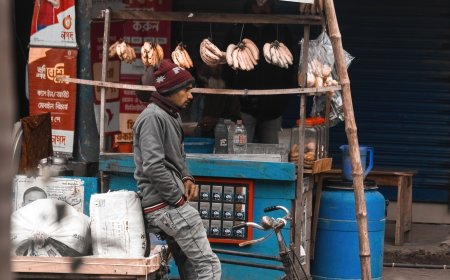
The street vendor who sets up his vegetable stall at 6 AM in Dhaka’s Karwan Bazar, the tea seller who refills his kettle before Fajr in Chittagong, the small grocer in a Sylhet upazila who restocks eggs and lentils daily -- these microvendors share a hidden financial ritual.
They borrow money at night, buy goods before dawn, sell through the day, repay by evening, and borrow again. The cycle repeats daily.
To an economist, this is high-frequency working capital financing. To a banker, it does not exist -- it sits on no balance sheet. To the vendor, it is survival. This is the day-night loan. It is not a theory; it is a lived reality across South Asia, Africa, and Latin America.
The question is not whether it exists, but whether the formal financial system will acknowledge it, price it transparently, and regulate it so that it stops extracting abnormal costs from the poorest.
A typical transaction is simple. At 9 PM, a vendor needs 10,000 taka to purchase goods from a wholesale market opening at 2 AM. Banks are closed.
Microfinance institutions operate on weekly cycles, not overnight. Informal lenders -- aratdars, commission agents, or local moneylenders -- step in.
He borrows 10,000 taka and repays 11,000 taka the next evening. The 1,000 taka is not called interest. It is a service charge, a line fee, or simply help.
On paper, this is 10 percent per day -- over 37,000 percent annualized. By conventional metrics, it is usurious. Yet vendors continue to use it because the alternative is worse. No stock means no sales, and no sales means no income. For a vendor earning 1,500-2,000 taka daily, missing a day’s trade is more costly than paying the fee.
This is high-velocity, low-ticket, unsecured, ultra-short-term credit. The lender’s risk is low -- loans turn over within 24 hours, and default carries social consequences in tightly knit markets.
The borrower’s cost is high because no formal institution prices for such duration and immediacy. This is not market failure in existence, but in structure.
Why do banks not step in? The constraints are structural. Banking systems are built for loans of 100,000 taka and above, with tenors of months or years.
Processing a 10,000 taka overnight loan requires nearly the same compliance cost -- KYC, documentation, staff time -- as a much larger loan. The economics simply do not work under traditional models.
Further, vendors lack collateral, formal records, or credit history. The overnight nature of the loan makes monitoring difficult. Interest rate caps add another barrier.
A product charging even 1 percent per day would breach conventional ceilings. Regulators look at economic substance, not labels. Calling it a fee does not change its nature.
The result is predictable: A real demand is met entirely outside the regulated system, with no pricing transparency, no consumer protection, and no data trail.
Policy responses have largely missed the point. Financial inclusion efforts -- microcredit, agent banking, digital accounts -- focus on access but ignore timing. A weekly loan does not solve a 12-hour liquidity gap. By overlooking the time dimension, policy leaves millions exposed to high-cost, unregulated credit.
Formalizing the day-night loan can deliver three immediate gains.
First, transparency. Vendors would know the true cost of borrowing and compare alternatives. Today, pricing is opaque and bundled.
Second, consumer protection. Regulation can curb coercive recovery practices, limit exploitative rollovers, and provide grievance redress.
Third, data creation. Daily repayment builds credit history. A vendor completing hundreds of cycles can graduate to cheaper, longer-term credit.
The goal is not to make overnight credit cheap in accounting terms. The costs of immediacy, liquidity, and distribution are real. The goal is to make it fair, visible, and a bridge to better finance.
A regulator-enabled day-night loan would differ from standard microcredit. It would be an unsecured revolving line of 20,000-50,000 taka, with daily drawdown and repayment. Pricing would combine a capped interest component with a fixed transaction fee -- for example, 80-120 taka per 10,000 taka per day -- fully disclosed upfront.
Delivery must be digital: Mobile wallets, USSD, and agent networks embedded in markets. No paperwork, no branch visits. Disbursement and repayment happen within minutes. The digital trail substitutes for collateral.
Risk management would rely on small limits tied to daily turnover, supplemented by cash-flow data, mobile usage patterns, and local verification through market actors. Rollover would be strictly capped -- say, three consecutive cycles -- to prevent debt traps.
Regulators would need to define a new category: An Intraday Working Capital Facility for Micro Enterprises. This category could sit outside standard microcredit caps but remain subject to a total cost ceiling and strict disclosure rules. Banks, MFIs, and fintechs could operate under a sandbox framework.
The pricing may still appear high. A 100 taka fee on 10,000 taka per day equals 1 percent daily, or 365 percent annually. But the alternative is not a 20 percent annual loan -- it is an unregulated 10 percent daily loan. The policy choice is not between low and high cost, but between transparent and opaque, regulated and unregulated.
The economic logic is straightforward. If 10,000 taka generates 1,500 taka in daily margin, paying 100 taka for access yields a net gain of 1,400 taka. Without the loan, income is zero. The decision horizon is 24 hours, not 12 months. Annualized rates distort the picture.
The real risk lies in rollover. Short-term credit becomes harmful when it becomes permanent. That is why design matters: Hard rollover caps, cooling-off periods, and clear cost disclosure.
From a macro perspective, formalizing this segment increases working capital velocity. More goods flow through markets, more vendors remain active, and more transactions enter the formal data ecosystem. Over time, this improves credit allocation, tax compliance, and even monetary transmission.
International precedents suggest feasibility. Mobile-based nano-loans in Kenya and overdraft-style facilities in India have demonstrated strong uptake, despite high effective APRs. Bangladesh already has high mobile financial service penetration and dense agent networks. What is missing is regulatory recognition.
Safeguards must be central. Total cost disclosure should be mandatory before each transaction. A dedicated grievance redress mechanism with rapid resolution should be in place. Agents engaging in coercion must lose licenses. Regulators should monitor market-level borrowing intensity -- if most vendors rely on daily loans, deeper structural issues may be at play.
Implementation can follow a phased approach. A sandbox pilot with a few institutions can test viability, with strict reporting on pricing, defaults, and usage. Integration with the credit bureau can build borrower histories. If performance is stable, guidelines can be formalized and scaled. Over time, high-performing borrowers can graduate to longer-term, lower-cost loans.
The role of regulators is not to run such products, but to define boundaries and enable innovation. Ignoring the market does not eliminate it -- it only entrenches opacity and exploitation.
Financial inclusion cannot be measured solely by account ownership. It must be judged by whether a vendor can access 10,000 taka at 2 AM at a known cost, without humiliation or hidden charges, and with a pathway to better finance.
Critics will object to triple-digit annualized rates. But this critique often ignores context. For the borrower, the relevant question is simple: Does the loan enable income that exceeds its cost? In most cases, it does.
The day-night loan is not an anomaly. It is a rational adaptation to a timing mismatch in micro commerce. Formalizing it will not make it cheap, but it will make it fairer, safer, and more productive.
The technology exists. The demand is proven. What remains is regulatory will. When that emerges, the midnight market will continue to thrive -- but it will no longer remain invisible to the system meant to serve it.
Nasrin Sheely is an analyst and commentator based in Dhaka, Bangladesh, specializing in banking, economic policy, and international trade.