






































































The Solar Panel Solution
The integration of solar panels into agricultural land offers a practical pathway toward achieving energy independence, environmental sustainability, and resilient food systems in Bangladesh.

Bangladesh is widely recognized as an agriculture-dependent country where farming plays a central role in ensuring food security for a large and growing population. The agricultural sector not only sustains rural livelihoods but also contributes significantly to national economic stability.
At the same time, Bangladesh faces a rapidly increasing demand for electricity driven by industrialization, urbanization, and improved living standards. In recent years, the country has prioritized renewable energy development to reduce greenhouse gas emissions and decrease dependence on fossil fuels.
Among various renewable energy sources, solar energy holds immense potential due to Bangladesh’s favorable geographic location, abundant sunlight, and relatively consistent solar radiation throughout the year.
Despite this potential, an important question remains: Is it possible to install solar power systems on agricultural land without negatively affecting crop production? Traditionally, agricultural land has been viewed as incompatible with solar energy infrastructure, as conventional solar farms require large open areas and may compete with food production.
However, recent scientific developments and practical experiences suggest that this perceived conflict can be transformed into an opportunity through innovative land-use strategies.
Bangladesh is also a country rich in biodiversity, particularly in terms of native and indigenous crop varieties that have been cultivated for generations within both human settlements and natural ecosystems. This biological diversity provides a strong foundation for adapting agriculture to changing environmental conditions.
Many crop species possess natural tolerance to partial shade, and through careful selection, breeding, and agronomic management, it is possible to identify and cultivate crop varieties that perform well under reduced sunlight conditions.
Research indicates that several vegetables and leafy crops can grow successfully with limited sunlight exposure, demonstrating the feasibility of integrating solar panels with crop production systems.
The current global energy and environmental situation further reinforces the urgency of exploring such integrated solutions. Fossil fuel-based development models are becoming increasingly unsustainable due to environmental degradation, rising fuel costs, and climate change risks.
Bangladesh remains heavily dependent on imported fossil fuels, which exposes the national economy to energy price fluctuations and supply uncertainties. Transitioning to a green economy is therefore essential, and solar energy is expected to become a major pillar of this transformation. However, achieving large-scale solar deployment requires innovative approaches that maximize land-use efficiency while safeguarding agricultural productivity.
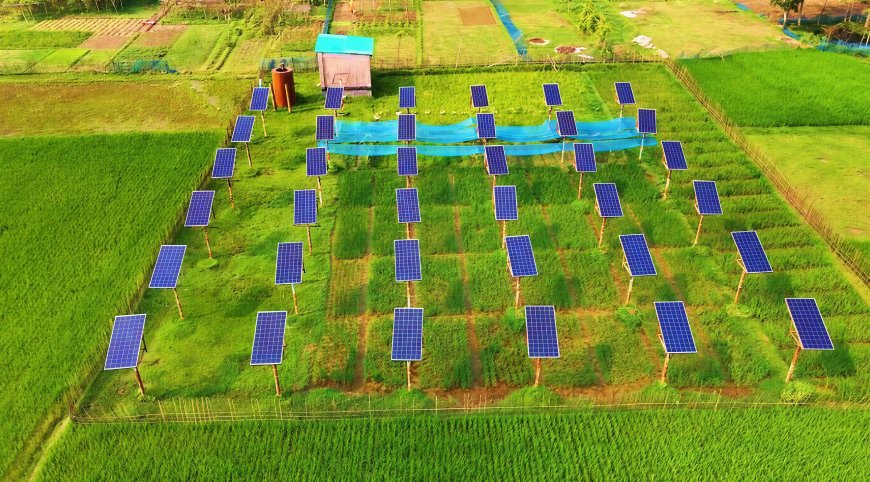
One promising solution is the adoption of agro-photovoltaic (APV) systems, also known as agrivoltaics. These systems enable the simultaneous production of food and electricity on the same piece of land by installing solar panels above crops at an appropriate height and spacing.
The design of such systems is critical, as factors such as panel elevation, tilt angle, and gap spacing determine the amount of sunlight reaching the crops below. When properly designed, APV systems can create a balanced microclimate that benefits both plant growth and energy generation. For example, partial shading from solar panels can reduce soil evaporation, maintain moisture levels, and protect crops from excessive heat stress during hot seasons.
International research and field experiments have demonstrated that dual-use agricultural systems can provide significant economic and environmental advantages. Instead of forcing farmers to choose between agriculture and energy production, integrated systems allow them to generate additional income from electricity while continuing to cultivate crops.
Studies from agricultural research institutions have shown that combining solar energy production with farming can improve land productivity and increase financial resilience for rural communities.
In some cases, the presence of solar panels has even enhanced crop yields by moderating extreme temperatures and improving water-use efficiency.
Farmers in several regions around the world have reported practical benefits after installing solar panels in their fields. These benefits include reduced irrigation demand, improved crop survival during drought conditions, and protection from extreme weather events such as heat waves.
The shade provided by solar panels can create a cooler microenvironment that supports plant growth, particularly in regions experiencing rising temperatures due to climate change. Such findings highlight the potential of agrivoltaic systems to address both energy security and climate adaptation challenges simultaneously.
In Bangladesh, the concept of agro-photovoltaics is still in its early stages but shows considerable promise. Using Hazipur Union as a model area, a pilot scenario can be developed to evaluate the technical and economic feasibility of installing solar panels on agricultural land.
Preliminary assessments suggest that standalone agro-photovoltaic (SAPV) systems can generate substantial amounts of renewable electricity while maintaining crop productivity. These systems represent a sustainable model for integrated food and energy production, enhancing land-use efficiency and supporting long-term agricultural and energy resilience.
Furthermore, the adoption of solar-powered agricultural systems aligns with national development priorities, including renewable energy expansion, climate change mitigation, and rural economic development. By promoting the dual use of land resources, agro-photovoltaic technology can contribute to reducing carbon emissions, improving farmer income, and strengthening food security.
The successful implementation of such systems requires collaboration among scientists, engineers, policymakers, and farmers to develop locally appropriate designs and management practices.
To sum up, solar radiation can serve a dual purpose in Bangladesh -- supporting both photosynthesis for crop production and electricity generation for sustainable development. Rather than competing with agriculture, solar energy infrastructure can complement farming activities when implemented through thoughtful design and scientific planning.
The integration of solar panels into agricultural land offers a practical pathway toward achieving energy independence, environmental sustainability, and resilient food systems in Bangladesh.
Abed Chaudhury is a scientist and Tahmid Anam Chowdhury is a lecturer in Spatial Informatics Section in Habiganj Agricultural University.