































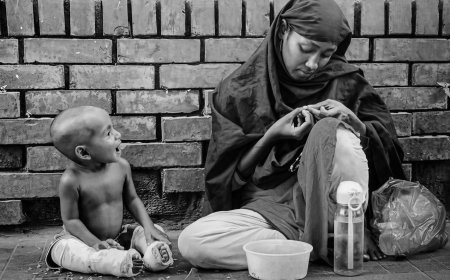




































Development Begins Where Human Potential is Nurtured
In a world driven by technology and innovation, the value of human intellect far exceeds that of raw materials. Countries that fail to recognize this shift risk being trapped in cycles of dependency and underdevelopment.


The real wealth of a nation does not lie buried beneath its soil or flowing through its rivers. It walks, thinks, dreams and often stumbles before rising again in the form of its people.
History, when read carefully, reveals a stubborn truth that defies geographical determinism. Nations blessed with abundant natural resources have frequently lagged behind, while others, seemingly deprived by nature, have risen to global prominence through the sheer cultivation of human potential.
This is not merely a rhetorical observation. It is a philosophical position that finds resonance in the works of thinkers from Aristotle to Amartya Sen. Aristotle, in his Politics, emphasized the role of the state in shaping virtuous citizens, arguing that the character of a polity is ultimately a reflection of the character of its people.
Much later, Sen would articulate the idea of “capability,” suggesting that development is not simply the accumulation of wealth, but the expansion of human freedoms and capacities. Between these two intellectual landmarks lies a consistent message that development is, at its core, a human project.
Geography, once considered destiny, has steadily lost its deterministic grip. The classical geopolitical theories of Halford Mackinder or Friedrich Ratzel placed immense emphasis on land, resources and strategic location. Yet the trajectories of countries in the late twentieth and early twenty-first centuries have complicated this view.
Japan, with its limited arable land and vulnerability to natural disasters, transformed itself into an industrial powerhouse. South Korea, emerging from the ruins of war in the 1950s, now stands as a technological and cultural force. Finland, once a peripheral economy, invested deeply in education and innovation, turning its human capital into its greatest asset. These examples challenge the simplistic notion that natural endowment guarantees prosperity.
What then explains this divergence? The answer lies in the long, often invisible process of human cultivation. Human resources are not born in their final form.
They are patiently shaped through institutions, values and policies that operate over generations. A child is not merely an individual but a potential citizen, a future decision-maker whose capacities must be nurtured with deliberate care.
This requires an integrated approach where family structures, educational systems and state policies work in quiet coordination.
Pierre Bourdieu’s concept of cultural capital helps explain how societies reproduce or transform themselves. Education is not just about literacy or technical skill; it is about instilling habits of thought, discipline, curiosity and ethical reasoning.
When these elements are systematically cultivated, they create a society capable of innovation and resilience. When neglected, they produce a fragile social fabric where talent exists but fails to coalesce into collective progress.
The metaphor of land is particularly instructive. A country resembles an uncultivated field not because it lacks potential, but because potential alone is inert. Land requires preparation, careful selection of seeds, timely irrigation and protection from weeds. Human development follows a similar logic.
Early childhood nutrition, access to quality healthcare, a robust and inclusive education system, and a moral framework that encourages responsibility and empathy are all essential stages in this process. If any one of these elements is neglected, the entire structure becomes unstable.
Yet in many developing societies, this integrated vision remains absent. Policies are often reactive rather than strategic. Education systems prioritize rote learning over critical thinking. Healthcare remains inaccessible or inadequate for large segments of the population.
Moral and civic education, which once formed the backbone of community life, is increasingly sidelined. The result is a paradoxical landscape where individual brilliance occasionally emerges, but systemic excellence remains elusive.
It is tempting in such contexts to attribute failure to cultural or even genetic factors. This line of reasoning is not only flawed but also dangerous. The comparison between countries with similar ethnic or historical backgrounds but vastly different developmental outcomes exposes the weakness of this argument.
Myanmar and Thailand share cultural and geographical proximity, yet their developmental trajectories have diverged significantly. Singapore and Malaysia, once part of a shared political entity, have followed different paths shaped largely by governance and policy choices.
These contrasts underline a crucial point. Development is not predetermined by identity. It is constructed through decisions.
History provides ample evidence of this constructed nature of progress. Post-war Germany rebuilt itself from devastation through a combination of institutional reform, economic planning and a strong emphasis on vocational education. The Marshall Plan provided external support, but the internal commitment to rebuilding human capacity was decisive.
Similarly, South Korea’s transformation was not the result of natural advantage but of deliberate state intervention in education, industry and technology. These examples demonstrate that with vision and discipline, societies can redefine their destinies.
Philosophically, this aligns with the idea of human agency as articulated by existentialist thinkers like Jean-Paul Sartre. While circumstances impose constraints, they do not eliminate the capacity for choice. Nations, like individuals, are not merely products of their conditions.
They are also products of their responses to those conditions. This perspective shifts the focus from what a country has to what it does with what it has.
The failure to invest in human development, therefore, is not a neutral oversight. It is a structural decision with long-term consequences. When education systems fail to nurture critical thinking, societies become vulnerable to misinformation and manipulation.
When healthcare systems are weak, productivity declines and inequality deepens. When moral and civic education is neglected, corruption and social fragmentation take root. These are not isolated problems. They are interconnected outcomes of a broader neglect of human capital.
The transition from resource-based economies to knowledge-based economies has fundamentally altered the dynamics of global competition. In a world driven by technology and innovation, the value of human intellect far exceeds that of raw materials. Countries that fail to recognize this shift risk being trapped in cycles of dependency and underdevelopment.
The so-called “resource curse” observed in several resource-rich nations illustrates this paradox. Abundance of natural resources, in the absence of strong institutions and human development, can lead to economic stagnation and political instability.
In contrast, countries that have prioritized human development have reaped sustained benefits. Investments in education, research and innovation create a virtuous cycle where knowledge generates wealth, and wealth is reinvested in further knowledge.
This cycle not only drives economic growth but also enhances social cohesion and political stability. It creates citizens who are not just economically productive but also socially responsible.
The cultural dimension of this process cannot be overlooked. Development is not merely about infrastructure or income levels. It is also about values. A society that values discipline, integrity and collective responsibility is better equipped to translate individual potential into collective progress.
This is why cultural narratives, literature and even music play a subtle yet significant role in shaping societal attitudes. The line from Ramprasad’s song about fallow land yielding gold if cultivated captures this idea with poetic precision. It is not the land that is deficient. It is the absence of cultivation that limits its potential.
For many developing countries, this remains the central challenge. The issue is not the absence of talent or potential, but the absence of a coherent strategy to nurture it. Short-term political considerations often overshadow long-term developmental goals.
Policies change with administrations, disrupting continuity and undermining progress. In such an environment, the cultivation of human resources becomes fragmented and inconsistent.
Ultimately, the measure of a nation’s progress lies not in the height of its buildings or the depth of its resources, but in the quality of its people. A society that invests in its citizens invests in its future. One that neglects them, no matter how rich its land or abundant its resources, risks remaining trapped in a cycle of unrealized potential.
H. M. Nazmul Alam is an Academic, Journalist, and Political Analyst based in Dhaka, Bangladesh. Currently he teaches at IUBAT.