





























































Armed in History, Unarmed in Memory
Women were not mere supporters; they were shapers of conditions, bearers of risk, and, in many cases, decisive actors. The war cannot be imagined without them, but its written history has often proceeded as though it could.

"Who longs to live without freedom?
Who chooses to live enslaved,
Bound in the chains of servitude?”
Rangalal Bandyopadhyay’s famous lines did not speak only to men in the context of 1971, they belonged to women as well. Yet history has rarely paused to listen to their answer.
The dominant narrative of Bangladesh’s Liberation War centres almost exclusively on the figure of the armed male fighter. Why? Because, in mainstream historiography, women appear in only two familiar frames: Either as birangona, victims of wartime sexual violence or as “supporters” who cooked, sheltered, or nursed freedom fighters.
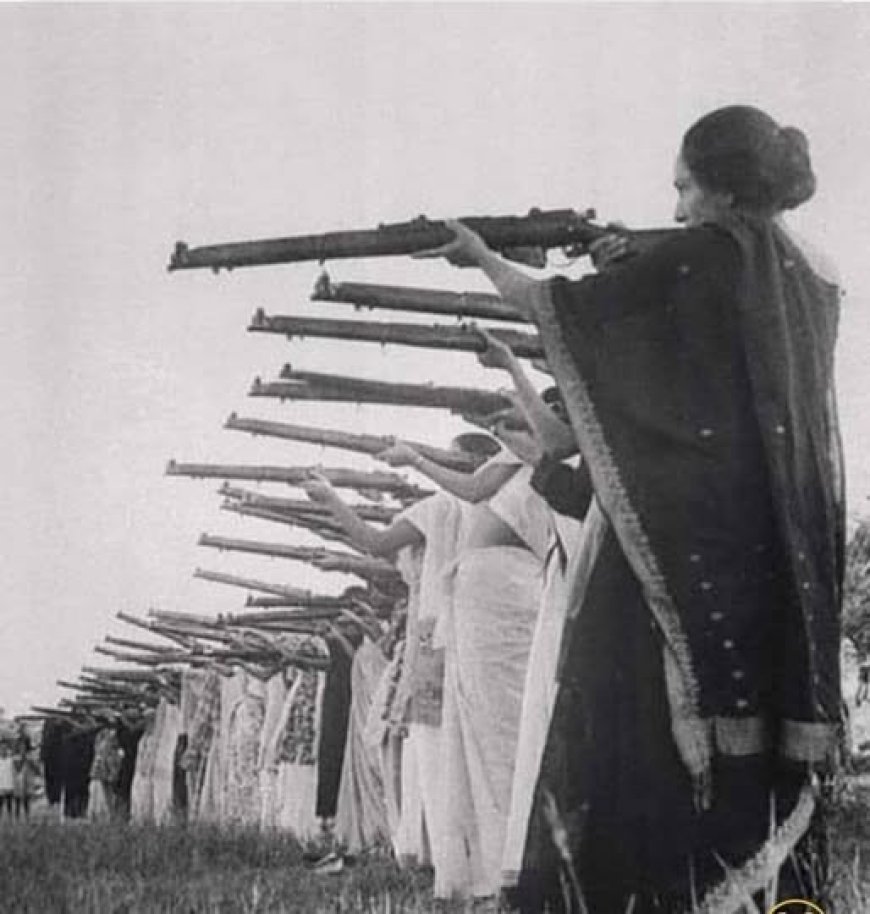
This framing is not only incomplete; it is politically convenient. It obscures the histories of women who carried arms, devised strategy, transmitted intelligence as secret operatives, organized local resistance, and exercised direct leadership.
But archival records, oral histories, memoirs, and recent scholarship tell a very different story.
The struggle for Bangladesh’s independence was profoundly gendered, and women were not passive adjuncts, they were active, strategic, perceptive political agents whose contributions were indispensable to the movement.
In feminist theory, these contributions form what is often called the movement infrastructure. Cynthia Enloe has long demonstrated that the invisible labour of war, labour disproportionately performed by women, constitutes the very foundation of military and political structures (Enloe, 2000).
Yet conventional history glorifies only the visible battlefield heroism of men, while relegating women’s labour to a moral or symbolic backdrop.
This raises an urgent question: Why this selective remembering? Why does women’s active participation rarely reach the centre of historical discourse?
The answer lies in the patriarchal structure of nationalist historiography. Nation-building narratives traditionally imagine a male hero: His body, his voice, and his language of valour define the nation’s mythic identity.
As Nira Yuval-Davis argues, women become the carriers of the nation while remaining its most regulated subjects (Yuval-Davis, 1997). Present in the national imagination, they are yet absent from political agency.
In this light, the 1971 war, from the perspective of women, must be understood as a struggle of dual resistance. A male fighter fought primarily against the state and the occupation forces. A female fighter battled those same forces and the deeply embedded gender norms of her own society.
In a context where women’s mobility, public presence, and political engagement were restricted, taking up arms was simultaneously a military act and a profound social rebellion.
Feminist international relations theory also echoes this view, conceptualizing war as state conflict layered with multiple hierarchies of power (Enloe, 2000).
The Liberation War of 1971 unfolded across a dispersed geography, villages and towns, border regions and refugee camps, even the domestic interior. Women occupied every layer of this landscape: As fighters, spies, couriers, nurses, shelter providers, cultural resisters.
Oral histories and regional studies show that women’s guerrilla groups were active in Rangpur, Kurigram, Sylhet, Mymensingh, and many other regions.
Bir Protik Taramon Bibi stands as one well-known example, but she is often framed as an “exception,” as though armed women were anomalies. In reality, they were part of a much larger, if less documented, collective.
The war of 1971 was not confined to the exchange of gunfire. It was a total politics of survival, intelligence gathering, sheltering, medical care, cultural defiance.
In each of these spheres, women worked both visibly and invisibly. Yasmin Saikia, in Women, War, and the Making of Bangladesh (2011), shows how women’s contributions were deliberately categorized as “supportive” or “safe” to preserve the masculine core of nationalist narratives. The image of an armed woman disrupts this narrative, hence its strategic omission.
Oral history-based research by scholars such as Bina D’Costa, Yasmin Saikia, and Selina Hossain further demonstrates that women were not only helpers; they were architects of the war’s strategic and structural foundations.
Taramon Bibi was an active guerrilla who led operations against the Pakistani army. Many others, such as Sultana Kamal carried clandestine messages, transported arms, and mobilised resistance networks.
Nilima Ibrahim’s seminal Ami Birangona Bolchi (1994) reveals how women occupied multiple roles on the ground -- fighters, caregivers, informants, strategists.
Yet, in the post-war state narrative, this multiplicity was narrowed. The political deployment of the term birangona is crucial here. While the state claimed to honour survivors of sexual violence, the designation also confined them within a fixed identity.
As Nayanika Mookherjee argues in The Spectral Wound (2015), the term both venerates and isolates, rendering women’s central wartime experiences simultaneously visible and erased.
Sexual violence, now widely acknowledged by historians as a central military strategy of the Pakistani forces and their collaborators, was intended to produce ethnic, cultural, and psychological rupture. But the postwar state offered neither adequate recognition nor meaningful rehabilitation.
During the war, the female body symbolized national honour. After the war, that same body became a site of social discomfort. This paradox helps explain why women’s contributions remain only partially visible in historical memory.
Bina D’Costa’s Nationbuilding, Gender and War Crimes in South Asia (2011) reveals how nationalist states both utilise and control women’s narratives, highlighting what serves the heroic image while suppressing what challenges it.
Women’s participation extended beyond the battlefield to cultural resistance as well. In the broadcasts of Swadhin Bangla Betar Kendra, through songs, poetry, and voice, women helped sustain the emotional and ideological momentum of the war. This too was a frontline, where language, culture, and identity were defended.
Together, these histories confront us with an uncomfortable truth: The story of the Liberation War is incomplete unless women’s labour, experiences, and resistance are placed at the centre.
Women were not mere supporters; they were shapers of conditions, bearers of risk, and, in many cases, decisive actors. The war cannot be imagined without them, but its written history has often proceeded as though it could.
This is why rereading the women of 1971 is not just an academic task; it is a political act. We must ask:
Which histories do we preserve?
Which ones are we taught to forget?
Whose voices do we elevate as “national,” and whose do we consign to the margins?
Even after half a century, these questions remain unsettled. But every time the stories of women at the war’s edges return, they remind us: Freedom is never a single-voiced narrative. It is a chorus, and within that chorus, women’s voices are indispensable.

Dr. Lubna Ferdowsi is an Academic and Researcher based in England.