
























































BJP in Bengal: Back to the Future
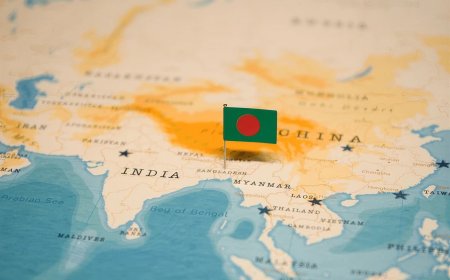
Does it mark the end of an era, or return to a bygone era in which Hindu-Muslim clash was a celebrated theme? The Muslim-majority Bangladesh next door, which has just survived a massive political upheaval, adds urgency to our query.

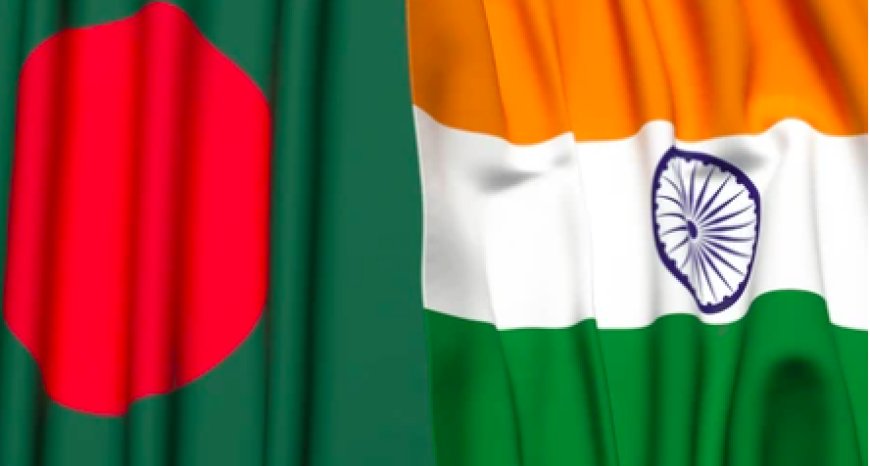
BJP’s victory in the recently held assembly election in West Bengal is a matter of huge import. In a federal democracy, that India is, that it can happen is not the issue.
The issue is, does it mark the end of an era, or return to a bygone era in which Hindu-Muslim clash was a celebrated theme. The Muslim-majority Bangladesh next door, which has just survived a massive political upheaval, adds urgency to our query.
This essay has three parts. The first is meant to explode the myth that Bengalis by nature are secular. The second is aimed at showing how the British exploited the Hindu-Muslim cleavage.
The third is speculative, how to gauge its impact upon the region’s security in which the texture of the India-Bangladesh relationship will matter the most. That the latter is structurally connected to the political winds that blow in Delhi, Kolkata and Dhaka is common knowledge.
In the beginning let’s settle the matter for good that Bengalis, both Hindus and Muslims, can be as un-secular as any other South Asian.
If one compares the comparatively less bloodshed on the Bengal front during the Partition compared to the Punjab front one will have to look for some complicated explanations than some unfounded gossip.
In Bengal, Kolkata (then Calcutta) was the epicentre of Hindu nationalism as well as the cradle of Muslim sub-nationalism.
About the latter, Australian scholar Kenneth McPherson has explained the phenomenon in detail in his 1974 publication: The Muslim Microcosm: Calcutta 1918 to 1935.
It needs underlining that Hindutva, both as a concept as well as terminology, originated in Bengal, and not in V. D. Savarkar’s book on Hindutva published in 1923, which is popularly believed.
Three decades before Savarkar’s book, an upper caste Bengali, Chandranath Basu, had written in Bengali, Hindutva: Hindur Prakita Itihas (The Real History of the Hindus) in the year 1892.
The book extolled Hindu greatness which, according to him, had been under threat ever since the Muslims arrived in India.
Ever since the 1857 Revolt against the East India Company rule, Bengal had emerged as a hotbed of Hindu nationalist sentiments in the forefront of which was the English-educated Bengali upper castes (the so-called Bhadralok community).
Eminent journals like Modern Review routinely advanced the theory of Hindu greatness. Even if there were some pretentions about social justice for the lower and untouchable Hindu castes, they were never politically pushed.
Incidentally, like the Bengal-based Hindu nationalists the Muslim League too owed its origin to Bengal’s Dhaka, situated in eastern Bengal.
It is not true that only the orthodox or upper caste Hindus were anti-Muslim. Even the modernists that included the Brahmo Samaj were occasionally so.
For example, an 1876 Brahmo Samaj publication spoke plainly that:
"[T]he misfortunes and decline of this country began on the day the Yavana [Muslim] flag entered the territory of Bengal ... There are limits to everything. When the oppressions of the Musalmans became intolerable, the Lord of the Universe provided a means of escape ... the day the British flag was first planted on this land."
It may be noted that in the early years of Hindu and Muslim revivalism both groups hankered for British patronage. It did not escape the clever eyes of the British.
They made masterly use of this through their strategy of divide and rule. It must however be quickly clarified that divide and rule was not a British invention.
The construct is always grounded in the governance strategy of all rulers in all times and climes. I recall how in the 1960 Bimal Roy movie Parakh a small time zamindar talked about the same tactics to win a petty village election. Particularly to remember is how he sermonized his sidekicks that: "It were not the Brits who had invented the theory of divide and rule, it was there from the day human society was politically organized."
There was yet another clever component of the British political acumen. They tended to distinguish between the able-bodied Bengali Muslims and the weakly-built Bengali Hindus.
Any Bengali in Epar Baagla, Opar Bangla (across the borders) will certify that people in both East and West Bengals are ethnically the same, whether one characterizes them as timid, militant, poetic, emotional or mercurial, it is the same.
But according to Sir John Strachey (1823-1907), a Harvard doctorate in Economics, an author of several books on India, and one who served on important positions during the East India Company rule, the Bengali Hindus and Bengali Muslims were distinctly different.
Here are two quotations from his book: India: Its Administration and Progress (London, 1903), which will drive home the point.
Alluding to Hindu Bengalis he wrote: "Bengal is the only country in the world where you can find a great population among whom personal cowardice is looked upon as in no way disgraceful."
Then he quotes Lord Macaulay: "Whatever the Bengalee does, he does languidly … and scarcely ever enlists as a soldier."
Contrast the above with what Strachey had to say about the Bengali Muslims. They "are men of far robuster [sic] character" and "it was among them that the sepoys who fought under Clive at Plassey were chiefly recruited ... The maritime districts [mostly Muslim majority] supply thousands of intrepid boatmen and lascars to the mercantile marine."
While discussing about regional security one may argue that since South Asia is accustomed to living with inter-religious conflicts why should it be a big deal that Hindu chauvinist BJP is now in power in West Bengal.
The problem is that while the Hindu-Muslim conflict had indeed led to the Partition of India but the new conflict is pregnant with the larger possibility of becoming fiercer because of the potential Chinese adventurism in the region.
It is common knowledge that Bangladesh is increasingly getting closer to China. India will, therefore, have to judiciously withstand this headwind.
Given the Hindu-Muslim societal dichotomy in the broader WB-Bangladesh region it requires farsighted political outlook from both ends.
There are today about 280 million Bengali speakers (sixth largest linguistic group in the world) across the globe of which about 160 million live in Bangladesh and 110 million in West Bengal, Tripura, and Assam.
If a sense of militant Hindu nationalism picks up among the Hindu Bengalis and that of Islamist nationalism among the Bangladeshi Muslims, no power on Earth can prevent some catastrophic riots across the region.
Against the gloomy forecasts presented above there are also some silver linings which bode well for regional security. Two signals are particularly relevant.
First, since Bangladesh politics is primarily India-centric this opens the possibility of a continuous dialogue between the two.
Bangladeshis virtually know little about the broader South Asian region with the notable exception of Pakistan.
Given the murky past relationship between them this relationship is at the most transactional. Indians should not unnecessarily spoil their sleep over an imagined Pakistan bogey.
If at all any country other than India should catch the imagination of Bangladeshis, it should be Myanmar which has pushed a million-plus Rohingya refugees to Bangladesh causing a huge financial burden on Dhaka.
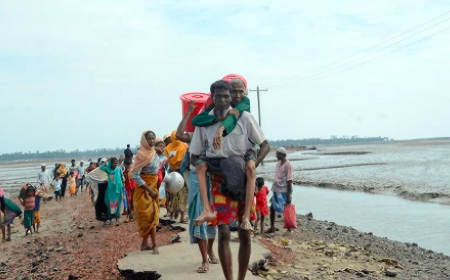
Just a week ago a boat illegally carrying about 280 Rohingya refugees from Bangladesh's Cox's Bazar capsized in the Bay of Bengal on way to Malaysia. Barely a dozen on board survived. It underlined the pathetic condition these refugees face.
Our second hope is, given that Bangladesh has now Dr. Khalilur Rahman, a pragmatic and seasoned diplomat, and one who is highly educated with degrees from some leading academic institutions of the West, as its foreign minister, while India has sent Dinesh Trivedi, a mature BJP politician from West Bengal, as India's High Commissioner to Dhaka -- not a career diplomat which has been the practice -- one may expect more sophisticated political understanding between the two nations.
Not only Trivedi has the blessings of BJP, he is also a Gujarati like Narendra Modi and Amit Shah. His additional bonus point is he is from West Bengal and speaks Bengali like an ethnic Bengali.
Let me end this essay with an amusing information. About 60-65 years ago a new political party was floated in West Bengal called Aamra Baangali.
Its basic premise was that a reunified sovereign Bengal with its 150 million Bengali-speaking people would be a massively powerful political unit to reckon with. The then ruling Congress ridiculed the party’s hope as sheer daydream.
I recall a wall writing put up by Aamra Baangali saying: Baangali jege otho (Wake up, you Bengalis).
To this some wicked brat wrote with chalk: Kaancha ghum bhangio naa (Has just gone to bed, don't disturb).
Partha Ghosh is a retired professor of South Asian studies, JNU.