


























![A Ledger of the Soul: Navigating the Allah-Bhagavant Nexus in a 19th-Century Puruṣākāra Jñāna Caupara [Gyan Chauper]](https://counterpointbd.com/uploads/images/202608/image_430x256_6a93baa3b09a7.jpg)




















Where the Dead Come to Dinner
At its core, Nawaz is asking something very simple and very devastating: What do we owe the dead, and how much of ourselves must we sacrifice to pay that debt?
There is something quietly radical about a bookstore that believes it can save a city. Bookworm, tucked into Tu'do in Banani, is exactly that kind of place, small and cosy in the way that only literary spaces manage to be. Before the evening's talk began, Amina Rahman, the woman behind Bookworm, said something I keep returning to.
She wants this space to be a hub, a place where discussions are not just welcomed but expected, where artists thrive, where the idea of a bookstore café stops being a fantasy (come on, we have all thought of this at least once in our life) and becomes, as she put it, the most beautiful collaboration she could imagine.
The evening before, they had held their first concert. Last night, they held a book talk. Both packed. There is clearly a hunger here that Dhaka has been quietly nursing.
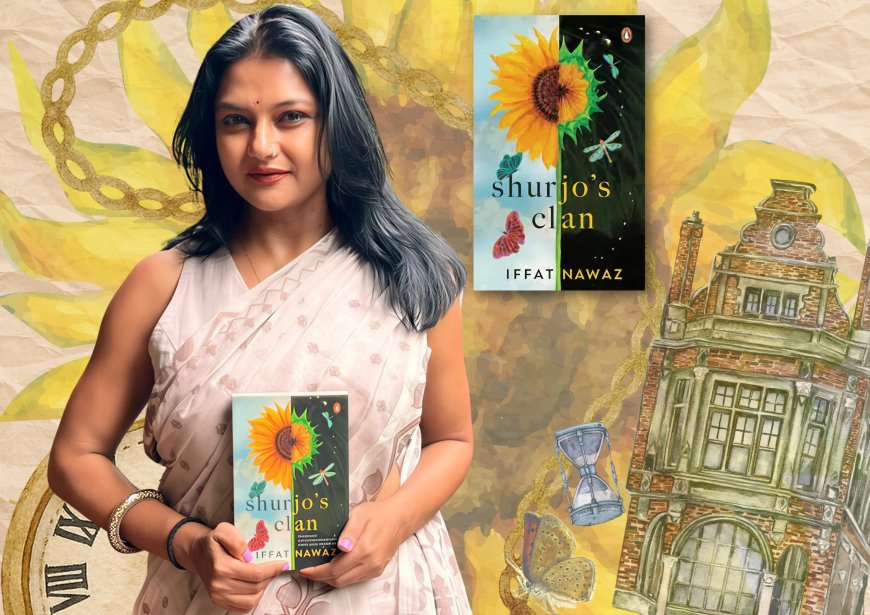
The occasion was Shurjo's Clan, the debut novel of Iffat Nawaz, published by Penguin India in November 2022 and shortlisted for best debut fiction at the Mumbai Lit Fest in 2023.
Nawaz, born in Dhaka but long shaped by years of humanitarian work across the US, Asia, and Africa, arrived at the evening with the ease of someone who has spent considerable time thinking about how to carry a heavy story lightly.
And Shurjo's Clan is nothing if not heavy, in the most gorgeous sense of that word.
The novel follows Shurjomukhi, a young girl growing up in an asymmetrical house in Gandaria, Old Dhaka, a house that in daylight functions like any other family home but at night becomes something else entirely. Once darkness falls, the martyred uncles, Shoku and Bhiku, cross back over whatever threshold separates the living from the dead and take their seats at the dinner table, as familiar and as ruinous as memory itself.
Shurjo's father carries them with him always, the grief of two brothers lost to 1971 written into everything he does and does not say.
The book moves across time the way our grief actually moves, not linearly but in waves, from the forced displacement of Partition in 1947, through the Liberation War, through the diaspora years in the West, and back again to Dhaka, each return carrying the weight of all the departures before it.
At its core, Nawaz is asking something very simple and very devastating: What do we owe the dead, and how much of ourselves must we sacrifice to pay that debt?
That is the particular cruelty of inherited grief, that you mourn losses you never personally suffered, that you carry wounds that were cut into someone else's body, and yet they ache in yours just as persistently.
Nawaz read aloud from the first chapter, and when she finished, she said, almost apologetically, "that's the lightest version I have written." The passage had contained a suicide, two martyrs, and the quiet devastation of partition.
She spoke about growing up in the 70s and 80s, inheriting the Liberation War as a kind of emotional curriculum, celebrating Ekushey February in bare feet with flowers in hand, absorbing a national grief that was not hers in experience but was entirely hers in feeling. "Shurjo is 25% me," she said, "not fully me." Writers always say something like this, and they are always only partly telling the truth.
What strikes me most about Shurjo's Clan, both in the reading and in hearing Nawaz discuss it, is how it refuses to be a war novel while being entirely about the war. It does not document 1971 so much as diagnose what 1971 left behind in the bodies and silences of everyone who came after. Nawaz was frank about her decision to use fiction: She was afraid, she said, of getting the facts wrong in front of a generation for whom every detail of 1971 is sacred, almost forensic in its importance.
But more than fear, there was an artistic conviction. She wanted to write the psychological residue of the war, not its chronology. She mentioned Persepolis, Marjane Satrapi's graphic memoir of the Iranian revolution, and the principle is the same: You remember Marjane because you felt her wounds, not because you memorized the dates.
The question of magical realism in South Asian, and specifically Bangladeshi fiction, came up naturally. Someone in the audience invoked García Márquez. Nawaz acknowledged the inspiration. "Why don't we have our own One Hundred Years of Solitude?" she asked. She spoke about why magic realism is not a borrowed concept for our stories but something native to them. After all, we are a country where Sufism runs through the soil and grief is always communal.
There is a concept in the novel that Nawaz introduced during the reading, the Bengali word obhiman, meaning hurt pride, a wound acquired when offended by someone close, a poison pouch of misunderstandings that accumulate until they spill over. I think obhiman is the emotional key to the whole book, and perhaps to how we as Bangladeshis continue to carry 1971, never quite grieving it fully, never quite letting it go.
Those of us born after the war inherited not the event itself but the emotional residue of it, a secondhand sorrow with no clear object and no clear end, and Nawaz, more than any writer I have read recently, understands exactly what that feels like from the inside.
Walking out of Bookworm into the night, I thought about what Amina apa had said at the beginning, about wanting this place to be where artists grow, where real conversations happen. Last evening, it was exactly that. And I went home with the book tucked under my arm.
Azeema Anhar is an English Language Instructor at ULAB and member of the editorial team at the weekly Counterpoint.
Azeema Anhar Humaira
Azeema Anhar is an English Language Instructor at ULAB and editorial assistant at Counterpoint.