

























































India’s Projection Problem
What India did for us is real. What India has done to us, and what it has told itself to justify that, is the projection.

There is a concept in psychology called projection. It is when you take the thing you most fear about yourself, and place it, carefully and convincingly, onto someone else.
You do not do this consciously. That is what makes it so effective. The projector genuinely believes the accusation. The performance is sincere. And the audience, more often than not, believes it too.
India has been projecting onto Bangladesh for fifty-four years. And the audience, more often than not, believed it. The story was always the same: India, the large secular democracy, managing the volatile Islamic periphery next door. Bangladesh, the porous border, the extremism pipeline, the country that needed watching. India was the diagnosis. Bangladesh was the disease.
I want to suggest, with evidence and without apology, that this story has always had the countries reversed.
Start with the language, because the language is where the unconscious speaks most clearly. Amit Shah -- Home Minister of India, the second most powerful man in the state, the administrator of the BSF and the architect of the NRC -- has called Bangladeshis termites. He has pledged to drive us into the Bay of Bengal.
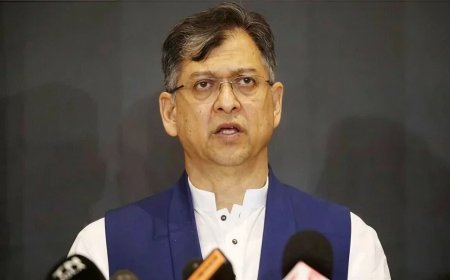
A BJP MLA in Uttar Pradesh, documented by Hindutva Watch, compared Bangladeshi and Rohingya Muslims to swine at a public rally, to warm applause. Bangladesh's then Foreign Adviser formally protested in September 2024, describing Shah's remarks as "highly derogatory". India's response was, essentially, silence.
Now ask yourself: Where have you heard this kind of language before? The termites. The infestation. The vermin at the border that must be driven into the sea. This is not the language of policy disagreement. This is not the sharp edge of diplomatic frustration.
This is the specific, ancient vocabulary of dehumanization -- the language that precedes pogroms, that prepares populations for atrocity, that history has taught us, with terrible repetition, to recognize early and name loudly.
And here is the projection laid bare: The country using this language about its Muslim neighbor is the same country whose ruling party has, according to the FATF-addressed report on Hindutva terror networks, presided over a 786 percent rise in hate crimes against religious minorities between 2014 and 2018.
The 2002 Gujarat pogrom -- over a thousand Muslims killed while state police observed from a comfortable distance -- happened under a Chief Minister named Narendra Modi. The Citizenship Amendment Act of 2019 wrote religious discrimination into the formal architecture of Indian citizenship. India did not drift toward this. It elected it. It legislated it. It gave it a cabinet portfolio and a border force.
We all remember 16th of December 2024. The Narendra Modi X post. India cannot credit Bangladesh with its own liberation because doing so would require India to acknowledge something it finds deeply uncomfortable: That Bangladesh is a sovereign nation with its own history, its own agency, its own claim on the moral inheritance of 1971.
Instead, India has, for fifty years, narrated that war as its war. Our Liberation becomes their victory. Our martyrs become their footnote. Our nation becomes their achievement. And when we object -- when we insist on the grammatical correction that this was our war, our dead, our country -- we are accused of being ungrateful. Of being anti-Indian. Of being, inevitably, Islamic fundamentalists who cannot appreciate what India did for us.
What India did for us is real. What India has done to us, and what it has told itself to justify that, is the projection.
India calls Bangladesh a haven for extremism. This is perhaps the most audacious version of the projection, because it requires the most deliberate blindness to sustain. Look at the RSS, the paramilitary organization that staffs the BJP's intellectual and organizational infrastructure, whose founding ideologues wrote with open admiration for European fascism of the 1930s, and which today runs what the Northeast Citizens' Advocacy and Research Forum documents as an accelerating project of saffronization across Assam, Manipur, Nagaland, and Tripura -- states that border Bangladesh, states whose indigenous, tribal, and Christian communities are being systematically absorbed into a single homogenizing Hindu nationalist identity.
The Akhand Bharat vision -- undivided India stretching from Afghanistan to Myanmar -- is not a fringe aspiration. It is the active geographical imagination of the organization that produced the Prime Minister of India.
This is a maximalist territorial ideology driven by religious supremacism, organized through a paramilitary structure, and backed by state power. If this were operating out of a madrasa in Sylhet, the international community would have convened three conferences about it by now. Because it is operating out of Nagpur and New Delhi, it gets called nationalism, culture, heritage, pride.
The Diplomat noted in 2022 that Indian analysts "rarely examine whether anti-India sentiment in Bangladesh is manufactured or a rational response to decades of real grievances". Rarely, because the examination would collapse the projection. Because the examination would require acknowledging that the extremism in this story has an address, and it is not Dhaka.
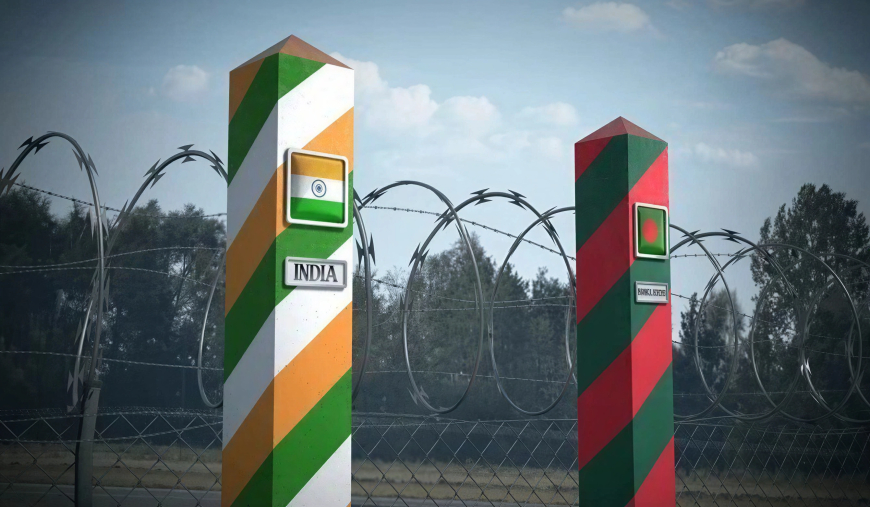
And then the border, which is where the projection turns lethal.
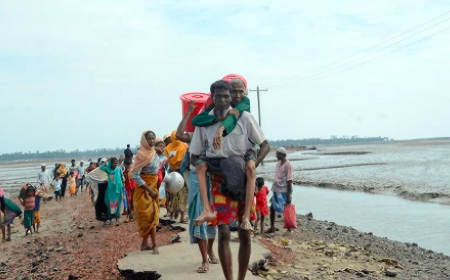
Between 2001 and 2020, the BSF killed 1145 Bangladeshis. Human Rights Watch, in their 2011 investigation, named it without diplomatic softening: India's "shoot-to-kill policy". Felani Khatun was fifteen years old. She was shot crossing the fence. Her body was left hanging on the barbed wire for hours while her father watched from the other side.
The image went around the world. India promised zero killings. The Daily Star reported at least thirty-four Bangladeshis killed in roughly eleven months of the interim government's tenure. Not one soldier prosecuted. Not one family compensated. Not one senior official who faced any consequence at all.
This is what India does at the border while warning the world about Bangladeshi radicalism. It projects the violence outward -- onto us, onto our supposed extremism threat -- while administering real, documented, zero-accountability lethal violence against our civilians. The BSF does not shoot Indian citizens on the border. It shoots Bangladeshis.
And when we say this, when we call it what it is, Indian officials respond as Harsh Vardhan Shringla did -- that ties are "too strong to be disturbed". The projection is so complete that even the protest becomes evidence of our problem.
On the 4th of May 2026, something happened that makes this entire conversation urgent in a way it has not been before.
The BJP won West Bengal. 207 of 294 seats. Fifteen years of Mamata Banerjee -- gone. Modi's first statement: "Bengal has seen poriborton" -- change -- followed immediately by a promise of action against infiltrators. Al Jazeera's headline read: "Hegemonic Power: How Modi's BJP Won India's Bengal for the First Time".
Data analysts writing in Millat Times showed that the Special Intensive Revision of voter rolls had deleted Muslim names from constituencies in numbers exceeding the BJP's victory margins in those same seats -- in Jangipur, Muslim-majority, over 36,000 names removed, BJP winning by around 10,500 votes.
The New York Times called it what it was: Hindu nationalists conquering a bastion of India's secular tradition.
Here is what this means for Bangladesh, stated plainly: The projection has moved to our border. Hindutva -- the ideology that calls us termites, that erases our liberation, that shoots our teenagers and calls it security -- now governs every tier of Indian political authority that faces Bangladesh. From the Prime Minister's office in New Delhi to the Writers' Building in Kolkata.
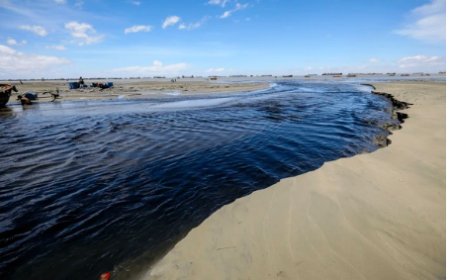
The Teesta flows through West Bengal before it reaches us. The Daily Star asked whether any realistic scenario exists in which the Teesta deal gets done on fair terms, now that the BJP controls both New Delhi and the upstream state. The answer is no. The projection is no longer a rhetorical problem. It is a hydraulic one. It controls our water.
I want to be careful here. I am not arguing that Bangladesh is without fault, without complexity, without its own reckonings. A serious nation does not deal in that kind of self-flattery. We have our own impunities, our own democratic deficits, our own questions about pluralism that deserve honest answers. None of that is what this piece is about.
What this piece is about is the frame. The thirty-year analytical frame that has positioned Bangladesh -- and Muslim South Asia more broadly -- as the region's extremism problem, and India as its solution. That frame was not neutral. It was constructed from Indian strategic briefings, absorbed by Western capitals looking for a stable anchor in a volatile region, and reproduced so consistently that it began to feel like geography -- like something that had always been true, that did not need examining.
It was never true. It was always a projection. And the projection has now produced a fully saffronized state on our border, an upstream neighbor that calls our people termites while deleting Muslim voters from its rolls, a government that takes credit for our liberation while hanging our children on its fences.
The word is extremism. The address is New Delhi -- and as of this week, Kolkata. And the time for treating these as separate conversations -- Hindutva over here, extremism over there, India somewhere else entirely -- is finished. They were always the same conversation. We were just too polite to say so.
Apurba Jahangir is a writer, political analyst, and former deputy press secretary to the Chief Adviser of the Interim Government of Bangladesh.