




























![A Ledger of the Soul: Navigating the Allah-Bhagavant Nexus in a 19th-Century Puruṣākāra Jñāna Caupara [Gyan Chauper]](https://counterpointbd.com/uploads/images/202608/image_430x256_6a93baa3b09a7.jpg)

















The Paper Trail to Tehran
It begins, as so many things in modern Iran begin, with a woman and a song

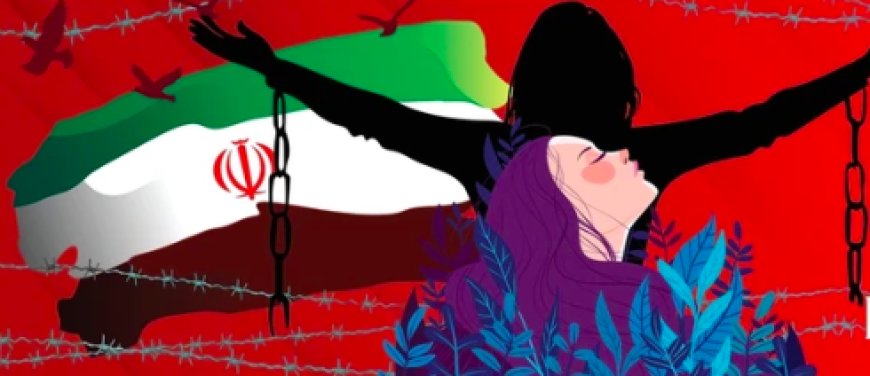
September 2022. Mahsa Amini is arrested by Iran's morality police for wearing her hijab "improperly." Three days later, she is dead. That same week, a young musician named Shervin Hajipour sets the grief of Twitter into music.
The song is called Baraye -- "Because of." Because of dancing in the streets. Because of the fear we feel when we kiss. Because of my sister, your sister, our sisters.
He posts it on Instagram. Within 48 hours it has 40 million views. The Islamic Republic arrests him but the song is already everywhere.
In February 2023, Baraye wins a Grammy for "Best Song for Social Change." The acceptance speech is delivered in Los Angeles. Iran watches through a VPN. Nobody in Washington calls this a policy event.It isn't one.
It does something papers cannot: It constructs feeling. And feeling, accumulated over time, becomes the atmosphere in which the decisions of powerful states are eventually made by people who experienced it at a comfortable distance, and will experience the consequences at an even greater one.
July 2024. A street musician named Zara Esmaeili posts an Instagram video of herself singing Amy Winehouse's "Back to Black" in public, without a hijab.
Five days later, she is arrested from her home, held at Tehran Central Detention, her family unable to find her. The video, of course, keeps circulating.
October 2025. Two things happen in the same week. Karim Sadjadpour publishes "The Autumn of the Ayatollahs" in Foreign Affairs; the most consequential Iran essay in years.
It is rigorously argued, genuinely reflecting the lived reality of millions of Iranians who have spent their lives under a system that delivered poverty and repression in exchange for revolutionary purity. The Islamic Republic's tenure, he writes, has amounted to "a lost half century for Iran."
He is not wrong. But the essay assumes the ending and asks only about the sequel. Not whether the regime will end, but what kind of change is coming. The regime's mortality is taken as given. What follows is left for others to decide.
That same week, a band plays "Seven Nation Army" in central Tehran. A woman plays bass guitar without a hijab. The crowd, men and women, shoulders touching, nobody looking over their shoulder, nods and sways. Jack White shares the clip. Within hours it circles the globe.
Every major newsroom picks it up. The story writes itself: Iran is already free. It is only waiting for the world to notice.
The think tank and the street band are doing different work, but work that rhymes. One speaks to the mind. The other speaks to the gut.
Together they construct a world in which the Islamic Republic has already been rejected by its own people, and all that remains is for that rejection to be ratified by someone with the power to ratify it.
What that ratification might cost the woman with the bass guitar is a question neither the essay nor the video stops to answer.
The tempo quickens with mechanical precision.
December 2025: the Atlantic Council announces "A Political Transition in Iran Approaches." Not "may approach," not "could approach," but approaches. January 12, 2026: Brookings declares "The New Iranian Revolution Has Begun" and calls on Trump to invest in "meaningful
support to the revolution underway." February 19: The Atlantic Council warns that Iran's regime is suffering from "strategic vertigo" and that "its next misstep may be its last."
February 23: the CFR publishes its succession planning report, five days before the attack. February 26: The Atlantic Council publishes its most honest piece; ”Regime Change in Iran? Here's Why the US Should Avoid the Temptation." 48 hours before the bombs do. February 28: The United States and Israel strike Iran.
What followed was not what the literature had promised.
The IRGC does not fracture. The regime does not fall. Succession protocols activates within days of Khamenei's death. The regime that emerged was, by every serious post-war assessment, more hardline than what preceded it.
The National Intelligence Council had concluded in a classified report completed one week before the attack that regime change was "unlikely in either a short or long war."
This was not published in Foreign Affairs. It was leaked to the New York Times on March 7, 2026; 10 days after the bombing had started. The woman who had played bass on Iranshahr Street in October 2025 did not get a democratic transition. She got the IRGC.
Hovering at the edges of this narrative, groomed and press-ready, was Reza Pahlavi, the son of the last Shah, living in his Virginia suburb, giving interviews, presenting himself as the natural heir to a free Iran.
Washington found him reassuring. What Washington tended not to mention was that Pahlavi has no meaningful constituency inside Iran. The surveys that show overwhelming Iranian rejection of the Islamic Republic do not show equivalent enthusiasm for a return of the Pahlavis.
Al-Monitor reported bluntly in March 2026 that even with Khamenei gone, the Iranian opposition remained "at war with itself”, incapable of coalescing around any single figure, least of all one whose claim to leadership rests primarily on his surname and his proximity to think-tank dinner tables.
The Shah's son gave more interviews. The actual Iranians were left with the IRGC.
There is a reason this outcome feels not just strategically mistaken but historically melancholy -- and it requires a brief digression about what American foreign policy used to be capable of, and what it has quietly stopped being.
Those of us who are interested in international relations grew up reading Kissinger.
Whatever one thinks of his moral record -- and there is much to think -- Diplomacy and The World Restored were serious engagements with the actual texture of power.
Where is that tradition now? The op-eds declared revolutions begun and transitions approaching, confusing what a society feels with what a state does.
The think tanks still publish. The op-eds still appear. But the rigour, the willingness to model adversary resilience, to take the contradictory evidence as seriously as the confirming evidence has gone somewhere.
The deeper failure is not intellectual. It is civilizational and Afghanistan is where it was already written, in plain sight, for anyone willing to read it.
20 years. Two trillion dollars. The longest war in American history. And when the last C-17 lifted off from Kabul airport in August 2021, the Taliban walked back into the presidential palace within hours; wearing the same sandals, carrying the same rifles, reciting the same verses, running the same courts.
Two decades of state-building, girls' schools, constitutions, elections, civil society workshops, gender-sensitivity training, and democracy seminars and the underlying power structure had not moved a millimetre.
The institutions America built dissolved like sugar in rain. The institutions Afghanistan already had; the tribal networks, the religious authority, the memory of every foreign army that had ever come and gone remained exactly where they were.
The lesson was available. The West chose not to learn it.
What Afghanistan exposed and what Iran confirms is a specific and persistent illiteracy about how Islamic state systems actually function.
The IRGC is not simply an army. It is an economic empire, a parallel government, a theological project, and a self-perpetuating organism that has spent 40 years ensuring it cannot be switched off from the outside.
The Taliban is not simply a militia. It is the expression of a Pashtun socio-religious order that has outlasted every empire foolish enough to mistake its quietness for weakness.
Western analysts -- brilliant, well-credentialled, published in the best journals -- consistently make the same error: They read the dissent and mistake it for the whole.
They see the woman with the bass guitar and conclude that the IRGC is therefore hollow. They see the girls in Kabul attending school and conclude that the Taliban is therefore finished.
They are reading the surface of these societies and calling it depth. Seeing what these societies produce, the art, the protest, the courage, the grief, while missing what these societies are built on: Structures of authority and legitimacy that a Grammy win and a think-tank report cannot dissolve, and that an airstrike tends to reinforce rather than undermine.
The viral video of the Tehran rock band is real. The courage of the woman playing bass is real. The conclusion drawn that this represents the imminent structural collapse of the Islamic Republic reflects a reading of Iran through a lens ground in Cambridge, Massachusetts, not in the bazaars of Isfahan or the seminaries of Qom.
It is the same lens that read Kabul coffee shops and concluded Afghanistan was turning a corner. It is the same lens that read Baghdad's middle class and concluded Iraq was ready for democracy.
It has been wrong in the same way, in the same direction, with the same confidence, for decades. And it keeps getting published.
That lens is not neutral. It is a product of a civilizational assumption so deep it rarely announces itself: That modernity looks Western, that resistance to Western modernity is temporary, and that the correct endpoint for every society on earth is a version of itself that the West finds legible.
The Iranians who played in the streets, who sang without hijabs, who wrote protest poetry on VPNs, were not pawns. They were people with legitimate and long-suffering grievances acting with extraordinary courage. What is worth examining -- without diminishing that courage by a syllable -- is what happens to it once it leaves their hands and enters the global narrative machine: A machine with its own interests, its own definition of liberation, and a consistent habit of moving on to the next file when the bombs fail to produce the promised result.
Afghanistan knows how that story ends. Iraq knows. Libya knows. And now, in the rubble of a war that hardened the very regime it claimed to dismantle, Iran is learning it too.
The soft power came first -- it always comes first. The song before the essay, the essay before the report, the report before the resolution, the resolution before the strike. And then the silence, once the cameras move on.
The West, it seems, is still reading the same map. It just keeps being surprised when the territory refuses to match. That surprise, at this point, is no longer innocent.
It is a choice -- the choice to remain illiterate about how these societies actually function, because literacy would complicate the narrative, and the narrative is what makes the next intervention possible.
The woman on Iranshahr Street played beautifully. The crowd danced. The clip went everywhere. And somewhere in that everywhere, in a room with better lighting and worse intentions, someone pressed save -- and began to build a case.
The least the analysts could do, before the next case is built, is learn to read the room they are actually in -- not the one they wish were there.
Apurba Jahangir is a writer, political analyst, and former deputy press secretary to the Chief Adviser of the Interim Government of Bangladesh.