










































![A Ledger of the Soul: Navigating the Allah-Bhagavant Nexus in a 19th-Century Puruṣākāra Jñāna Caupara [Gyan Chauper]](https://counterpointbd.com/uploads/images/202608/image_430x256_6a93baa3b09a7.jpg)





















NCP and the Perils of Losing One’s Way Too Soon
The NCP is still young. Its leaders are young. When it was launched, the response was electric; crowds gathered wherever it went. That energy is now waning. The atrophy has begun -- but it is not irreversible.


As I was attempting to pen my next article on the National Citizens Party (NCP), I was reminded of a lesser-known Greek myth -- of Monestratus, a hero who volunteered to free his people from a monstrous creature. He devised a grim but ingenious plan: He wrapped himself in armour fitted with sharp hooks, allowed himself to be swallowed by the beast, and in doing so pierced its brain from within. The monster died -- but so did Monestratus.
The parallel I seek to draw with the NCP is not exact, but the motif is strikingly similar: sacrifice, courage, intent -- and the ever-present danger of self-destruction.
The National Citizens Party, formed only a few months ago, seems to have lost its way almost as soon as it was born. It now risks being drowned in the cacophony of more than a hundred political organizations -- most of them unknown to the electorate, save for a handful of established parties.
This was not how it was meant to be. The NCP was not born out of whimsy or personal delusion, unlike many so-called “VW parties” -- a driver and two passengers. Its origins were rooted in a historic moment. That makes its current predicament all the more troubling.
For years, I have been haunted by a fundamental question shared by many citizens: What compels the creation of so many obscure political parties in Bangladesh, and from where do they derive their purpose or resources?
According to the Election Commission, 51 registered political parties are now preparing to contest the next national election. How many will realistically secure even a single parliamentary seat? The answer is sobering.
Returning to the NCP, it is painful to observe its loss of identity, loss of direction, loss of momentum, and -- most importantly -- loss of public trust and affection. Once greeted with curiosity and hope, it is now increasingly perceived as drifting toward irrelevance.
The reasons are many: Poor judgment, organisational immaturity, lack of strategic vision, and perhaps an overestimation of moral capital earned too quickly.
To understand the depth of this tragedy, one must revisit the 36 days of relentless anti-government uprising, romanticised as the Monsoon Revolution. That movement succeeded in dismantling the 17-year authoritarian rule of Sheikh Hasina, forcing her to flee to India to save her life. It galvanized the nation and shook the world. Global media attention followed.
The cost was staggering. According to UN estimates, more than 1,400 innocent lives -- students, workers, elderly men and women -- were lost, with thousands more wounded. The courage, endurance, and patriotism of Bangladesh’s youth became an international story of defiance and hope, inspiring movements beyond our borders.
Yet the coda of this epic struggle fizzled out abruptly, dissolving into confusion and disarray. The protagonists appeared lost in the wilderness, uncertain of their next step. Their single indisputable achievement was persuading the world-renowned Nobel Laureate Professor Dr. Muhammad Yunus to head the Interim Government -- his leadership proved decisive.
History will record his role in rescuing Bangladesh from imminent collapse in golden letters. To the international community, Yunus emerged as the saviour Bangladesh needed at its darkest hour.
Tragically, many of the young leaders who once embodied hope soon lost their moral sheen. Reports of corruption, extortion, rent-seeking, and abuse of power -- from the Secretariat down to the Union Council level -- spread rapidly. Sympathy evaporated. Local activists from the BNP and Jamaat joined the fray. Law and order deteriorated alarmingly. Mob rule became contagious. The country teetered on the edge of paralysis, raising genuine fears of a descent toward a failed state.
External pressures compounded the crisis. Our large neighbour exploited the instability, amplifying disinformation abroad to malign Bangladesh. Dislodged supporters of the former ruling party were equally active in discrediting the Interim Government.
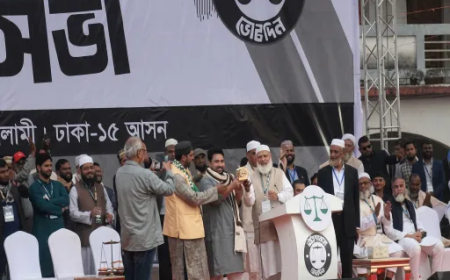
Against this backdrop, the most damaging decision of the NCP -- both short-term and long-term -- has been its electoral alliance with Jamaat-e-Islami. This is not a matter of tactical disagreement; it is a matter of historical memory and moral legitimacy.
At every critical juncture of our history, Jamaat stood against the people’s aspirations: opposing Pakistan’s creation in 1947, resisting the Language Movement in 1952, and most unforgivably collaborating with the Pakistani army in 1971 in the annihilation of our people.
The blood of three million martyrs cannot be erased without repentance or apology. Attempts at contrition, however phrased, remain painfully inadequate.
For the NCP, this alliance offers no electoral dividend -- now or in the future. Instead, it accelerates its erosion of credibility. The writing is already on the wall. Several prominent and popular leaders have distanced themselves from the party, inflicting severe damage on an already fragile organization.
Yet, all is not lost.
The NCP is still young. Its leaders are young. When it was launched, the response was electric; crowds gathered wherever it went. That energy is now waning. The atrophy has begun -- but it is not irreversible. I confess that I, too, was once hopeful. Today, I am frustrated -- but not indifferent.
My sincere advice to the NCP is this: Please consider the value and dividends of your alliance with the Jamaat. Step out of its long shadow. Contest elections with your own identity, your own manifesto, and your own vision for Bangladesh. Forget, for now, the arithmetic of seats won or lost. Focus instead on establishing moral clarity, political credibility, and generational purpose.
You represent the future. And as the old adage goes, it is better to be the head of a dog than the tail of a lion.
Only then will the people see you through your own lens, not a borrowed one.
The author is a freedom fighter, a retired Major , former Secretary and served as Ambassador/ High Commissioner to several countries. He can be reached on: [email protected].