








































































Grameen University and the Global Future of Social Business Education
While the university’s roots lie in Bangladesh, its ambitions are unmistakably global. The challenges that social businesses seek to address -- poverty, environmental sustainability, access to healthcare, and economic inclusion -- are universal.

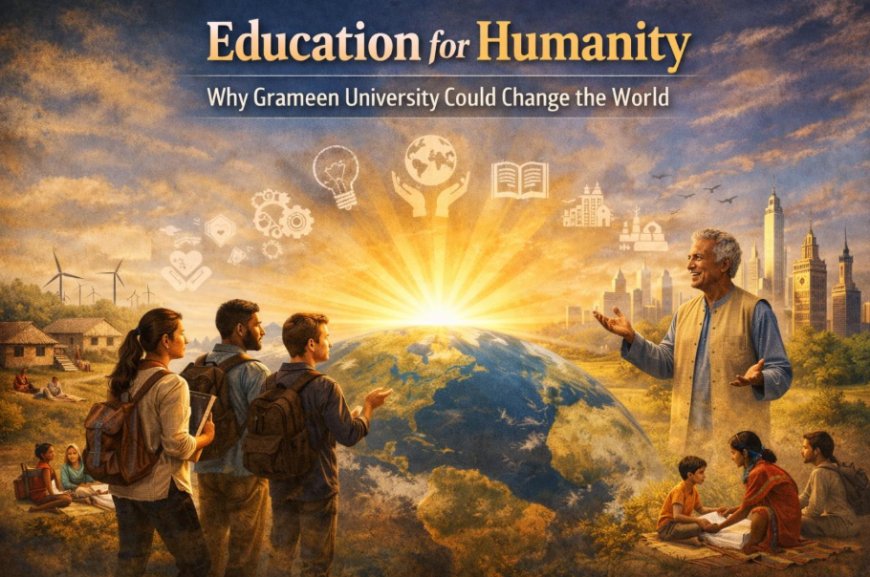
At a time when the world faces profound challenges -- persistent poverty, climate instability, widening inequality, and the growing disconnect between economic growth and human well-being -- the question confronting higher education is no longer simply how to prepare students for careers.
The deeper question is how universities can prepare young people to solve humanity’s most urgent problems.
For more than a century, universities have primarily trained students to become employees, professionals, and corporate leaders. Although this model has led to technological innovation and economic development, it has also neglected an important factor: How education can prepare students to become problem solvers for society as a whole. This recognition has sparked a global dialogue about the reimagining of higher education.
It is within this moment of reflection that an ambitious and transformative idea is emerging: Grameen University, an institution inspired by the philosophy of Nobel Laureate Dr. Muhammad Yunus and his pioneering concept of social business.
More than simply another university, Grameen University represents a bold rethinking of what higher education could become in the 21st century. It seeks to create a new generation of leaders who view business not merely as a mechanism for profit, but as a powerful tool for solving social problems.
The Intellectual Foundation: Social Business
The vision of Grameen University is based on the revolutionary concept of social business, as introduced by Dr. Muhammad Yunus through his years of service with the Grameen Bank and other social businesses. It is a concept that challenges the conventional notion of business purpose -- namely, to maximize profits for shareholders.
Rather, social businesses aim to address issues such as poverty, healthcare, clean and sustainable energy, education, and environmental protection while remaining financially sustainable.
This has already been proven to have tremendous potential in a number of fields. From providing affordable healthcare to sustainable energy solutions for rural populations, social businesses have already proven that markets can serve humanity rather than be exploited.
Yet despite the growing global interest in social entrepreneurship, most universities still teach business primarily through the lens of profit maximization and shareholder value. Courses on social impact often remain peripheral or elective rather than central to the curriculum. Grameen University aims to change this paradigm.
Reimagining the Purpose of Higher Education
Grameen University’s central premise is simple yet transformative: Education should empower students to become changemakers rather than merely job seekers.
In this model, classrooms become laboratories for solving real-world social challenges. Students will not merely study theories of development, economics, and innovation; they will design, test, and implement solutions that directly impact communities.
The university is expected to integrate disciplines that traditionally operate in silos. Economics will interact with environmental science. Engineering will collaborate with social policy.
Business students will work alongside public health researchers and community organizers. This interdisciplinary approach reflects a deeper understanding that modern problems -- whether climate change, urban poverty, or public health crises -- cannot be solved by any single field of knowledge.
By bringing together diverse disciplines around a shared mission of social impact, Grameen University aims to cultivate a generation of thinkers who can navigate complexity and create solutions that are both innovative and humane.
Learning by Doing: A New Educational Model
Perhaps the most distinctive feature of Grameen University will be its emphasis on experiential learning. Students will be encouraged to work directly with communities, design social enterprises, and conduct field-based research.
This is because Dr. Yunus has long believed that the best knowledge is not simply something one can learn from books but is something that requires one to interact with people and communities. This is because philosophy is similar to that used in developing the concept of microfinance.
This is because the Grameen Bank was not born in a boardroom but rather in the villages of Bangladesh, as Dr. Yunus experimented with poor women who were excluded from the formal system.
The success of the experiment has reshaped the way the world thinks about poverty alleviation. Grameen University seeks to replicate that spirit of experimentation -- transforming students into innovators who approach social problems with creativity, empathy, and determination.
A Global Platform for Social Innovation
While the university’s roots lie in Bangladesh, its ambitions are unmistakably global. The challenges that social businesses seek to address -- poverty, environmental sustainability, access to healthcare, and economic inclusion -- are universal. They affect communities from rural Asia to urban America, from African villages to European cities.
Grameen University, therefore, envisions itself as a global hub for social innovation, attracting students, scholars, and practitioners from around the world. Through international collaborations, joint research initiatives, and partnerships with social enterprises, the university could become a meeting place for those committed to building a more inclusive economic system.
It is not difficult to imagine future students from Africa studying renewable energy solutions alongside peers from Europe, or young entrepreneurs from Latin America working with Asian innovators to develop new models of inclusive finance. In this way, Grameen University may emerge as a global laboratory where ideas cross borders and innovations spread across continents.
Transforming Business Education Worldwide
However, the influence of Grameen University might not be confined to its immediate students. If Grameen University is successful, other universities worldwide may take a second look at how they teach business and economics. Business schools may start incorporating more social impact, social entrepreneurship, and sustainable development courses into their curricula.
Students may start seeing the value in business as more than just a way to make a living. Already, the global popularity of courses on social entrepreneurship suggests that a new generation of students is eager to align professional ambition with moral purpose. Grameen University could serve as the institutional embodiment of that aspiration.
The Power of an Idea
History shows that groundbreaking concepts can start with a single organization willing to think differently. When the first modern research universities were founded in the 19th century, they transformed the way we think about science. When the land-grant universities were created in the United States, they expanded access to higher education and fueled economic growth.
Similarly, institutions such as the London School of Economics and MIT helped redefine the relationship between knowledge, industry, and policy.
Grameen University has the potential to become a similar catalyst -- this time for the global movement toward social business and socially responsible innovation.
A Vision for the Future
In the end, the meaning of Grameen University lies not in the buildings, classrooms, or organizational structure. It is found in the vision. It is a visionary question: What if the point of education is to enable every student to change the world?
Imagine a generation of graduates who measure success not only by financial wealth but by the number of lives they improve. Imagine entrepreneurs who design businesses specifically to solve problems of hunger, clean water, climate resilience, and healthcare access. Imagine universities where the goal of learning is not simply employment, but human progress.
In many ways, this vision reflects Dr. Muhammad Yunus’ enduring belief that human creativity is far greater than the systems that constrain it.
“Poverty is not created by poor people,” Yunus once observed. “It is created by the institutions and policies we have built.” If that is true, then new institutions built with imagination, compassion, and courage can also help eliminate it. Grameen University may well be one of those institutions.
And if its vision bears fruit, the world may soon see the birth of a new kind of university that does not just educate students but also produces changemakers capable of transforming society itself.
Dr. Serajul I.Bhuiyan is professor and former chair of the department of journalism and mass communications at Savannah State University, Savannah, GA. USA. Contact: [email protected]