



































































Teesta Without Tripwires
Whatever the causes, Bangladesh cannot wait indefinitely. It must build damage-reducing infrastructure without delay. This does not replace a water-sharing settlement; it reduces damage while politics drags on, and it must be designed with geo-politics in mind.


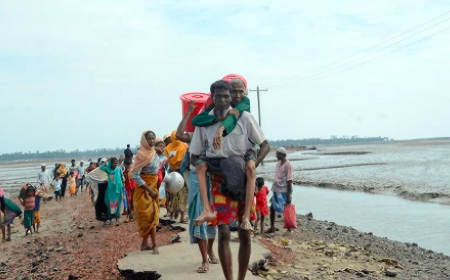
Northern Bangladesh does not experience the Teesta as a concept. It experiences it as punishment on a calendar: a dry season that shrinks irrigation and earnings, followed by surges that chew embankments, fields, and homes.
Each year of delay is accumulated damage. The bill arrives as emergency repairs, crop losses, and pressure on public finances. These costs are predictable, compounding, and costlier than prevention.
In 2026, Teesta management is not a prestige project. It is survival infrastructure.
For more than a decade, Teesta water-sharing has remained unresolved, shaped by politics, federal constraints, and mistrust that Bangladesh does not control.
Whatever the causes, Bangladesh cannot wait indefinitely. It must build damage-reducing infrastructure without delay. This does not replace a water-sharing settlement; it reduces damage while politics drags on, and it must be designed with geo-politics in mind.
In the Teesta basin, ambiguity becomes a tripwire. When no one can clearly see who controls instruments, data, and operational decision loops, every actor assumes the most strategic interpretation.
A project can be technically benign and still become politically unsustainable if it is built as a black box.
So the real choice is not between partners. It is between ambiguity and verifiable control. Teesta can be built in a way that invites suspicion, or it can be built as a monitored system where major claims must survive professional scrutiny.
Bangladesh should choose the second, without surrendering sovereignty. That choice is being forced by three tightening constraints.
Why This Is Becoming Unavoidable
First, volatility is compounding. Sediment shifts, dry-season pinch, and flood shock are moving faster than policy cycles. Second, execution capacity is binding. Large-scale river training is capital- and logistics-heavy, and delivery capacity has to be accessed if delays are to stop compounding. Third, unverifiable systems turn engineering into geo-politics. Verification is not a luxury. It is a stability cost.
The rational conclusion is to proceed using delivery capacity and finance Bangladesh can access, while making the project auditable through bounded verification. In practice, speed concentrates delivery capacity, making governance terms even more important.
The Governance Problem Modern River Projects Create
A Teesta project is not just dredging and embankments. It is also monitoring, forecasting, and operational decision-making. It is the operational system that turns a river into a managed one.
In contested settings, that operational system is where sovereignty questions concentrate, because that is where data, models, and control pathways can create dependence.
This is why Teesta needs a doctrine that is easy to explain and hard to misread. Import delivery capacity where it is rational, but never outsource command authority.
The distinction is not rhetorical. It is a boundary that must be enforced between what contractors build and what the state alone is allowed to operate.
Construction can be contracted. Operations cannot. The moment any equipment, sensor, software, or procedure becomes part of Teesta’s operational environment, it must enter through Bangladesh-controlled custody and commissioning.
Acceptance into operations requires a verified baseline of what the device is, what it runs, and what it is permitted to transmit. This must be recorded before it goes live and re-verified after any replacement.
If it is not inventoried and documented, it is not accepted. If it is not accepted, it is not paid for, subject to clear cure windows and dispute rules that do not require operational access.
A Sovereign Integrity Framework
To make that boundary enforceable, Teesta needs rules that tie sovereignty to contracts. Progress is verified before it is paid for. The framework rests on four enforceable conditions: Owner custody of control and data, no standing access into operations, verification-gated milestones, and the right to switch suppliers without losing control.
Here, "Owner" means the Government of Bangladesh and its designated project authority. No standing access means no permanent remote pathway into operations.
Any outside support is time-bounded, Owner-approved, and recorded. In practice, this means the “brain” of Teesta, the operational system, remains a national asset. Identities, credentials, and access custody are held by a compact Owner’s Systems Unit.
The Owner must also hold lifecycle control, meaning the ability to maintain, upgrade, and replace the operational system without vendor permission or vendor re-entry into the command layer. Contractor support is treated as an exception.
It is time-bounded, Owner-approved, and fully recorded, rather than a persistent pathway. Operational data accounts and pathways remain Bangladesh-controlled. Integrity also needs independent proof. Create an Independent Verification and Integrity Program (IVIP).
It should be a third-party engineering and integrity auditor appointed through transparent procurement, contracted directly to Bangladesh (not the EPC contractor), and funded through a ring-fenced project line item.
Its mandate is read-only verification. It holds no operational credentials and cannot issue commands.
Verification also has to be fair to suppliers. Bangladesh should protect legitimate vendor intellectual property, regardless of the supplier.
But confidentiality cannot extend to control pathways. Custody, access records, and the Owner’s right to operate independently must remain verifiable.
IVIP does not publish proprietary designs, demand source code, or expose vendor trade secrets. Where confidentiality is legitimate, IVIP works under strict nondisclosure while reporting compliance outcomes and exceptions publicly.
IVIP verifies custody and integrity by checking that what is installed matches what was approved, and that access records comply with the no-standing-access rule. Its job is evidence-based verification through commissioning packs, tamper-evident logs, change-control records, and configuration baselines.
Acceptance and payment for critical milestones can be paused when custody or access rules are breached. IVIP must be written into feasibility terms, financing covenants, and the EPC contract before mobilization. After mobilization, verification becomes a negotiation rather than a rule.
Why a Financier-Builder Would Accept This
A common question is whether a financier-contractor would accept independent verification. The practical answer is not by default. In infrastructure finance, opacity can preserve discretion, bargaining power, and narrative control, whether intentional or not. The lender wants repayment on schedule.
The contractor wants room to manage milestones, delays, and change orders. Equipment suppliers often want long-term dependency. This framework binds all of them through the same gate: Acceptance and payment depend on independently provable custody and integrity.
That is precisely why the Sovereign Integrity Framework matters. It is not a request for goodwill. It is a bankability filter. Bangladesh will pay for progress only when custody and integrity are independently verifiable, with clear cure windows.
A serious financier that wants completion and repayment should be willing to accept that cost, because the alternative in a high-suspicion project is politicized derailment, delay, and contested milestones.
Verifiable safeguards can also convert suspicion into proof, demonstrating completion without coercion.
Verification here is bounded. It does not grant outsiders standing in operations. It does not become an open-ended probe into proprietary systems. It simply proves three things: Bangladesh holds the keys, outsiders do not retain permanent access, and Bangladesh can operate and, if necessary, switch suppliers without being trapped.
If a financier-builder refuses even this, the refusal is telling. It signals comfort with ambiguity, the very tripwire this project is designed to remove.
The Proof Layer: Publish Continuity
Proof has to be continuous. When reporting slips, allegations return and politics fills the vacuum.
A monthly integrity note should track major changes, QA/QC status, change orders, and corrective actions opened or closed.
A quarterly performance dashboard should publish verified progress and performance outcomes, including dredging progress, embankment test results, sensor uptime, flood-warning performance metrics, and environmental indicators.
An annual methods-and-exceptions report should state what was tested, what failed, what was fixed, and what remains unresolved.
Safety Visibility Without Standing
Safety visibility must not become standing. Observation should be equal-access and safety-minimum, with no privileged feeds and no operational interfaces.
In extreme events, coordination should run through disaster channels only, and Bangladesh should publish a public flood bulletin with flow bands, basin trends, and alert timing windows, plus a single time-bounded, logged humanitarian channel. A transparent Teesta reduces the space for strategic interpretation, by friends as much as by rivals.
Financing Transparency to Prevent “Contingent Leverage”
Financing must be legible, too. Headline terms, including maturity, grace period, interest rate, and any collateral or security clauses, should be disclosed alongside an independent fiscal-risk note.
If full disclosure is politically sensitive, full terms should be disclosed to audit authorities with a public summary released.
IVIP should be funded via an escrowed line item inside the project, paid against deliverables. External partners may contribute through grants, but funding should confer no governance rights.
Guardrails Against Self-Sabotage
This approach fails the moment “exceptions” become routine, when custody blurs, access stops being time-bounded and logged, and reporting slips.
The Owner must be properly staffed; it needs a compact unit with authority, backed by a team that combines state mandate with technocratic depth.
Closing Position
This framework establishes the core terms for building Teesta: Sovereignty in operations, and verification as the price of progress. Speed concentrates delivery capacity. That makes ambiguity unaffordable.
The question is not who builds Teesta, but whether any financier-builder will accept a project where custody is provable, access is bounded, and legitimacy is consistently demonstrated.
If the answer is no, the disagreement is not engineering. It is control.
Bangladesh should proceed on verifiable terms and treat refusal as the clearest clarification available.
Nazrul Islam is a policy-focused opinion columnist and entrepreneur with experience across healthcare, ICT, fertilizer, and chemical retail.