





































































An Open Letter to the Hon’ble Foreign Minister
The compact’s energy architecture amplifies rather than mitigates geopolitical shock exposure. A rational energy-security doctrine would diversify suppliers, transit routes, and contract structures; this agreement funnels us toward a single, unbuilt source over which we possess zero strategic control.
Dear Minister:
You recently invited the citizens of this republic to read the February 2026 US-Bangladesh Agreement on Reciprocal Trade “alongside those of others.” It is a statesmanlike invitation, and one we have accepted with the seriousness it deserves.
What follows is not polemic but analysis -- grounded in the economic theory of asymmetric bargaining, the architecture of international trade law, and the geo-political realities of a fragmenting global order.
We have examined the text of our compact, placed it beside the parallel agreements struck by Indonesia, Vietnam, and India, and measured each clause against established norms of sovereign treaty-making. The diagnosis, I regret to report, is grim.
The Sovereignty Surrender: Article 4 and the Blank Cheque
At the heart of the compact sits Article 4, a triptych of provisions without precedent in modern bilateral trade agreements. Article 4.1 obliges Bangladesh to “adopt or maintain a complementary restrictive measure” whenever the United States unilaterally “deems” a trade action necessary for its security, with no right of appeal, no independent injury assessment, and no sunset clause.
In WTO jurisprudence, safeguard measures require multilateral notification, demonstrable serious injury, and compensation. Article 4.1 dispenses with all three, reducing Bangladesh from a co-equal contracting party to a downstream enforcement arm of US strategic preferences.
Article 4.2 then harmonizes our export-control regime with Washington’s, explicitly anchoring our regulatory apparatus to the US Entity List and OFAC sanctions rosters. The obligation to prevent Bangladeshi firms from “backfilling or undermining” US controls -- and to restrict transactions that would violate US sanctions had they occurred on American soil -- extends American legal jurisdiction into our territory without the reciprocal grant of sovereign police power to Dhaka.
In international law, such extra-territorial application of one state’s administrative law requires either treaty-based consent with balanced obligations or Security Council authorization. This compact provides neither.
Article 4.3.4 then compounds this surrender with a strategic straitjacket: should Bangladesh enter a preferential trade agreement with any “non-market country” that Washington considers undermining the deal, the United States may terminate and re-impose the 37% tariff rate after consultations it alone judges unsatisfactory.
This is a de facto veto on our sovereign right to diversify commercial partnerships. No comparable clause exists in Indonesia’s July 2025 agreement, Vietnam’s parallel pact, or India’s hard-won FTA with the United Kingdom. Each of those nations retained the full prerogative to pursue independent trade diplomacy; Bangladesh alone signed it away.
A Quantitative Marker of Power
The Centre for Policy Dialogue has documented what any careful reader discerns: the phrase “Bangladesh shall” appears 108 times in the compact; “USA shall” appears six. In the grammar of sovereignty, frequency of obligation correlates directly with the direction of power.
Economic theory teaches that trade agreements between asymmetric partners tend to institutionalize the existing power disparity unless deliberate institutional safeguards -- such as binding dispute resolution, symmetrical exit clauses, and objective standards of harm -- are embedded in the text.
This agreement contains none of those safeguards. The United States retains unilateral discretion to trigger compliance measures, suspend concessions, and determine what constitutes a security threat; Bangladesh retains only obligations. The asymmetry is not incidental; it is the agreement’s organizing principle.
The Boeing Mandate
Annex III commits Biman Bangladesh Airlines to “intend to purchase 14 Boeing aircraft.” This procurement is not the outcome of a competitive commercial tender but a diplomatic prerequisite embedded in a treaty annex. Commerce Secretary Mahbubur Rahman has already conceded that Boeing would likely deliver only “four to five planes by 2035 whatever orders are made.”
Meanwhile, the European Union -- destination for over €20 billion in annual Bangladeshi exports, dwarfing the $9 billion bound for American ports -- has formally protested the politically directed Boeing deal as undermining the level playing field essential for GSP+ consideration.
We are trading a vital, diversified commercial relationship for a fleet mired in production bottlenecks and safety crises: The March 2026 wiring defect halting 737 MAX deliveries, the June 2025 Ahmedabad crash of a Boeing 787 with documented technical failures, and FAA-mandated inspection slowdowns across the Dreamliner program.
No independent cost-benefit analysis was presented to Parliament; no competitive bidding process was observed. This is not procurement; it is tribute.
Energy Security Redesigned as Vulnerability
The compact commits Bangladesh to “endeavour” to facilitate $15 billion in US LNG purchases, the only concrete expression of which is a non-binding agreement with a single Louisiana facility still seeking financing and a Final Investment Decision. Concentration risk at this order of magnitude is indefensible under any portfolio-diversification model.
The Iran crisis that erupted in February 2026 demonstrated precisely the catastrophic cost of such dependency: The Strait of Hormuz blockade severed our contracted long-term supplies, forcing 11 emergency spot cargoes at $21.35 per mmBtu -- double pre-war levels -- at a total cost approaching $880 million, equivalent to nearly 15% of our monthly import bill.
The compact’s energy architecture amplifies rather than mitigates geopolitical shock exposure. A rational energy-security doctrine would diversify suppliers, transit routes, and contract structures; this agreement funnels us toward a single, unbuilt source over which we possess zero strategic control.
Agricultural Commitments and the Cotton Trap
The agreement locks in 700,000 metric tons of US wheat annually for five years, alongside $1.25 billion in soybean products and binding cotton purchase volumes -- a total agricultural redirection of approximately $3.5 billion. US wheat consistently commands a $30-40 per-ton premium over Black Sea alternatives. This premium is not a quality adjustment; it is a political surcharge borne directly by Bangladeshi consumers and food processors.
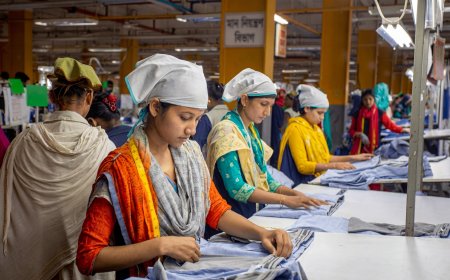
The zero-tariff garment concession, meanwhile, is conditioned on the use of US-origin cotton and man-made fibres -- a sourcing requirement that renders the benefit largely theoretical for the 98.3% of our garment production lines that currently rely on inputs from China ($9 billion in 2024) and India ($3.1 billion), against a mere $274 million from the United States. The economic logic is circular: We are granted a tariff preference we cannot use, in exchange for agricultural commitments we cannot escape.
The Comparative Record
Indonesia’s July 2025 agreement with Washington accepted a 19% reciprocal tariff and $15 billion in energy purchases, but contained no complementary-measure obligation, no sanctions harmonization, and no non-market FTA restriction. Vietnam secured a reduction from 46 percent to 20% without surrendering sovereign alignment on export controls.
India’s FTA with the United Kingdom -- negotiated with a former colonial power no less -- staged tariff elimination over seven years, permanently excluded 14% of UK exports from liberalization, and included not a single national-security blank cheque. Each of these nations understood that tariff rates are temporary bargaining chips; sovereignty clauses are permanent encumbrances. Bangladesh alone failed to draw that distinction.
The Path Forward
The compact contains a termination clause -- Article 6.5 -- permitting either party to exit with 60 days’ notice. Our Commerce Adviser noted this was inserted because the government was “mindful of the next government.” That clause is the one genuine point of leverage we possess.
It should be activated not to sever ties with a vital strategic partner but to signal that a sovereign nation, having now read its deal alongside those of its peers, will no longer accept a paternity suit dressed as partnership.
We respectfully request that you initiate the notification of intent to renegotiate, deleting Articles 4.1, 4.2, and 4.3.4 in their entirety, decoupling procurement from treaty text, and restoring to Bangladesh the full measure of diplomatic autonomy that international law and the Comity of Nations guarantee.
The invitation was yours, Minister. The comparative reading is complete. The verdict is unanimous: This agreement must be returned with proposed amendments, or it must be withdrawn.
A nation of 170 million deserves nothing less.
Respectfully submitted,
Zakir Kibria
Policy Analyst, Kathmandu
Zakir Kibria is a Bangladeshi writer, policy analyst and entrepreneur based in Kathmandu, Nepal.