



































![A Ledger of the Soul: Navigating the Allah-Bhagavant Nexus in a 19th-Century Puruṣākāra Jñāna Caupara [Gyan Chauper]](https://counterpointbd.com/uploads/images/202608/image_430x256_6a93baa3b09a7.jpg)


















The City That Kills You on Your Walk Home
Ashfaq Chowdhury Piplu’s death is a question thrown at our feet by the city we are building. The falling rod asks: What do you value more? The abstract future value of a building, or the concrete, present life of a person walking?
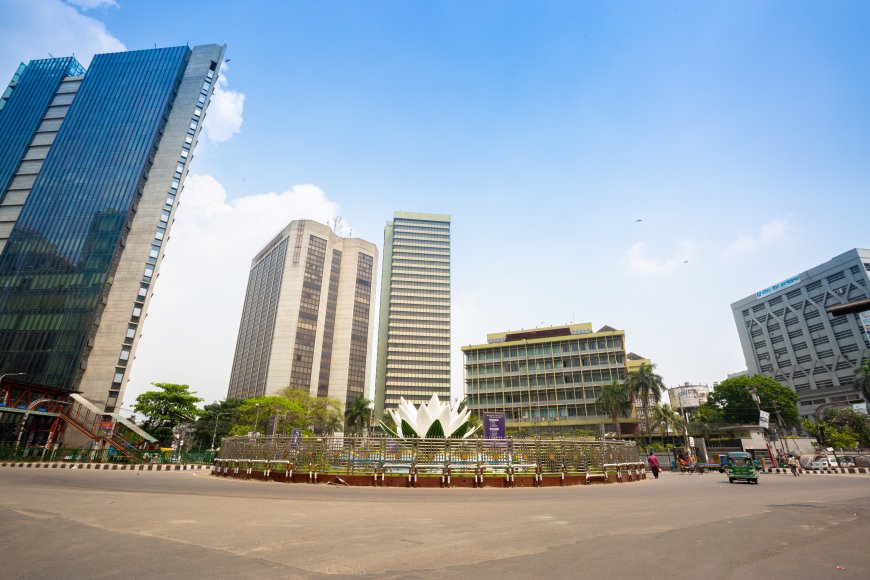
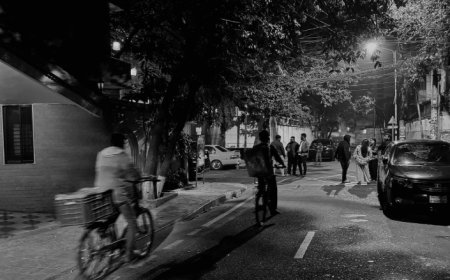
The afternoon sun hangs heavy over Gulshan. The air vibrates with the relentless percussion of a city rebuilding itself -- the hammering of iron, the growl of concrete mixers, the metallic shrieks of cranes pivoting against the sky.
Below, Ashfaq Chowdhury Piplu walked. He had just finished lunch. He was returning to his job at a multinational company. It is a simple, universal act. A man, walking.
Then, a whistle in the air. Not a warning, just physics. An iron rod, falling from the roof of a 25-storey building under construction, found its mark. The everyday symphony of the street halted, replaced by a stunned silence. A life, extinguished in the act of walking home.
Ashfaq, a son of Chittagong, an organizer of community football tournaments, was killed not in a warzone but on a street in the capital’s most affluent district. He had a train ticket booked for that night, meant to take him to a prize-giving ceremony. He returned to his village not alive, but as a body.
This is not an accident. It is an assassination by negligence. And it begs the most terrifying of civic questions: what does it mean when the simplest human act --walking through your own city -- becomes a lethal gamble? Could it have been me? Could it have been your child? The horror lies in its democratic randomness. It is the logic of our urban future arriving with brutal, metallic clarity.
A World We Have Already Built
To call this a mere “accident” is to be willfully blind. It is, instead, a perfect symptom. Decades ago, the writer J.G. Ballard was diagnosing our urban sickness. In his novel High-Rise, he depicted a luxurious, self-contained tower block where residents, freed from the norms of the outside world, descend into violent tribal chaos. The building itself becomes an active agent, a “huge machine” that caters to individual isolation and unleashes repressed psychopathies.
Look at the site of Ashfaq’s death. Is it not a “denatured ecosystem”? A sealed zone of production, where the human calculus is reduced to progress and profit, utterly divorced from the vibrant human life flowing at its base.
Ballard’s fiction explores the “social and psychological entropy” generated by modern urban landscapes. On that Thursday afternoon, this was no metaphor. The city’s body -- its exposed steel skeleton -- violently merged with Ashfaq’s, making a grotesque mockery of the idea that we are separate from the worlds we build.
We have summoned this dystopia into being. The falling rod is not a plot point from High-Rise; it is our daily news. Ashfaq’s death reveals that our cities are no longer planned habitats for living; they have become engines of “exchange-value,” where the only thing that matters is the financial worth of the next square foot of air.
The Calculus of the Expendable Citizen
This brings us to the heart of the matter: a brutal political calculus. The philosopher Achille Mbembe theorizes necropolitics -- the power to decide who may live and who may die, and the social structures that expose certain populations to death. This is not the dramatic power of a sovereign with a sword; it is the mundane, bureaucratic power of a system that prioritizes.
It is the power evident when a major developer’s chairman and managing director are named in a negligence case, yet the company denies responsibility. It is the power embedded in a system where, according to a 2025 safety report, workplace deaths jumped to at least 1,190 in a single year, with more than eight out of ten reported accidents ending in death. When accidents are not exceptions but statistically inevitable outcomes, we have entered a necropolitical reality.
The randomness of Ashfaq’s death is its most political feature. He was not targeted. He was just there. In this calculus, anyone can be sacrificed at the altar of progress, which ultimately means no one’s life is sacred. The public footpath, the very space of civic life, is transformed into what Mbembe might call a “death-world” -- a zone where the citizen is reduced to a bystander in the path of falling debris.
The City of Exchange vs. The City of Life
This is the core fracture. Our urban model privileges exchange-value—the price of a condo, the return on a developer’s investment—over use-value. The use-value of a city is its utility for living: safe passage, clean air, peaceful sidewalks, the simple assurance that you will return home unharmed.
The iron rod that killed Ashfaq was a component of the City of Exchange. Its purpose was to help complete another floor, another unit, another digit in a ledger. In this city, speed is king, safety nets are cost centers, and the pedestrian below is an externality -- a statistical risk, not a human life.
Ashfaq himself was a citizen of the City of Life. He was using the street for its most fundamental purpose: to connect two points of his existence. He was embedded in a network of care -- a job, a family, a community. His value was social, human, irreplaceable.
The criminal case filed after his death uses the correct legal term: “death by negligence” under Section 304A of the Penal Code. But this is systemic negligence. Bangladesh has a dense framework of construction laws, including the Bangladesh National Building Code 2020. The violence occurs in the gap between the law on the books and the law on the street, in the hollow space where enforcement should be.
Reclaiming the Right to the City
So, what would a city built for Ashfaq look like? It begins with reclaiming our right to the city—not the right to just inhabit space, but to shape it, to demand it serves life first.
We need more than technical fixes. We need a political and moral reckoning that closes the gap between legislation and reality. We need transparent and terrifying deterrence: developer safety records must be public, visible dashboards. Fines for violations must be catastrophic to profit, not a manageable business expense. Liability must pierce the corporate veil, reaching those who sign the cheques.
We need militant urban citizenship: communities must have the legal standing and power to audit, report, and halt visibly dangerous sites. Public space must be defended by the public.
Finally, we must re-zone our imagination. Urban planning must mandate inviolable, protected perimeters for pedestrians. The “footpath” must be resurrected as a sacred, safe corridor for human life, not an afterthought or a parking annex.
Ashfaq Chowdhury Piplu’s death is a question thrown at our feet by the city we are building. The falling rod asks: What do you value more? The abstract future value of a building, or the concrete, present life of a person walking?
We answer that question every day through our silence, our acceptance, our hurry. Or we can answer it by finally seeing the street not as a conduit for commerce, but as a commons. By seeing the pedestrian not as an obstacle, but as the sovereign reason the city should exist at all. The city for living is waiting to be built. But first, we must stop building the one that kills.
Zakir Kibria is a Bangladeshi writer, policy analyst and entrepreneur based in Kathmandu, Nepal. His email address is [email protected].