













































![A Ledger of the Soul: Navigating the Allah-Bhagavant Nexus in a 19th-Century Puruṣākāra Jñāna Caupara [Gyan Chauper]](https://counterpointbd.com/uploads/images/202608/image_430x256_6a93baa3b09a7.jpg)





















Will Turning Korail Into a High-Rise Solve the Problem? Not So Fast.
The Korail high-rise promise is not just a construction project. It is a governance challenge shaped by misaligned incentives, fragmented land control, extreme density, contested beneficiary selection, weak tenure enforcement, and post move-in affordability.

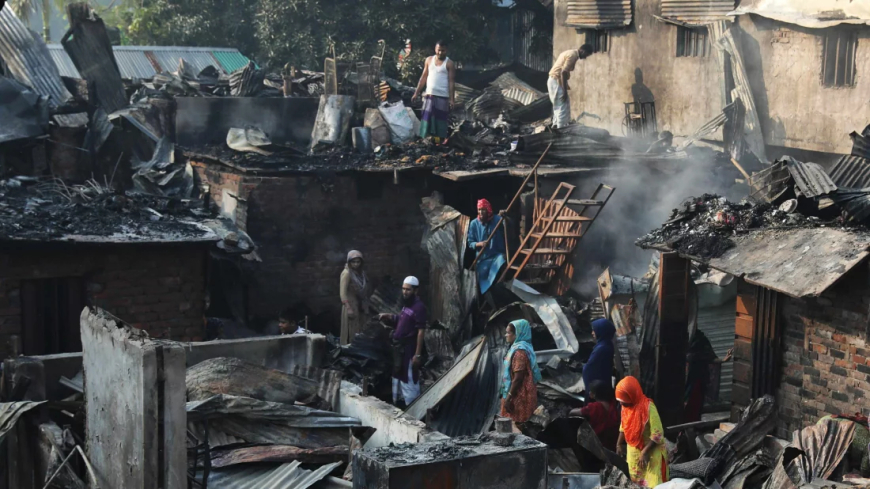
The 2022 census counts about 1.8 million people living in roughly half a million slum households, even before accounting for floating populations. Korail Bosti offers a concentrated view of this national crisis.
It sits on roughly 90 acres of some of Dhaka’s most valuable land and houses around 100,000 residents who keep the formal city running while living without secure services or dignified housing.
So, when political leaders promise to “solve Korail” by building high-rise apartments, the proposal must be judged less by emotional appeal and more by implementation reality.
Informal settlements exist because rural-to-urban migration in Bangladesh is structurally inevitable. Cities concentrate economic opportunity. Urban households earn over 40 percent more than rural households on average.
That gap often determines whether a household slips into poverty or survives. It is therefore unsurprising that there has been net rural-to-urban migration of roughly six million people between 2011 and 2022.
But arriving in the city does not mean entering formal housing. Rents near job-rich areas are often unaffordable and living on the periphery unviable due to inadequate public transport. For the few households that can pay, entry into the formal rental market is often blocked by discrimination.
New arrivals are usually engaged in low-status informal work, and landlords and neighbours reject tenants seen as poor, rural, low-educated, or lacking “respectable” jobs and social networks. Informal settlements therefore become the default because they offer proximity and low barriers to entry.
Politicians often pledge to replace slums with modern high-rise housing, but these plans rarely materialize after elections. This is not deliberate deception. Usually, it reflects how poorly the complexity is understood at the time of the promise. The obstacles begin before construction, continue through delivery, and persist long after families move in.
Slums often sit on government or semi-public land near key infrastructure. Yet the state avoids charging rent because that would imply legal recognition, and consequently, strengthen the urban pull the state seeks to discourage. Many slums also grow on privately titled land, frequently, low-value wetland-adjacent plots with limited commercial value.
They persist through unauthorized occupation and, less often, informal permission or rent extraction outside legal tenancy rules. In both settings, underinvestment is rational for all stakeholders. Keeping settlements “temporary” preserves the option of clearance when redevelopment becomes profitable for the landowner.
That insecurity also deters donors and residents from funding long-term upgrades, since eviction always remains possible.
Intermediaries fill this vacuum. Through political links, they keep settlements tolerated and broker informal utility connections. Residents then pay a poverty premium: Reportedly BDT 47 per sq ft, about twice “decent housing” rents in upscale Dhaka, and up to 14 times more for water.
The incentives are reinforced because informal settlements are cheaper to build than code-compliant housing and can cram almost four times as many people onto the same land. This is why dismantling slums requires sustained political will.
Land becomes the next constraint. Even on public land, authority is rarely clear. Korail sits on overlapping claims linked to BTCL, PWD, and the Bangladesh Hi-Tech Park Authority.
Any decision therefore requires negotiation across multiple agencies. In high-value areas, the opportunity cost of prime land makes clearance commercially attractive and low-income allocation politically contested. Part of Korail, for instance, is earmarked for an amphitheatre.
If a settlement sits on disputed private land, the state must first resolve ownership, negotiate a settlement, and acquire the often-expensive plot. Court resolution alone can take over a decade. If the landowner profited from exploiting residents, buying from them can look like rewarding exploitation.
When disputes are too complex or the site is unsuitable for code-compliant construction, such as wetland-adjacent land, relocation becomes the only viable option. But relocation is also constrained. Land near job clusters is scarce, and moving households too far leads to income loss, higher commuting burdens, and eventual return to informality closer to work.
Informal settlements achieve extreme densities because they bypass the land-consuming requirements of a functional city, including roads, fire access, drainage, utilities, and public facilities. Once land is reserved for these essentials, the solution turns vertical.
Korail illustrates the scale: Rehousing on-site would require roughly 1,100 people per acre, far above the 200 to 250 level cited for Dhaka and well beyond international recommendations of 40 to 150. After allocating land for infrastructure and services, the site would likely need an average built form of 25 to 40 storeys, supported by city-grade systems.
The pressure intensifies because Korail is also an economic hub of informal enterprises that depend on low-cost space and constant foot traffic, so redevelopment must be mixed-use with market space built into ground and podium levels, pushing heights higher still.
Even if the land and design issues are solved, the politics of distribution remains. Governments often prioritize rent collectors because they are assumed to have invested in the structure, are easiest to identify, and allow one claimant per unit.
Tenants and sub-tenants, who are poorer and often the majority, are harder to include because residency is undocumented, households overlap, and tenancy is intermittent. Demand also exceeds flat supply, forcing contested choices over eligibility criteria: Income, length of stay, current residency, and cut-off dates for new entrants.
Household structure adds another complexity. Multiple families often share one dwelling, so rehousing can reproduce slum conditions vertically. Family-based allocation can also encourage reunification, intensifying the urban pull. Even then, lists remain vulnerable to capture without safeguards. In Bhashantek, the government listed 849 eligible households, but only 218 reportedly received flats.
Once beneficiaries are chosen, the tenure model must be fixed. Ownership offers permanent security, reduces eviction fear, and helps low-income households build assets. But ownership also makes each flat a tradable commodity.
Under financial pressure, households may sell, rent out, or informally transfer units, turning ownership into a pathway to displacement. Governments can limit this through lock-in periods, transfer approvals, or resale restrictions to eligible low-income buyers. These safeguards only work if informal possession transfers are also prevented.
The alternative is social rental or state tenancy. This reduces resale capture and preserves housing for low-income groups. But it requires transparent allocation, enforceable tenant rights, and monitoring of real occupancy.
Strong safeguards are also needed so monitoring does not become harassment or a tool for politically motivated eviction. A fairness dilemma remains.
Should rehousing be permanent for the first recipients, or should there be turnover for other poor households? Income thresholds are often proposed, but enforcement is difficult in an informal economy with fluctuating earnings and risks becoming another channel for selective enforcement.
Affordability is the final failure point. Apartment living brings fixed costs such as utilities, lift maintenance, repairs, security, waste management, and service charges that low-income households with volatile earnings struggle to sustain.
High-rise construction also costs close to twice as much per square foot as low-rise building, and those higher costs flow into rents and long-term maintenance. When expenses become unmanageable, households cope by subletting, overcrowding, renting out the unit, or moving back to informal settlements where costs and rules are more flexible.
Affordability is not a side issue. It is how rehousing turns into quiet displacement or a vertical slum.
The Korail high-rise promise is not just a construction project. It is a governance challenge shaped by misaligned incentives, fragmented land control, extreme density, contested beneficiary selection, weak tenure enforcement, and post move-in affordability.
Even if Korail could be delivered well, it cannot be treated as a one-off exception. Granting ownership on prime Dhaka land to one settlement while others receive nothing creates unfairness and turns rehabilitation into a political lottery. It also rewards informality and can encourage new migration into slums.
Korail should be treated as a test case, not a headline. Without safeguards, credible management, and a national roadmap, the high-rise promise will fail where it usually does in Bangladesh: Implementation.
Dr. Mariha Tahsin is the former head of Urban Development Program at Sajida Foundation.