
































![A Ledger of the Soul: Navigating the Allah-Bhagavant Nexus in a 19th-Century Puruṣākāra Jñāna Caupara [Gyan Chauper]](https://counterpointbd.com/uploads/images/202608/image_430x256_6a93baa3b09a7.jpg)




















Victory is Ours, and Ours Alone
Our Liberation War was basically about human rights and dignity. It was a call to refuse to be oppressed, to fight on behalf of the right of self-government, and to struggle in support of the values that unite us as a people: freedom, justice and equality. We must take pride in this history on Victory Day, as it represents not only a past victory but also a promise for the future.

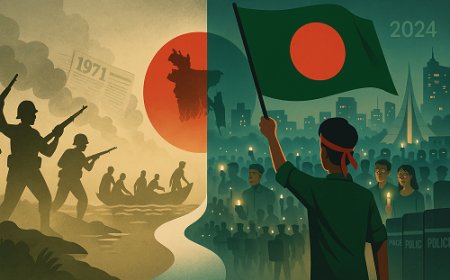
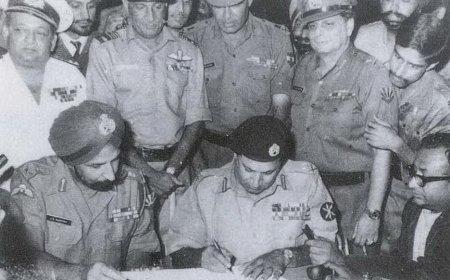
Bangladesh won a hard-fought battle on December 16, 1971, overthrowing a military dictatorship and several centuries of colonial dominance, discrimination, and oppression. Victory Day is a day of immense pride, the day when we remember what sacrifices we made to obtain our freedom.
As we celebrate another Victory Day, we have to consider the way this history is taught and recalled. This year's celebration should not stifle, distort, or politicize our history. Our Liberation War was not an extension of the India-Pakistan war or even a civil war. Bangladesh's struggle was for our identity, sovereignty, and culture.
Sharing a Special Struggle of Independence
The history of 1971 was a key event in world history, but our perception of the events should be informed by our experiences, not by filtered perception of the outer forces or the conflict.
Although the intervention of the Indian army contributed to the victory over Pakistani troops, we should not overlook the fact that the struggle of Bangladesh depended on the visions and losses of our nation.
We should keep uppermost in our mind that it is not the geo-political wrangles between India and Pakistan that gave rise to our Liberation War, but rather it was the long-standing struggle of the Bengali people.
The genocide of March 1971 was the result of the brutal oppression of the Bengali culture, language and identity by the Pakistani military government led by General Yahya Khan. The Bangladesh people reacted with unremitting resistance, the heroism of the students and the intellectuals to the struggle which our freedom fighters initiated with the call to arms in the Mukti Bahini. This was not just a war over political authority but a war over the rights to be able to exist as a people, to exercise our language and our culture and to start a future we make out of ourselves.
In this respect the 1971 Liberation War was not only a struggle of freeing ourselves of the Pakistani oppression but also a struggle of restoring our dignity. The final objective was not some military triumph but the fact that we have the right to self-determination, to manifest our culture and self-rule. It was a wave that was sunk into our culture through the gospel of freedom songs, as well as the courage exhibited by the masses of the common people. This is what the struggle was all about, and we should make sure that this story is always in the spotlight of our commemoration.
Not a Footnote to Somebody Else's Story
It is always a tragic point to mention that every Victory Day there is a tendency to tint the specific, irresistible spirit of the liberation of Bangladesh with the greater geo-political aspects of the conflict. Despite being a constituent of the story, the India-Pakistan angle often receives unnecessary weight. As Bangladeshis, we should remember that the history of our Liberation War belongs to us; it is our struggle, our story, and our past.
Putting too much emphasis on the India-Pakistan situation negatively alters the fact of our liberation. Indeed, the role played by the Indian army in ensuring the ultimate victory cannot be undermined, but it does not reduce the role played by the struggle of the people of Bangladesh in the escalation of the conflict.
This is what happens when we start permitting our past to be recounted as a single part in the greater India-Pakistan antagonism, and so we start obliterating the real interpretation of independence. Our sacrifice, our suffering, and our triumph are Bangladesh and not any other historical account.
This misrepresented account is even worse when it is politicized. Overall history can be distorted, and that has been the case when foreign powers tried to redefine our Liberation War in their own political perspective.
One such instance of how political interests may distort the historical event has been the Pakistani version of events concerning the attempt to downplay the genocide of 1971 and label it as a civil war. People of Bangladesh have to resist such an extraneous framing as the citizens of an independent country.
We should not forget that our Liberation War was a war of freedom and justice and not a war of one party to conquer another one.
The Significance of Saving Our Story
Why should we preserve the documentation of our own history, complete with all its complexities? Since identity is shaped by history. Our thinking of the past affects the way we see ourselves now and shapes our future.
The 1971 victory for Bangladeshis is not only a historical incident, but it is also a source of identity and pride that gives our concept of nationhood. Our national identity is woven with the victory over colonialism, the refusal of being oppressed, and the assertion of our sovereignty. Perverting or watering down this history is meant to underscore the meaning of being Bangladeshi.
Besides, our history is not merely the history of some military feats; it represents the values and ideals which contributed to our emancipation. In the Bangladeshi Liberation War, the war was basically about human rights and dignity. It was a call to refuse to be oppressed, to fight on behalf of the right of self-government, and to struggle in support of the values that unite us as a people: freedom, justice and equality. We must take pride in this history on Victory Day, as it represents not only a past victory but also a promise for the future.
Our Responsibility to Honour the Sacrifices
This Victory Day, we must not just think of what happened in 1971, but we must also celebrate all the sacrifices of millions of men and women who sacrificed everything to obtain our freedom. These individuals, often overlooked in history, made invaluable contributions to our liberation.
It is our responsibility to remember them and transmit their memory to the new generation. This is the heritage which we must guard – not only because of the history, but because we cannot do justice to the spirits of her ancestors.
Victory Day is a perfect occasion to reflect and be grateful, yet it is also an occasion to act. We need to renew our commitment to the principles that the Liberation War represented, which were democracy, human rights, social justice and cultural integrity.
We should use these values to continue shaping the development of our country. On celebrating, we shall bear in mind that our liberation was not merely a military victory; however, it was a triumph of the soul of Bengali people.
A Call for True Celebration
To sum up, Victory Day could be taken as more than the celebration of the military victory; it is the celebration of our freedom, identity, and culture. This is the year to put our concerted effort into seeing that the story we are telling is our own, the story of the unique struggle of Bangladesh to gain independence, the bravery and strength of our people, and the sacrifice of our martyrs.
We must retain this history in our hands, without the influence of foreign hands or politics. It is our day, Victory Day, and we should celebrate it with the regard, admiration, and genuine nature it requires.
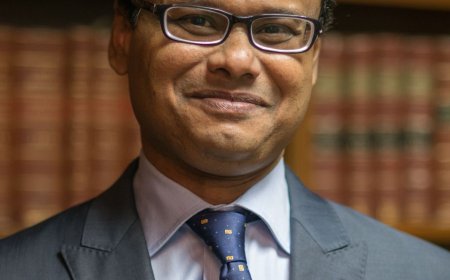
Arman Ahmed is the founder and president of DhakaThinks, a youth-led think tank in Bangladesh.