
































































What Does Farakka Long March Day Mean to Us?
The Farakka Long march of 1976 was ultimately a march for dignity, justice, and survival. Even after five decades, its meaning has not faded. Rather, it has become more urgent than ever before. Because when rivers survive, nations survive too.

Every year on May 16, Bangladesh remembers a date that carries deep historical, political, and environmental significance. Farakka Long March Day is not merely the remembrance of a protest from the past; it is a reminder of an unfinished struggle over water, rivers, and national survival.
For millions of Bangladeshis, especially those living in river-dependent regions, Farakka symbolises decades of concern over dying rivers, agricultural decline, environmental imbalance, and unequal sharing of transboundary water.
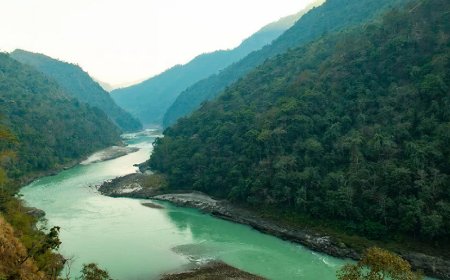
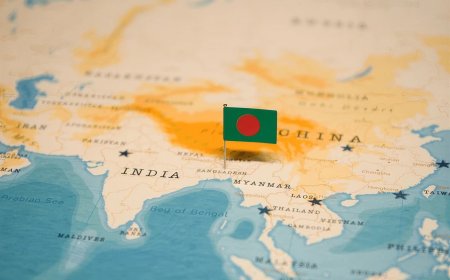
The affected area is a part of the Ganges-Brahmaputra-Meghna Basin which is among the world’s largest and most populated river basins.
The roots of the Farakka issue go back to the years following the partition of the Indian subcontinent in 1947. India later initiated the construction of the Farakka Barrage in West Bengal with the objective of diverting water from the Ganges into the Hooghly River to maintain the navigability of Kolkata Port, although it has not gone so well.
The barrage officially became operational in 1975 which actually started in 1961. In the past few decades, many of the 54 Bangladeshi rivers that originate in India have either been diverted or dammed upstream, inside India.
However, as Bangladesh is a downstream country heavily dependent on the natural flow of shared rivers, the reduction of dry-season water and sudden occasional overflow quickly became a serious national concern.
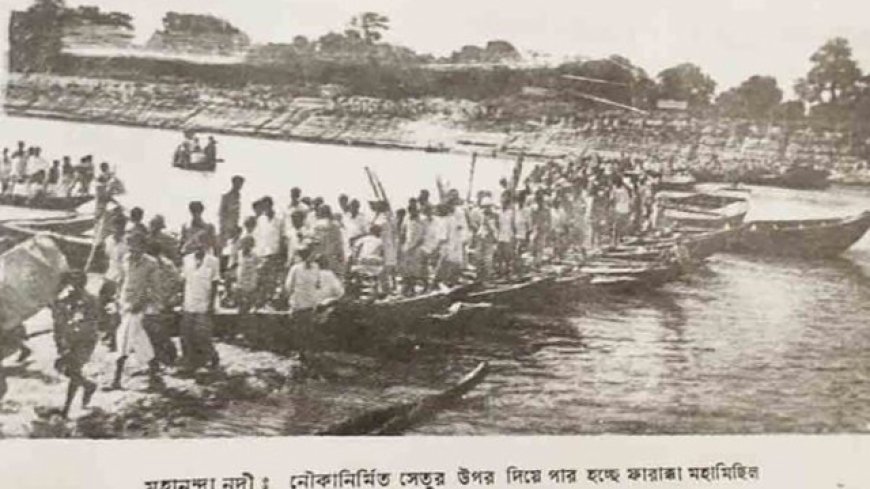
The crisis intensified in 1976. Maulana Abdul Hamid Khan Bhashani organized the historic Farakka Long March on May 16, 1976.
At nearly 96 years of age, he led thousands of people from Rajshahi towards Chapainawabganj to demand Bangladesh’s rightful share of water.
Farmers, workers, students, and ordinary citizens joined the march, turning it into one of the most significant mass movements in post-independence Bangladesh.
Bhashani warned that if the natural flow of the rivers continued to decline, Bangladesh could face severe environmental and agricultural consequences.
Half a century later, many of those fears appear painfully relevant. Over the decades, reduced dry-season flow has affected numerous rivers across western and southwestern Bangladesh.
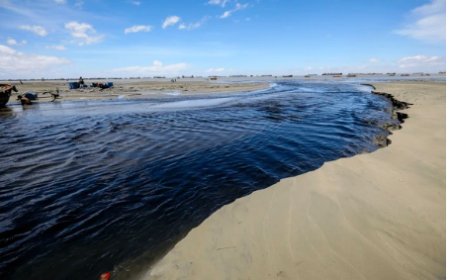
Rivers such as the Kopotakkho, Bhairab, Chitra, and Nabaganga have lost navigability in many areas, while large sections of riverbeds now turn into sandbars during the dry season.
The impact on agriculture has been severe. Irrigation in many districts has become increasingly dependent on groundwater as surface water levels continue to fall. Farmers in Rajshahi, Kushtia, Chuadanga, and surrounding regions regularly struggle with water shortages during cultivation periods.
In many places, groundwater levels have dropped significantly, increasing irrigation costs and placing additional pressure on rural communities. On the contrary, during the monsoon, critics say that sudden or excessive water release can worsen downstream flooding in Bangladesh.
The environmental consequences extend beyond agriculture. Reduced freshwater flow has accelerated salinity intrusion in the southwestern coastal belt, allowing seawater from the Bay of Bengal to move further inland. This has damaged croplands, affected freshwater fisheries, and threatened biodiversity.
The Sundarbans, the world’s largest mangrove forest, has also faced ecological stress because of changing salinity levels. Climate change has intensified these challenges further through rising temperatures, irregular rainfall, and sea-level rise.
Bangladesh and India have signed several agreements over the years regarding Ganges water sharing. The Joint Rivers Commission was formed in 1972, and a five-year agreement was signed in 1977.
Later, in 1996, the two countries signed a 30-year Ganges Water Sharing Treaty. Although the treaty was considered an important diplomatic achievement, concerns remained regarding its implementation and the absence of a strong guarantee mechanism.
Bangladesh has repeatedly expressed concerns that it did not always receive its expected share during critical dry-season periods.
The significance of Farakka Long March Day has become even greater today because the 1996 treaty is set to expire soon. At a time when climate change, population growth, and increasing water demand are placing additional pressure on South Asia’s rivers, water security is emerging as one of the region’s most sensitive geopolitical issues.
For Bangladesh, a downstream riverine nation, the stakes are exceptionally high.
Farakka Long March Day therefore reminds us that rivers are not merely waterways; they are directly connected to agriculture, food security, biodiversity, livelihoods, culture, and economic stability.
The day also highlights the importance of scientific planning, effective diplomacy, and regional cooperation. Bangladesh must continue constructive dialogue with India while strengthening its own water management systems through river dredging, rainwater conservation, wetland restoration, and sustainable irrigation practices.
At the same time, the younger generation must understand that river protection is not only an environmental issue but also a national priority.
The movement led by Bhashani transformed a technical water-sharing dispute into a matter of public consciousness and national identity. It showed how environmental struggles can unite people beyond political divisions.
Fifty years after the historic Long March, the message of that movement remains profoundly relevant. Farakka Long March Day should not only be observed as a day of remembrance but also as an opportunity to rethink Bangladesh’s water future.
The survival of rivers is directly linked to the survival of agriculture, ecology, and public wellbeing. A country shaped by rivers cannot remain secure if those rivers continue to weaken.
The Farakka Long march of 1976 was ultimately a march for dignity, justice, and survival. Even after five decades, its meaning has not faded. Rather, it has become more urgent than ever before. Because when rivers survive, nations survive too.
Md. Yeasir Arafat is a Student at the University of Rajshahi, department of Political Science.