































































When Hospitals Cannot Save Us
The doctors of Bangladesh are not the disease. They are symptoms of a system that has been starved, stretched, and left to collapse quietly while our politicians fly to London and Singapore for their own check-ups. Someone needs to call this what it is. A national emergency. A moral failure. A crusade waiting for people willing to fight it.
Bangladesh woke up on Saturday morning to news that should have been impossible. Karina Kaiser -- screenwriter, content creator, a young woman who made a generation of Bangladeshis laugh while making them think -- had died in the small hours of the night in a hospital in Chennai, India.
Thirty-one years old. Liver failure. Her father had sold land, chartered an air ambulance, flown her across the Bay of Bengal with two of her brothers beside her, each ready to give pieces of themselves so she might live.
It was not enough.
“Despite having so many big hospitals,” Kaiser Hamid told reporters, his voice breaking, “I did not know there was no liver transplant setup in Bangladesh.”
Sit with that for a moment. This is a man who has spent his life in public, who knows this country intimately, who has access and connections and resources that most Bangladeshis can only dream of. And he found out -- at the worst moment a father can face -- that the door he needed did not exist. Not in Dhaka. Not anywhere in Bangladesh.
There is one more thing about Karina that I cannot let pass unspoken. Less than two years ago, she stood in the streets of this country and demanded something better.
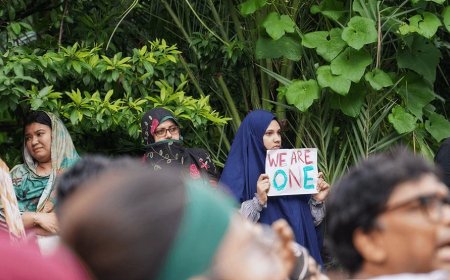
She was part of the 2024 uprising that changed this country’s government. She risked herself for Bangladesh’s future.
Bangladesh could not save her.
Karina’s story travelled because she was known. Because this country loved her family. But the story that keeps me awake is the one that never travels.
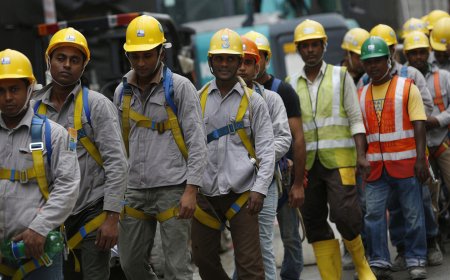
It is the garment worker in Gazipur -- twenty-seven years old, twelve-hour shifts, breathing air measured at nearly nineteen times the World Health Organization’s safe limit, an invisible clock already running on her life expectancy.
She goes to the only government hospital serving five million people in her district. She waits for hours. She sees a doctor for four minutes.
She walks home with paracetamol. The irregular heartbeat nobody heard. The shadow on the lung nobody had time to see twice. The thing that will quietly kill her -- sitting in her chest like a tenant who pays no rent and leaves no forwarding address.
She does not make the news. She does not have a father the nation mourns with. She just gets sick. And then sicker. And then she is gone. And the system moves on.
Now let me give you a number that should make every Bangladeshi incandescent with rage.
Bangladeshis spend approximately $5 billion every single year seeking medical treatment abroad -- more than the government’s entire health budget for the current financial year.
Between 450,000 and 800,000 Bangladeshis cross borders for treatment annually -- to India, Thailand, Singapore, Malaysia, China. There are roughly a 100 offices of foreign hospitals in Dhaka alone, each sending 10 to 15 patients a day abroad.
They have built an industry out of our failure. They are quietly harvesting our sick, with offices on our streets, in our cities -- and we are funding their expansion with money that could be rebuilding our own hospitals.
Nearly 80% of hospitals in Bangladesh lack advanced diagnostic equipment. Patients bear 73% of all healthcare costs out of their own pockets. Only 2.5% of the population has any health insurance at all.
This is not medical tourism. This is haemorrhaging. Bangladesh is bleeding patients, bleeding money, bleeding dignity -- one air ambulance at a time.
And here is the part that makes me angriest. None of this is inevitable.
Our doctors are not the problem. I want to say that clearly and loudly, because the comfortable narrative is to blame the physician -- and it lets everyone else off the hook.
A government doctor at a district hospital may see four hundred patients in a single day.
Imagine you are a pilot. You arrive at the airport, and they tell you: Actually, you are flying 400 flights today. Same plane. Same instruments. No co-pilot. No extra fuel. Just 400 times the sky to navigate.
That is what Bangladesh asks of its doctors every morning.
Bangladesh has 0.83 doctors per thousand people -- second from the bottom among all South Asian countries. There is a shortage of nearly 50,000 frontline healthcare workers across the public system. The people who remain are not failing their patients. The system is failing them. And through them, failing everyone.
When a diagnosis is missed under those conditions, we reach for the word negligence. I reach for the word arithmetic.
You cannot read a chest X-ray with full attention when you have seen 300 patients before lunch.
You cannot hear an irregular heartbeat with a standard stethoscope in a ward so noisy you can barely hear yourself think.
You cannot be the specialist you were never trained to be, in a department that has not had one in two years.
The doctors of Bangladesh are not the disease. They are symptoms of a system that has been starved, stretched, and left to collapse quietly while our politicians fly to London and Singapore for their own check-ups.
Someone needs to call this what it is. A national emergency. A moral failure. A crusade waiting for people willing to fight it.
I am not a politician. I am not a minister. I am one person with a plan and an absolute refusal to look away.
For the past several months I have been working on two initiatives. The first is a nursing pipeline -- training Bangladeshi nurses to international standards, building a generation of clinical professionals who can eventually bring their skills and their earnings back home.
The second is an AI diagnostic program for government hospitals.
Starting with one hospital -- Shaheed Tajuddin Ahmad Medical College Hospital in Gazipur, the only public facility for 5.26 million people -- I want to put alongside every exhausted doctor a tool that never gets tired. A tool that reads a chest X-ray in five seconds and flags every shadow.
A digital stethoscope that catches the heartbeat nobody had time to hear. An AI that reads an ECG and flags structural heart disease in the seconds between one patient leaving and the next entering.
These tools exist. They are working today in hospitals in Britain and India and in partnership with icddr,b here in Bangladesh. They do not replace doctors. They do what no human being can do after 400 patients: They bring the same attention to the last patient as they brought to the first.
If Year 1 at Gazipur shows what comparable deployments have shown elsewhere, I will take that evidence to the Ministry of Health with one question: Why is this not in every district hospital in Bangladesh?
Karina Kaiser stood in the streets for a better Bangladesh. She helped make it possible for us to ask that question freely.
The least we can do -- the very least -- is make sure her country learns to save the next one.
Kawsar “KC” Chowdhury is an entrepreneur, commentator, and Co-Chair of the Global Bangladeshi Alliance. He works closely with the Bangladesh Caucus in the US Congress, helping shape diaspora-driven policy, trade, and education initiatives. The author is developing a nursing pipeline and AI diagnostic program for Bangladesh’s government hospitals. Details will be shared in the coming weeks.