































![A Ledger of the Soul: Navigating the Allah-Bhagavant Nexus in a 19th-Century Puruṣākāra Jñāna Caupara [Gyan Chauper]](https://counterpointbd.com/uploads/images/202608/image_430x256_6a93baa3b09a7.jpg)


















The Rise of Leviathan
What happened in those few violent hours at Savar was not an isolated event; it was a revelation -- a rupture that exposed the bones of a much larger story, one about the decay of our collective empathy and the silence of power meant to safeguard our people and our institutions.

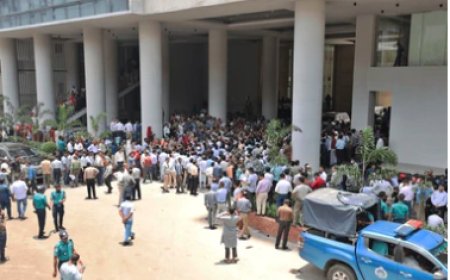
Flames engulfed the academic building of City University in Savar -- a place once meant for learning, dialogue, and hope.
The air was filled not with the voices of students, but with the crackle of fire consuming the first and second floors including the admission and accounts office, VC and Registrar’s office, canteen, and the very vehicles that carried teachers and learners through ordinary days parked beside the entrance yard.
Students and teachers fled in haste, their faces lit by the red glow of destruction, while the dreams that once animated this hallowed ground turned into smoke, ashes and silence.
The air reeked not only for burning plastic and paper, but of despair -- the death of faith in safety, in reason, in order.
What was once a vibrant campus transformed, in an evening of fury, had turned into an image of ruin.
Nobody could have imagined that our last peaceful bus ride through the vibrant campus would become a farewell to its very existence.
Never did we know that we shall not come back to the same place as we had passed through that familiar archway at the entrance of the university. On the evening of October 26, the unimaginable unfolded before our eyes.
It was more than the burning of a university; it was the burning of a promise, a sign of something far deeper and darker rising from the fissures of our time.
The upheaval of a new Leviathan, in the context of the 21st century, had begun to emerge. On that October evening, the everyday rhythm of university life -- lectures, laughter, and shared dreams -- came to an abrupt end.
And in its ashes rose something far darker: The unmistakable shadow of a new Leviathan emerging in 21st century Bangladesh.
As I stood before the ashes of what was once a place of learning, I was reminded of one of my favourite writers, Arundhati Roy, and her haunting words from The God of Small Things:
“Perhaps it’s true that things can change in a day. That a few dozen hours can affect the outcome of whole lifetimes. And when they do, those few dozen hours, like the salvaged remains of a burned house -- the charred clock, the singed photograph, the scorched furniture -- must be resurrected from the ruins and examined. Preserved. Accounted for. Little events, ordinary things, smashed and reconstituted. Imbued with new meaning. Suddenly they become the bleached bones of a story.”
In those lines, I found the mirror of our present condition -- the ruins of a university, the disfigured promise of our institutions, and fragile remains of trust that must somehow be resurrected, examined, and preserved.
What happened in those few violent hours at Savar was not an isolated event; it was a revelation -- a rupture that exposed the bones of a much larger story, one about the decay of our collective empathy and the silence of power meant to safeguard our people and our institutions.
How did we reach this point -- where power, the Common Power that philosopher Thomas Hobbes once envisioned as the guardian of peace, has become indifferent, even complicit?
In Leviathan (1651) Hobbes argued that the state endowed with sovereign authority exists to prevent chaos through a social contract. Citizens surrender certain freedoms -- their natural sovereignty -- in exchange for protection and order.
Without such a common power, Hobbes warned, human life would descend into “a war of every man against every man.” Yet today, the very Leviathan meant to prevent such disorder often stands idle as violence unfolds before its eyes. Power has grown in scale but diminished in conscience.
The Return of Leviathan to Bangladesh
One may ask, what is the relevance of Hobbes’s Leviathan nearly four centuries after its publication -- and especially in the context of Bangladesh?
My humbly response is that I invoke Hobbes not as a historical artifact, but as a philosophical mirror, to help us feel the magnitude of the brokenness of our law and order -- the moral vacuum that has emerged in the post-August 5 phenomenon from last year.
The vacuum consists of vanishing law and order, the chronic absence of accountability, and the silent complicity of those entrusted with authority.
Since last year’s August 5 mass uprising, Bangladesh has been caught in an unrelenting decline of civil safety and the collapse of institutional order.
For a year now, the promise of restoring law and order has faltered, replaced instead by an expanding terrain of mob violence, rampant hijacking, murder and arson, the plundering of property, and the demolition of institutions -- all unfolding before the public eye, under the watch of an interim government.
Though constitutionally empowered, the interim government has proved powerless to protect the very citizens from whom its legitimacy derives.
What we are witnessing is not merely a series of unfortunate events; it is a systemic failure to protect citizens to uphold the very essence of the social contract that legitimizes the state’s existence.
This cannot be waved away as an “exceptional” moment -- it reflects the structural collapse, a profound erosion of the state's moral and protective contract with its people.
Recent developments underscore how the interim government’s ‘inaction’ -- and, in some instances, tacit facilitation of mob violence -- has created a vacuum of authority, enabling a wave of lawlessness that I describe as the emergence of a “New Leviathan.”
This dangerous formation must be critically examined, contained, and ultimately dismantled through decisive and protective institutional responses. A Daily Star report from November 15 describes a populace living in “constant fear of mob violence” -- even a single unpopular online comment might spark a street attack.
Cultural performers say vigilantes are openly “harassing” them at events, accusing them of political disloyalty. The hijra (transgender) community is also hard hit: Homes meant for them were literally “vandalized, looted ... in broad daylight” with no police response.
Villagers now form armed watches as robberies surge under weak policing, and ethnic-minority leaders report that whole families were “evicted unlawfully” from their land while the authorities “stayed silent.”
These accounts -- from mob attacks to arson and evictions -- show ordinary people besieged by crime with little recourse to justice. In effect, the state’s failure has let disorder become a new Leviathan figure dominating citizens’ lives.
This breakdown is echoed at the national level. A Prothom Alo editorial of November 16 details a spree of coordinated sabotage: In one 24-hour period dozens of buses and trucks were torched and multiple bomb attacks occurred in Dhaka and neighboring districts.
By mid-November nearly 29 vehicles had been set ablaze nationwide, with several people killed or injured. Crucially, these attacks “could not be stopped” even after security was tightened, spreading panic and underscoring that the interim regime cannot enforce law and order.
Behind the scenes, institutional decay runs deep. Investigations by the special branch reveal that inmates in the country’s highest-security prisons freely use smuggled mobile phones to run drug rings, direct terrorist attacks, extort money and even plot jailbreaks -- criminals literally “controlling outside crime from inside jail.”
At the same time, analysts warn that decades of politicizing the police have “seriously eroded” public trust. Citizens now see the police as a partisan tool rather than a guardian, creating a “deep gap” that has become “a major obstacle to effective law enforcement and public safety.”
Altogether, these reports, incidents and evidence paint a picture of anarchy: a weak, dysfunctional interim government unable to protect its people, as criminal networks and vigilante violence fill the void—precisely the ominous New Leviathan of lawlessness has emerged.
Without this collective authority, human beings -- driven by self-interest, would descend into what Hobbes calls “the war of every man against every man.”
What happens when the Leviathan, once built to protect, turns away from the suffering of its own people? What happens when the “common power” forgets its moral bearings and the institutions of justice stand by as silent spectators to violence and fear?
Hobbes imagined the state as a necessary guardian against barbarism; yet today, it seems that barbarism has returned -- not from outside, but from within the very structure that was meant to contain it.
In Bangladesh, the Leviathan has not vanished -- it has mutated. It no longer commands through fear of punishment alone, but through a subtler, deadlier indifference. Its silence, its refusal to act, its complicity through inaction -- these have become the new instruments of control.
The sovereign’s absence is now its power. It is within this grim reality that the metaphor of Leviathan re-emerges -- not as a Hobbesian imagination, but as a broken colossus, stripped of moral purpose standing helpless before the chaos.
The Rise of Leviathan -- from Bangladesh to the Global Order
The smoke rising from the burnt walls of City University is not just the smoke of one campus, or even one nation. It is the sign of a global fatigue -- a loss of moral vigilance that echoes across borders, institutions, and ideologies.
The Leviathan that Thomas Hobbes once imagined as a guardian against chaos has evolved -- not as a roaring beast of overt tyranny, but as a silent Leviathan of bureaucratic indifference, economic dehumanization, and the corrosion of empathy.
This Leviathan is no longer the sovereign who commands obedience through fear; it is the systemic machinery that governs through apathy.
It thrives on the fragmentation of human concern -- a society where people scroll past suffering, where policymakers normalize the unthinkable, and where the language of justice is drowned by the noise of self-preservation.
Hannah Arendt once warned us how we live in an age where the banality of evil is not only institutional but internalized -- where the quiet absence of empathy becomes the most efficient form of violence. The result is a world where people die not because there is no system, but because the system looks away.
In Bangladesh, this indifference takes the form of broken institutions and silent power. Across the world, it takes other forms -- the refugee treated inhumanly, the child denied education because of postcode and poverty, the citizen reduced to data.
In all these manifestations, we witness what might be called the moral shrinking of our time.
This is where the humanistic philosophy of Amartya Sen gains urgency. In Development as Freedom (1999), Sen argued that true development is not measured by income or GDP but by the expansion of real freedoms -- the freedom to live a life one has reason to value.
Freedom, for Sen, is not merely political or economic; it is the capability to transform possibilities into realities.
The destruction of institutions, the silencing of reason, and the erosion of empathy are not only political failures -- they are capability deprivations.
When a university burns, it is not just the walls or the furniture or books or documents and data centers that are lost; there are far greater losses -- the capability of a generation to reason, to imagine, and to act in freedom.
Amartya Sen’s close collaborator, Martha C. Nussbaum, extends this vision in her book Creating Capabilities (2011), where she insists that justice requires us to ask: What is each person actually able to do and to be?
This question, simple yet radical, cuts through the hollow statistics of growth and power. It returns us to the essence of human dignity -- the ability to think, feel, and flourish without fear.
A silent Leviathan obstructs precisely this: it replaces genuine freedom with formal liberty, public reasoning with managed narratives, and collective well-being with privatized anxieties. Recent events make the metaphors of Hobbes uncomfortably contemporary.
International reporting documents a sharp escalation in regional military activity and a return of nuclear-era anxieties: Precision strikes on sensitive nuclear sites and a flurry of diplomatic denunciations have generated widespread concern about how easily local conflicts can widen into systemic confrontation.
At the same time, at home we have witnessed a disquieting erosion of basic public security. The violent attack on City University’s academic building in Savar resulted in scores of injured students and important campus infrastructure destroyed -- provides a vivid example of how the breakdown of order can occur not only at the strategic level but also within quotidian civic spaces.
Together, these developments suggest a twofold drift -- a rising international polarization that concentrates coercive power in the hands of states, and a domestic weakening of institutions that ordinarily mediate conflict and protect civic life.
Both trends feed into what I call the rise of the new Leviathan in the image of a public authority that is externally more militarized and yet less protective, internally more whimsical and yet claiming authority.
Putting Ourselves in Other’s Shoes
Adam Smith saw moral life as rooted in our capacity for sympathy -- the imaginative act of placing ourselves in another’s condition, of feeling, however faintly, their pain and joy.
It is this shared moral sentiment that binds individuals into a community and gives ethical substance to social life.
Hobbes, by contrast, conceived the Leviathan as an institutional solution to restrain chaos through power rather than empathy. What we witness now, I suggest, is a grim preservation of that idea: The modern Leviathan is re-emerging in two directions at once.
Externally, as renewed geopolitical brinkmanship and the revival of nuclear-era rhetoric; and internally, as a weakening of civic protections that leaves citizens vulnerable to violence and arbitrary coercion.
This dual trend is what makes recent events both alarming and historically resonant.
Ahmed Javed Chowdhury (Ronie) is an educator, economist and as a public intellectual.