



























![A Ledger of the Soul: Navigating the Allah-Bhagavant Nexus in a 19th-Century Puruṣākāra Jñāna Caupara [Gyan Chauper]](https://counterpointbd.com/uploads/images/202608/image_430x256_6a93baa3b09a7.jpg)


















Reading Between the Lines of the IRI Poll
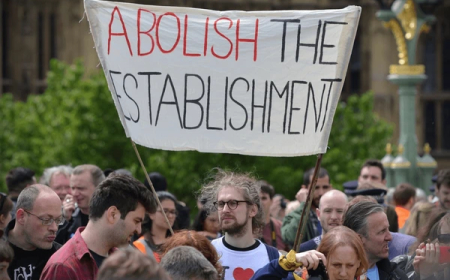
On one side: growing inequality; on the other: a deep feeling of elite-people divide; and in the middle: optimism that the future can still be changed. When these three things come together, they create the classic soil for populism.

When I re-read the full report of the International Republican Institute (IRI)’s “National Survey of Bangladesh” (September-October 2025), things became even clearer to me: we actually have in our hands a quantitative picture of the growing populist mood in Bangladesh, yet instead of reading it carefully, many of us are rushing to dismiss it outright.
This survey was conducted among nearly five thousand voters (4,985) across 63 districts, with a margin of error of less than 1.5 percentage points at the 95% confidence level.
It is not perfect; it has flaws, but it cannot be completely brushed aside as “junk.”
On page 21 of the report, respondents were asked: “To what extent do you agree with the statement that inequality between the rich and the poor is increasing in Bangladesh?”
Here, 55% said they strongly agree, and 33% said they somewhat agree. That means a total of 88% of people clearly believe the rich-poor gap is widening.
In another question: “How optimistic or pessimistic are you about Bangladesh’s future?” -- 42% said very optimistic, and 38% said somewhat optimistic.
In other words, a full 80% still believe that change for the better is possible in the future.
The same report asked a very important question: “There is a big gap between the political elite and the people -- how much do you agree with this statement?”
Here, 51% strongly agreed and 37% somewhat agreed.
Again, 88% are saying that the political class at the top and “we ordinary people” live in two completely different worlds.
On one side: growing inequality; on the other: a deep feeling of elite-people divide; and in the middle: optimism that the future can still be changed.
When these three things come together, they create the classic soil for populism.
Here, politics can very easily be framed in the language of “we ordinary people versus those powerful elites.”
The survey is clearly signalling that this kind of populist atmosphere is thickening in Bangladesh as well.
Elsewhere in the survey, most respondents described past elections not as “free and fair” but as “somewhat rigged” or “mostly rigged.”
Yet, regarding future elections, the same report shows people are quite hopeful; they believe that this time the election may at least be somewhat on the right track.
In another question, 52% of respondents said they want to see new political parties in the next election; only 43% said they are satisfied with the existing parties.
In other words, the old parties collectively are losing credibility in the eyes of the public, while at the same time a populist desire of “let something new come” is at work.
The clearest picture emerges from the hypothetical voting-intention question, which was asked using a secret-ballot format.
The question was: “If a national election were held next week, which party would you vote for?” Among all respondents:
- BNP: 30%
- Jamaat-e-Islami: 26%
- National Citizens Party: 6%
- Islami Andolon Bangladesh: 4%
- Jatiya Party: 5%
- Other parties: 8%
- 4% said they would not vote
- A sizeable portion said “don’t know” or refused to answer.
(Awami League was excluded from the list of options, which is the survey’s biggest weakness.)
What is fairly clear is that the two strongest vote-pulling forces right now are BNP and Jamaat -- both carriers of centre-to-right politics. No left–liberal force is visible at any meaningful level here.
If we connect these numbers with the feelings mentioned earlier -- rising rich-poor inequality, an unbearable gap between political elites and the people, past elections seen as rigged, strong support for the movement that removed Awami League, demand for new parties -- we see that the populism now forming in Bangladesh is primarily right-wing and is finding its space through a religious (Islamist) frame.
The old left language of “rich versus poor” inequality is still present, but it is now wrapped in the packaging of religion and coming forward through Islamist politics.
Assuming that this new reality can be managed with old nationalist rhetoric or old left slogans is where the mistake begins.
This reminds me of Delhi’s 2014 assembly election. Very few people had high hopes for the Aam Aadmi Party back then. Three months before the election, surveys started coming in that clearly showed their vote share rising fast. The BJP dismissed those results as unimportant; Congress called the surveys a conspiracy.
I was studying in Delhi at the time and was also working on communication strategy for that election -- I saw with my own eyes what happens when you ignore survey signals. When the results came, AAP had captured power in Delhi.
Only after eating that shock did the BJP realize that survey-based politics cannot be taken lightly. They set up a separate research and survey wing in the party with a big budget, and reaped the benefits in the next election.
There are many questions about this Bangladesh survey too; I am not a blind supporter of it. It is a self-reported survey, so bias is inevitable -- wording of some questions, sampling, interview method -- everything is open to criticism.
But in the last five months, at least four surveys of varying sizes have been conducted by different organisations, and I have had the chance to work with their methodologies.
One thing is very clear: on the major indicators, the results are statistically significant at close to the 95% confidence level. Yes, there are methodological weaknesses, but the phenomena that are hitting us in the face -- rising populist mood, the rise of right-wing voting, anger toward old parties, desire for new parties -- cannot simply be dismissed as “junk.”
Lived experience or ground-level reality is no less important here. Everyday survival, direct organizational work, complex issues like minority persecution or gender discrimination -- qualitative methods are far more helpful in understanding these.
Because of some methodological limitations of surveys, these subtle oppressions and deprivations are not fully captured.
At the same time, lived experience also has structural limits -- you cannot draw the map of an entire country from the experience of a few people in a few areas.
Therefore, pitting surveys on one side and ground experience on the other actually reduces the opportunity to learn from both.
Surveys mainly show correlation -- which feeling is linking to which behaviour; explaining why they are linking requires our lived experience.
Dhaka’s narrative-building class -- political commentators, talk-show speakers, columnists -- is moving forward with a big limitation here. They are skilled at explaining things in the language of political economy: who gave the money, what is an organization’s agenda, etc. But the same skill is not visible when it comes to reading statistics and surveys.
So the moment a survey appears, the first question is: “Who funded it?” -- especially if there is Western funding or any link to the opposition camp, many immediately assume the entire report is biased.
That may be politically satisfying, but it does not help much in understanding reality. If you want to challenge a statistically significant finding, you too have to bring comparable quantitative data to the table. Dismissing a quantitative model with only qualitative arguments may give mental comfort, but it does not stop the repetition of political misreadings.
After these recent surveys came out, many pro-BNP voices reacted very defensively and rejected them outright. This did not benefit the BNP; rather, they missed the opportunity to think about the places where the survey was signalling a need for strategic change -- such as the acceptability of religious rhetoric among the youth, the desire for new parties, distrust of old parties, etc.
Many left-leaning groups are stuck in the same place -- they talked about the politics behind the survey, but hardly thought about how to use the reality the survey is highlighting in their own political thinking.
On the opposite side stand the Islamist camp, especially Jamaat-e-Islami. For many years they have quietly built a policy space that includes researchers and strategists trained in the West who understand the language of numbers. They are not very visible in the foreground, but the moment they get a survey report in hand, they quickly figure out which numbers to weave into their own narrative.
As a result, they are turning populist mood, anti-elite anger, and economic uncertainty into political capital through their religious-political language.Yet this is exactly the work that should have been done by those who are worried about the rise of right-wing populism -- the BNP, left forces, secular citizen platforms -- all of them together. Had they taken the survey numbers seriously, at least it would have been this clear: the new reality cannot be managed with old left language or old nationalist rhetoric.
A new language is needed -- one that acknowledges people’s legitimate grievances, yet channels that anger toward justice-based, democratic solutions instead of pushing it toward religious hatred or conspiracy theories.
My overall point is very simple. The survey is not perfect, but we cannot finish the matter by calling it junk either.
The picture that stands before us right now -- intense discontent over rich–poor inequality, near-unanimous opinion about the elite-people gap, past elections seen as rigged, high support for the anti–Awami League movement, demand for new parties, and right-wing parties leading in voting intention -- if we push all of this aside just by citing the politics of the funder, we are simply blinding ourselves.
Only by holding both the survey data and ground experience together can we perhaps understand where Bangladesh’s new populism is coming from, and through which path its political countering is possible.