

























































The Legacy of Osman Hadi and Reclaiming 71 in a Post-July Bangladesh
Given how rapidly an emerging narrative hardens in current discourse, we must start our critical evaluations of Hadi’s legacy as soon as possible: Hadi’s image must be snatched away from those who want to worship him.

The shooting and death of Sharif Osman Hadi sent a shockwave of grief throughout the nation.
We should take a second to recognize how bizarre this is. Hundreds of thousands of people of diverse backgrounds and political affiliations gathered at his Janaza in Dhaka.
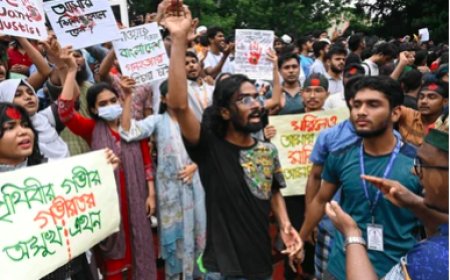
In the days following his shooting and death, social media was awash with expressions of sorrow and admiration. The last time we saw such an organic outpouring of public emotion at this scale was during the July uprising.
And yet, as exemplified by his firebrand rhetoric and populist activism, Hadi was certainly divisive as a political figure.
Given how bitter and polarized the current discourse is, it’s strange that such a subject of controversy has managed to command such universal admiration, somehow transcending ideology.
In the numerous clips of his speeches that have gone viral, Hadi appears as a figure of transparent sincerity: Someone who passionately believes in the cause they are advancing; projecting an all-smiles, down-to-earth demeanor -- the veritable Bangladeshi everyman, reflected both in the fotua and lungi he often wore while campaigning as well as the language he employed to get his message across.
Hadi was, if nothing else, home-grown. Whatever the vision of this young man was, he clearly loved his country, and he was brutally cut down before his best days had ever begun. One might argue that it’s small wonder that such a figure would demand sympathy.
I think this analysis is true as far as it goes, but incomplete. To understand the effect Hadi’s passing had on the nation at large -- including the politically unaffiliated -- it’s important to look closely at his brief career as an activist.
Hadi’s politics, as alluded to above, wore all the tell-tale signs of populism: he spoke to the grievances of the common man -- in a language familiar to them, raged against those whom he perceived to be the country’s sociocultural elite, and had no patience for financial corruption.
But it would be too simplistic to paint him as a run-on-the-mill populist radical.
Consider his Inqilab Cultural Center, an organization Hadi founded just a week after the fall of the regime.
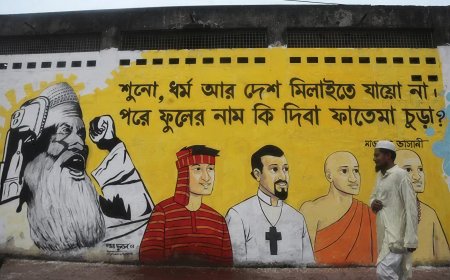
As a cursory survey of the events held at this venue would suggest, Inqilab was spearheading a movement that spoke to a majoritarian Bangladeshi-Muslim identity.
Some of these events, however, seem to present a poor fit when considered together.
In the same month, for example, Inqilab hosted a seminar on Sheikh Sadi presented by a classically trained Islamic scholar, as well as an evening folk music concert -- something mainstream religious orthodoxy would frown upon.
The center sold T-shirts bearing the face of Nazrul with a line from the poet’s famous Bidrohi poem printed underneath: Ami jahannāmer agune boshiya hāshi pushper hāshi -- roughly, I sit amidst the fires of hell and smile like a flower.
Again, dogma would bristle at the printing of human faces, not to mention the line of poetry that apparently makes light of Divine punishment. Clearly, Inqilab as an institute seemed unbothered by -- or at least, was willing to accommodate -- such ideological tensions.
I think it’s uncontroversial to say that the populist moment in the country leans towards the religious right, and yet Hadi, the firebrand populist, was building a people-facing cultural movement while refusing to be caught in the rightward-shifting undertow.
Somehow, Inqilab managed to construct a space where Islamic heritage and indigenous Bangladeshi culture could co-exist, perhaps even flourish.
The adjective that comes to mind is inclusive. Lest we overinterpret that word, the inclusivity only went too far.
Inqilab, to my knowledge, didn’t host any events on Tagore songs or poetry, for instance: Tagore is largely considered elite-adjacent and/or India-facing in today’s climate, and his material would conflict with the prevalent populist understanding of culture.
Regardless, it’s safe to say that Hadi’s cultural project was still inclusive in an unprecedent way, while still respecting majoritarian impulses. Which brings us to Hadi’s burgeoning political campaign.
Running against one of the old guards in Bangladeshi political establishment -- the BNP leader Mirza Abbas -- Hadi relied exclusively on door-knocking, street activism and social media-based campaigning to get his message out.
Populism despises financial corruption, and Hadi was on cue with a transparent accounting of his campaign donations, broadcast live on social media platforms.
His social media page was filled with photos of his campaign activism: simply dressed, all smiles, handing out pamphlets to the uncles leaving the mosque after Fajr.
It's hard not to notice similarities between Hadi’s campaign and that of Zohran Mamdani in the recent New York Mayoral election.
Both figures represented populism (albeit distinct strands), relied heavily on man-to-man outreach and social media-based campaigning, prided themselves in crowdfunding and transparent accounting, presented a consistently genuine, down-to-earth demeanor; and both of them were running against establishment giants with a view to pull off an upset victory.
Mamdani, however, while not a political insider, nonetheless came from means: Hadi came from a modest economic background.
This is the image of Hadi that emerges from the various strands of his activism: an outsider revolt against the political elite and corruption, and a celebration of indigenous Bangladeshi culture while nonetheless remaining respectful to majoritarian sensibilities.
One almost wants to say that Hadi, in his person, represented the promise of a post-uprising Bangladesh. Hadi was the child of July, the fresh blood in politics many of us had hoped for.
And yet he was cut down. In a way, his extinction represents a defeat for us all.
Amid this universal effusion of grief and admiration, there was also an unmistakable undercurrent of discourse that often started along the lines of: “I condemn the shooting, but ...”
As alluded to above, Hadi was a populist firebrand, and some of his rhetoric and actions drew stern criticism from the civil society. Many people were voicing these concerns even as the news of his shooting and death had spread.
I admit I was initially quite annoyed at this. The man’s body is still warm, I thought, give his family some time to grieve. We will have occasion to scrutinize Hadi’s legacy later.
I feel differently now. If we are to truly honor Hadi and what he stood for, we must resist the urge to deify him the way we’ve often done with our other national heroes (many of whom have been martyred).
If the past regime has taught us anything, consecrating the memory of a leader by placing them above all criticism can legitimize autocracy.
Hadi of all people -- as vocal and uncompromising as he was against the threat of autocracy -- must never be subject to such a treatment. We need to accept his legacy on face value, warts and all.
And given how rapidly an emerging narrative hardens in current discourse, we must start our critical evaluations of Hadi’s legacy as soon as possible: Hadi’s image must be snatched away from those who want to worship him.
In the remainder of the article is meant to start this conversation. As we’ll hopefully realize by the end, this exercise is useful not just to understand who Hadi was, but also to gain insights about the recent construction of discourse around issues of national importance.
Perhaps the most widely criticized aspect of Hadi’s legacy has to do with his incitement of violence.
Hadi took a leading role in the demolition of Dhanmondi 32, an act of collective violence that, to the minds of the organizers, was undertaken to score a symbolic win against the Awami League.
The same can be said about the vulgar comments he made against Shahbag, long become viral, following the conflict at Gopalganj that left four dead.
In hindsight, these comments and actions by an influential figure like Hadi might have been a significant driver of the country’s current state of lawlessness and polarization.
That’s not a particularly difficult argument to make.
I do not want to litigate the issue now, except to note that every uprising populist leader inevitably goes through a period of maturation. The New York Congresswoman Alexandria Ocasio-Cortez was an outspoken progressive when she ran her campaign.
Since getting elected and becoming involved in the process of politicking, she’s had to moderate her tone to score strategic wins.
This is part of the life cycle of the young populist. For Hadi, we only saw the beginning of that arc.
Just by choosing to enter the electoral process, Hadi positioned himself as less radical than someone who wants to burn the system down or destabilize the country (such figures are by no means in short supply); and his campaign messaging certainly struck a more conciliatory tone.
How, then, are we to judge his legacy -- on his early actions, or the presumed natural endpoint of the arc he was on? This is a question for the reader to ponder.
There’s another aspect of Hadi’s legacy that deserves attention, which concern his views on the 1971 Liberation War. The war serves as Bangladesh’s foundational narrative, and like all such narratives, forms part of the moral fabric that holds the nation together.
Undermining its tragedy or denying the agency of our freedom fighters should rightfully induce moral horror.
According to a clip that's been made viral since his passing, Hadi seemed to suggest that the 1971 war was a conspiracy designed to protect India's borders.
Elsewhere he expressed approval for Muhammad Ali Jinnah, a figure viewed negatively in Bangladesh due to his role in triggering the eventual 1952 language movement; and expressed deep sympathy for Quader Molla, a Jamaat-e-Islami leader implicated in war crimes during 1971.
These cluster of facts, along with his leading role in the demolition of Dhanmondi 32, have been taken by some to consider his stance morally problematic.
However, upon as much as a cursory glance at what he actually said, we quickly realize that such an accusation arises only when one takes his views out of context or employs a bloated, politically motivated definition of what it means to be “against” 71.
This discussion is useful beyond its utility in evaluating Hadi’s legacy, because it’s instructive to understand the emerging rhetoric around 71 in a post-uprising Bangladesh.
Take, for example, Hadi’s quote taken to suggest that he held conspiratorial views on the Liberation War.
When heard in context, we realize that all he was saying is that India took advantage of the war to secure their political gains -- for example, by arm-twisting Bangladeshi leaders to assent to policies that would compromise the nation’s sovereignty.
Clearly, what’s in Hadi’s crosshairs isn’t 71 itself, but a foreign government’s cynical use of the country’s tragedy.
In fact, in the same speech Hadi clearly refers to the war as “our struggle for independence” and “the second episode of our Azaadi (independence).”
If, to Hadi’s mind, 71 was merely an India-backed conspiracy, these statements make no sense: What is the independence in reference to -- independence from what?
To be sure, Hadi’s view of the Liberation War was nuanced. He viewed 71 as our struggle for independence, and an event India and the Awami League took advantage of to secure their political gains.
This was a ubiquitous refrain in his thoughts. Whether this account is historically plausible is irrelevant for our purposes: What matters is Hadi, when read in context, certainly didn’t reduce 71 to little more than Bangladeshis getting “played” in a conspiracy.
What about his expression of sympathy for Quader Molla? The verdicts of the International War Crimes tribunal have been widely criticized by human rights watchdogs as being politically motivated, and perhaps none was as fraught and controversial as that of Molla.
As legal commentators and journalists have documented, the case against Molla was based on the testimony of a single witness which too was inconsistent on relevant matters (In fact, there’s wide acknowledgement that his conviction was based on a case of mistaken identity).
Surely, there has to be a distinction between condemning war criminals and condemning what the state apparatus says about a putative “war criminal.”
Jinnah's declaration of Urdu being the state language of Pakistan in 1948 was certainly pivotal in the chain of events that led to the Language Movement four years later.
However, as one of the key historical figures involved in the Pakistan movement, it’s arguable whether Jinnah’s legacy can be reduced to that one event in 1948 -- or more specifically for our purposes, whether having a positive take on this figure necessarily contradicts a broadly conceived affirmation of 71’s moral legitimacy.
Perhaps the best demonstration of this is Sheikh Mujib’s views on Jinnah, as expressed in his now widely read Ôshomapto Attojiboni (Unfinished Autobiography).
Mujib, while sharply critical of Jinnah's stance on the state language, nonetheless described him as the figure who was responsible for preventing subversive or conspiratorial politics (p. 78, 119) and someone who was widely respected by the people of the then East Pakistan (p. 119).
It’s particularly instructive to read Mujib's comments when he's being critical of Jinnah: in a textbook example of the good tsar, bad boyars mentality, he glosses Jinnah’s comments on the state language as a result of him being misinformed by the other leaders of the Muslim league.
Similarly, while he expresses his disagreement with Jinnah's decision to become the Governor General of Pakistan (instead of Lord Mountbatten), he qualifies this view by saying "Jinnah was much smarter than us, and he knew best his reasoning behind this decision" (p. 74). Clearly, if Sheikh Mujib -- one of the leaders of the Liberation War -- can have a positive view of Jinnah, we can excuse Hadi's views a fortiori.
Likewise, the demolition of Dhanmondi 32 was undoubtedly an act of community violence, one that perhaps led to incitement of similar such events in the days to come.
However, I think reasonable people can disagree on whether this act expresses a rage against 71 itself -- or just the Awami weaponization of Bangladeshi heritage to gain moral legitimacy.
As a point of analogy, historians disagree on whether the destruction of Basilique Cathédrale Saint-Denis or the Mausoleum of Reza Shah can be viewed as rage against French or Iranian heritage, respectively; or just against the cynical exploitation of national history and symbols.
Anyone who pays attention to politics or political history would know that it’s possible to be against something while not explicitly being against that thing.
Some have interpreted Hadi’s comments about 71-adjacent as dogwhistling. Sure, appreciating Jinnah or condemning India’s overreach doesn’t strictly entail being against the Liberation War, but that’s the intended meaning: Hadi, like other politicians, was using strategic ambiguity to signal to his anti-71 in-group.
There’s something to be said about this view: the post-uprising populist current certainly contains voices that are explicitly anti-71, and they would be particularly receptive to the views we’ve been discussing above.
After all, someone who believes the Liberation War was illegitimate (or otherwise undermines its tragedy or moral weight) would hardly shed a tear for Dhanmondi 32, would have strong views about Indian intervention during and after the war, and would probably have positive things to say about Jinnah and Quader Molla.
But I think this reading of Hadi’s views is a non-starter. A dogwhistle, an effective one at least, needs to encode a message that would be recognizable to the in-group, which in turn requires the term and its associated meaning to be established in the discourse. We’re fresh out of an uprising, in an era of emergence of new political rhetoric and reclaiming of old ones.
Codes and their intended meanings haven’t had time to ripen. In this context, it’s beyond premature to suggest that pro-Jinnah views would get consistently translated as a stance against 71 in the right ears.
Instead, I think it's much more plausible to understand Hadi's views as a post-uprising construction of a novel 71-affirming discourse. Hadi was a July warrior, and in one of his numerous speeches he defined the uprising as “a revolt against Muktijuddher Chetona (roughly, the spirit of the liberation war), quote-unquote.”
The quote-unquote is part of the original quote, and that tells us everything about Hadi’s views on the matter. Hadi was not opposed to 71, but against the concept of Muktijuddher Chetona -- an Awami rhetorical project which enmeshed the memory of the liberation war with myriad politically expedient notions.
To be pro-71, one needed to assent to not just the moral legitimacy of the war but also buy into a rich political vision about Sheikh Mujib and his legacy. If the liberation war is to ever function as the ubiquitous moral fabric holding the nation together, we must melt away all that bloat.
To my ears, Hadi, and many other July leaders, seem to be affirming the Liberation War while refusing to accept the associated rhetorical paraphernalia.
Hadi was demonstrating that decrying the 2013 ICT trials takes nothing away from the mere spirit of 71, nor does having a positive view of Jinnah or seeing Indian opportunism at play during the war.
The 1971 Liberation War was a unique, unsurpassable tragedy visited upon Bengalis by the forces of West Pakistan, the end of which truly signified the second episode of Azaadi. That’s all there is the Spirit of 71 -- so Hadi’s argument goes -- and that Spirit is strongest at its most austere.
[Acknowledgements: This article is based on a set of online discussions I had about Hadi and his legacy. I’m particularly thankful for Nayeem Hossain Faruque for his patient engagement with me on this topic.]
Dr. Hassan uz-Zaman Shamol is a Postdoctoral Researcher of Molecular Biosciences at University of Texas at Austin.