























![A Ledger of the Soul: Navigating the Allah-Bhagavant Nexus in a 19th-Century Puruṣākāra Jñāna Caupara [Gyan Chauper]](https://counterpointbd.com/uploads/images/202608/image_430x256_6a93baa3b09a7.jpg)


















Let's Not Turn a Blind Eye to the Kol Displacement
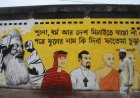
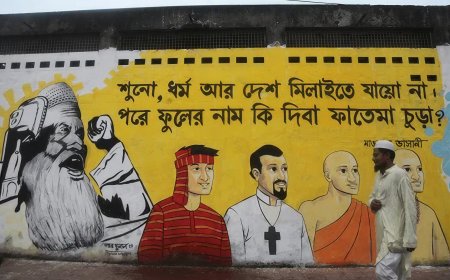
The Bengali nation is one of the largest in the world, a people of immense resilience and rich culture. Our greatness is not diminished by lifting up our smallest communities; it is defined by it. To stand with the Kol people today is to affirm the sentiment captured on a wall during the recent peoples uprising: "This country doesnt belong to any one group. It belongs to all of us".

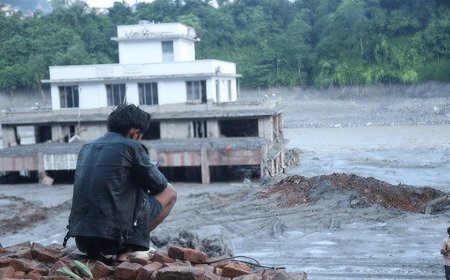
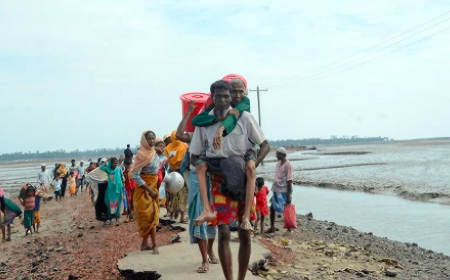
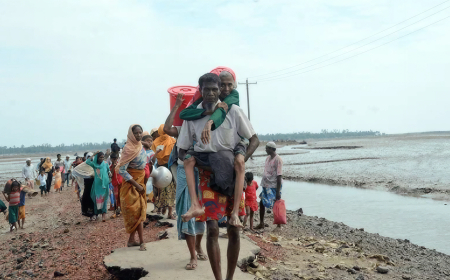
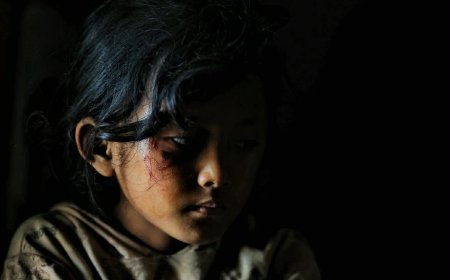
The scene resembles a quiet apocalypse, not one wrought by nature, but by human hands. The mud-brick and tin-roofed homes of the Kol community in Godagari, Rajshahi, have been deliberately reduced to rubble following a court-ordered eviction in October 2025. Families who had lived on the land for decades now huddle beneath a bamboo grove, stripped of shelter, food, and dignity.
Their displacement reflects a vulnerability that is not only immediate and physical, but also deeply symbolic of the precarious position of indigenous communities in Bangladesh. Their plight is a single, painful stanza in a much older, unresolved national epic -- a story about the chasm between the state and its smallest citizens, a story measured not in kilometers of bad road, but in the profound distance of perception, recognition, and respect.
This story is fuelled by a battle over words. In Bangladesh, the debate over whether to use "tribe," "ethnic minority," or "indigenous" (Adivasi) to define certain communities is an old one. It recently resurfaced when the word “Adivasi” was scrubbed from a textbook cover, sparking protests and alleged attacks on demonstrating students.
But for the Kol, this semantic quarrel is not academic; it is the very framework of their survival, determining whether they have a right to the land beneath their feet.
The Kol's Precarious Existence
The Kol people are not a mere statistic, though they have often been treated as one. For decades, they were statistically invisible, absent from the national censuses of 1991 and 2001. The 2022 census finally records their population at 3,822, a minuscule fraction of our nation, but a whole universe of unique culture and heritage.
Their recent eviction is a stark lesson in what happens when this statistical marginality becomes tangible peril.
The complexities of land ownership notwithstanding, the humanitarian crisis is unambiguous. Laws like Section 97 of the State Acquisition and Tenancy Act, designed to protect ethnic minorities from land alienation, appear to have been rendered meaningless. One is compelled to ask:
Did the Kol have access to legal aid?
Did they possess the means to navigate the labyrinthine bureaucracy required to defend their homes?
When the bulldozers arrived, were they armed with anything but a fading hope that the state would see them as citizens?
This is the true distance. It is the journey a Kol elder must undertake to a government office, only to be met with a wall of indifference. It is the gap between the constitutional promise of equality in Article 23A and the crushing reality of watching a lifetime’s shelter being torn down.
The Semantic Battlefield
To understand the Kols vulnerability, one must understand the national debate that casts a long shadow over them. For years, communities like the Santal, Garo, Marma, and Tripura have sought recognition as "Adivasi" or "indigenous peoples."
Their argument, as articulated by leaders like Gajendra Nath Mahato of the Bangladesh Indigenous Peoples Forum, is not a claim to being the "very first" inhabitants, a title many readily cede to the Austric ancestors of the Bengali people.
Instead, it is a claim to a distinct identity: unique languages, cultural systems, and a deep, spiritual connection to ancestral lands that has persisted for centuries.
They find resonance in the United Nations Declaration on the Rights of Indigenous Peoples (UNDRIP). While the declaration offers no strict definition, it outlines shared characteristics. For these communities, "indigenous" is an identity that connects them to a global framework of rights and protections.
The state, however, views the term with deep-seated apprehension. Officially, these groups are termed "Khudro Nrigosthi" or "Small Ethnic Groups." The government's long-standing position is that Bengalis are the true indigenous people of this land. The fear is that constitutional recognition of Adivasi status would automatically confer sweeping land rights and claims to self-determination, potentially fueling separatist sentiments, particularly in sensitive border regions like the Chittagong Hill Tracts.
The provisions in UNDRIP, emphasizing control over territories, protection from forced eviction, and the right to reclaim lost lands, are precisely what the state fears could challenge national sovereignty.
This is not an abstract philosophical debate but a hard-nosed geopolitical calculation. Consequently, the state remains firm: we are all equal citizens, and the constitution already protects the culture of "tribes and ethnic sects."
The Dilution of Identity
This political stalemate has concrete consequences. The Kol community, unlike those in the Chittagong Hill Tracts, does not benefit from specific regulations like the CHT Peace Accord. They are plains people, often falling through the cracks of a system that is supposed to protect them.
The governments recent move to amend the Small Ethnic Group Cultural Institute Act, 2010 to the Cultural Institution for Ethnic Diversity Act 2025 is a case in point.
Replacing "small ethnic group" with "ethnic diversity" may seem like a minor linguistic update, but it signifies a profound philosophical shift.
"Small ethnic group" acknowledges specific, rights-bearing communities. "Ethnic diversity" is a vague, celebratory concept that dilutes their historical and territorial claims, submerging their unique identity into a generic festival of variety.
It is a move from rights-based recognition to culture-based folklore.
Furthermore, when policies are debated in inter-ministerial meetings that exclude the physical presence and meaningful participation of the very people they affect, as was the case in a recent meeting on this act, the message is unequivocal: Your identity is ours to define, not yours to claim.
From Rubble to Reconciliation
The appeal, therefore, must extend beyond the immediate, urgent need to rehabilitate the displaced Kol families. It must call for a fundamental recalibration of the state’s approach.
First, the immediate humanitarian duty is clear. The state must not only ensure the Kol families are safely rehoused but also proactively and transparently re-investigate their land dispute. The legality of the claims against them must be scrutinized, and they must be provided with competent legal support to exercise their right to appeal. The UNOs visit is a start, but it must be the beginning of a process, not a public relations gesture.
Second, we must collectively urge a move beyond the paralyzing debate over terminology and toward the spirit of justice. The state should initiate a sincere, inclusive dialogue with all ethnic communities to understand what recognition truly means to them. The goal should be to enact robust, specific laws that explicitly protect their land from dispossession, their culture from erosion, and their future from uncertainty.
This is not about granting special status but about fulfilling the state’s constitutional duty to protect its most marginalized citizens.
The Bengali nation is one of the largest in the world, a people of immense resilience and rich culture. Our greatness is not diminished by lifting up our smallest communities; it is defined by it. To stand with the Kol people today is to affirm the sentiment captured on a wall during the recent peoples uprising: "This country doesnt belong to any one group. It belongs to all of us."
Acknowledging and empowering the first and most vulnerable threads in our national fabric is not a concession. It is our deepest constitutional and moral obligation. The rubble in Godagari is a test of our national character.
For the sake of all who call this land home, we must not be found wanting.
Nafew Sajed Joy is a Writer, Researcher and Environmentalist. Email: [email protected].