
































































What Zaima Said and Why It Matters
The most enduring line of her address may be her insistence that empowerment must reach homes, institutions, and mindsets simultaneously. This is not a comfortable demand. It implicates everyone.

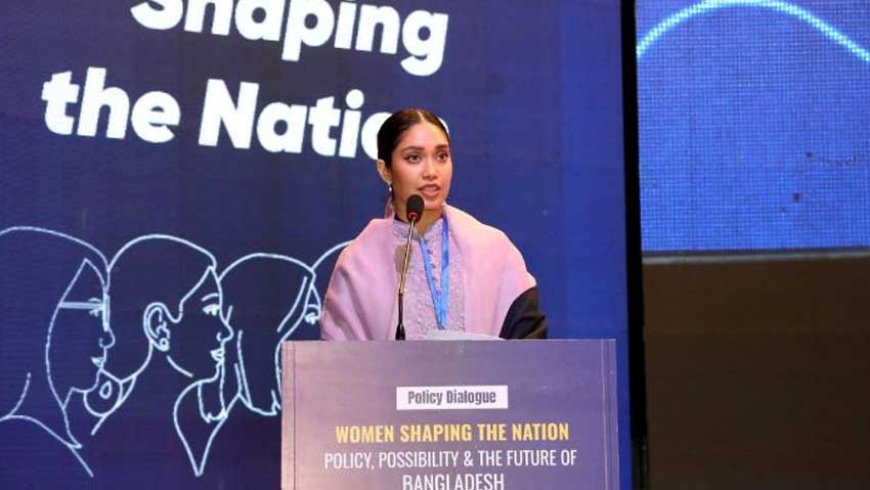
In a country where political speech is often reduced to slogans, counter-slogans, and inherited positions, Barrister Zaima Rahman’s first policy-level address in Bangladesh stood out not for its bombast but for its restraint.
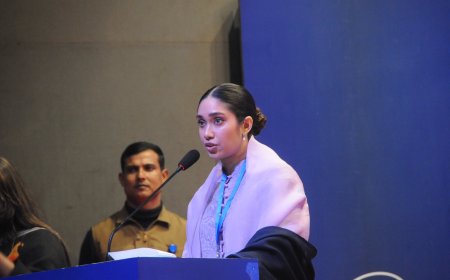
At a moment when political lineage often speaks louder than ideas, her speech at the Dhaka Forum dialogue on women’s empowerment carried an unusual mix of personal reflection, data-driven critique, and moral positioning.
It did not seek to dazzle, nor did it attempt to prematurely claim authority. Instead, it asked an older and more uncomfortable question. What does empowerment actually mean when laws exist but lives remain unequal?
Zaima Rahman returned to Bangladesh after 17 years of absence not as a triumphant heir making a political debut, but as a listener attempting to situate herself within a society she acknowledges she once understood imperfectly. That acknowledgement matters.
In Bangladeshi politics, self-awareness is often treated as weakness, yet her admission of a “skewed understanding of society” due to privilege served as the intellectual entry point of her speech. It allowed her to speak about women’s empowerment without resorting to abstraction or performative solidarity.
What distinguished her address was not simply its content but its framing. Rather than starting with policy prescriptions or ideological declarations, she began at home. Homes, she argued, are the first classrooms where gender norms are learned long before the state intervenes with laws or programmes.
This is not a novel argument globally, but in Bangladesh it carries particular weight. For decades, empowerment discourse here has been overwhelmingly institutional, measured by enrolment rates, stipends, quotas, and legal reforms.
Zaima Rahman did not reject these gains. She acknowledged them as necessary. But she pointed out their fragility when social expectations remain unchanged.
Her invocation of family legacy could easily have descended into self-congratulation. Instead, it functioned as a case study. By describing a household where women’s leadership was never questioned and where men actively enabled rather than merely tolerated female ambition, she illustrated how empowerment becomes sustainable only when it is normalized privately before being enforced publicly.
The examples of her mother’s medical career, her grandmother’s early grassroots activism, and her grandfather’s institutional decisions were not presented as exceptional feats but as outcomes of belief translated into action.
This distinction between belief and action became the moral spine of her speech. Bangladesh has no shortage of rhetorical commitment to women’s rights. From constitutional guarantees to national development plans, gender equality appears repeatedly on paper.
Yet Zaima Rahman’s intervention was to show how inequality survives comfortably not through overt discrimination but through habit.
Women perform the overwhelming majority of unpaid care work. Their labour, though economically valuable, remains invisible. Their participation in the formal economy stalls not because of lack of competence but because the system assumes their sacrifice.
These observations were not framed as feminist grievance but as national concern. When she said that gender equality is not a women’s issue but an economic one, she moved the conversation away from moral obligation toward structural consequence.
A country that sidelines half its population through exhaustion cannot compete, cannot innovate, and cannot claim sustainable development. This framing matters in a political culture that often dismisses gender justice as secondary or symbolic.
Equally significant was her emphasis on men, particularly fathers. In Bangladeshi public discourse, responsibility for empowerment is often placed almost entirely on women. Women must be resilient, adaptive, patient, and strong. Zaima Rahman challenged this expectation quietly but firmly.
Resilience, she reminded the audience, is not empowerment when it is endlessly demanded. This line cut through decades of celebratory narratives that praise women for surviving adversity without questioning why adversity remains their default condition.
Her address also confronted a form of inequality that remains politically under-discussed despite its prevalence: Harassment and hostility faced by women in public life, particularly online.
The statistic she cited on online harassment was not presented as an isolated digital problem but as part of a broader ecosystem that discourages women from remaining visible, vocal, and influential.
In a country where public life is increasingly mediated through social media, this is not a peripheral issue. It is central to democratic participation.
Yet the speech was not without its tensions. Zaima Rahman spoke from a position of undeniable privilege, and she acknowledged it. Still, the challenge ahead lies in whether this acknowledgement can translate into political advocacy that addresses structural inequities beyond discourse.
Appreciation of unpaid labour, for example, requires policy imagination that goes beyond recognition. Childcare systems, parental leave reform, workplace flexibility, and redistribution of care responsibilities are deeply political questions. They demand confrontation with entrenched interests, not merely cultural persuasion.
What made her speech politically significant was not that it offered solutions, but that it refused to pretend that solutions are simple. She explicitly stated that she does not have answers to every question. In a political environment saturated with absolute certainty, this humility is rare.
It positions her not as a ready-made leader but as a participant in a collective process. Whether Bangladeshi politics will allow such a position to survive remains an open question.
Her return also carries symbolic weight beyond gender discourse. For a generation shaped by exile, absence, and inherited conflict, Zaima Rahman’s re-entry into public life reflects a broader question facing Bangladesh’s political future.
Can new voices within old political families reshape narratives without replicating the same hierarchies? Can legacy be interrogated rather than merely inherited?
At this early stage, her speech suggests an attempt to do precisely that. She neither disowned her lineage nor hid behind it. Instead, she treated it as responsibility rather than entitlement.
That distinction may ultimately determine whether her public engagement deepens into meaningful political contribution or remains confined to well-received forums.
The most enduring line of her address may be her insistence that empowerment must reach homes, institutions, and mindsets simultaneously. This is not a comfortable demand. It implicates everyone. It removes the convenience of blaming policy failure alone and forces society to examine its everyday practices. That is precisely why it matters.
In a country navigating political uncertainty, economic pressure, and social transition, Zaima Rahman’s first policy-level speech did not promise transformation. It offered something quieter and arguably more difficult: Reflection coupled with responsibility.
Whether that reflection can evolve into action will depend not only on her choices but on whether Bangladesh is prepared to listen to uncomfortable truths delivered without theatrics.
For now, her intervention stands as a reminder that progress is not sustained by symbolic success stories or inherited authority, but by the willingness to question what has long been considered normal. That, perhaps, is where real empowerment begins.
H. M. Nazmul Alam is an Academic, Journalist, and Political Analyst based in Dhaka, Bangladesh. Currently he teaches at IUBAT.