























![A Ledger of the Soul: Navigating the Allah-Bhagavant Nexus in a 19th-Century Puruṣākāra Jñāna Caupara [Gyan Chauper]](https://counterpointbd.com/uploads/images/202608/image_430x256_6a93baa3b09a7.jpg)




















Five factors that helped the BJP conquer Bengal
The Bharatiya Janata Party has secured a two-thirds majority in the state that it has never won before.

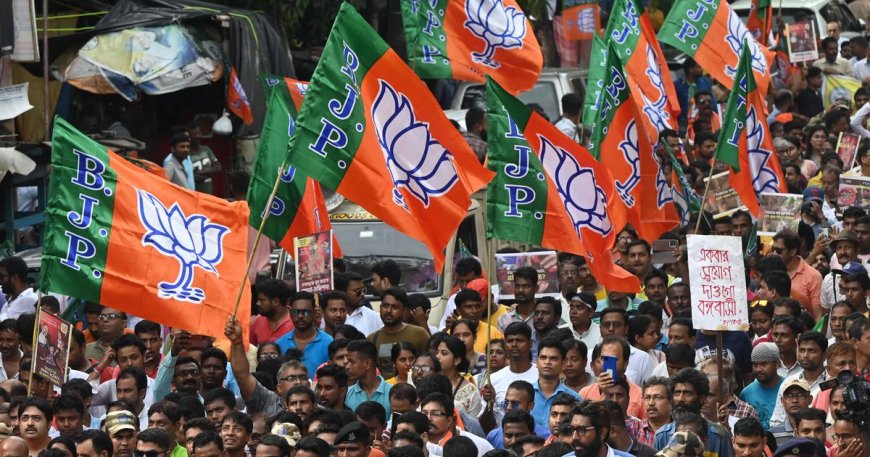
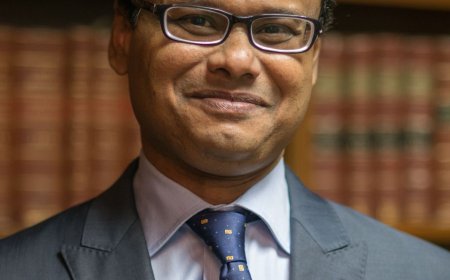
“She [Mamata Banerjee] is trying to divide the Hindu vote,” Rahul Sinha complained while talking to Scroll in July. The former president of the Bharatiya Janata Party in West Bengal had taken issue with Chief Minister Mamata Banerjee constructing a Jagannath temple in the beach town of Digha. “We have to make sure that the Hindu vote does not split.”
Sinha’s complaint underscored the problem the Hindutva party faced in the state: Despite all its efforts to consolidate Hindu voters behind itself, the BJP still trailed Banerjee’s Trinamool Congress by a handsome margin in the 2021 Assembly elections. The Trinamool had secured 48% of all the votes polled in Bengal then, finishing a solid 10 percentage points ahead of the BJP.
The Hindutva party could defeat the Trinamool, Sinha said, only if it ensured that more than 5% of the state’s voters switch their loyalty from Banerjee to itself. These extra votes would have to come from Hindus, he explained, because Muslims don’t vote for the BJP. But there was one other way to win Bengal, according to him.
“Minus joto hobe, amar plus er dorkar kom hobe,” the veteran Hindutva politician noted as he brought up the special intensive revision of the voter rolls. The more names that are removed from the voter list, the fewer votes we will need to win.
The Election Commission was conducting the SIR in Bihar at the time. In the months that followed, it rolled out its plans to conduct the exercise in several other parts of India, including West Bengal. The contentious revision process led to the deletion of about 91 lakh names from the Bengal voter rolls, shrinking them by 12%.
The results coming in on Monday show that what Sinha had wished for has come true. The BJP has finished with a 46% vote share. That is a whopping eight percentage point swing from the Trinamool, whose vote share is about 40%. This mean that nearly one in six Trinamool voters have voted for the BJP this time.
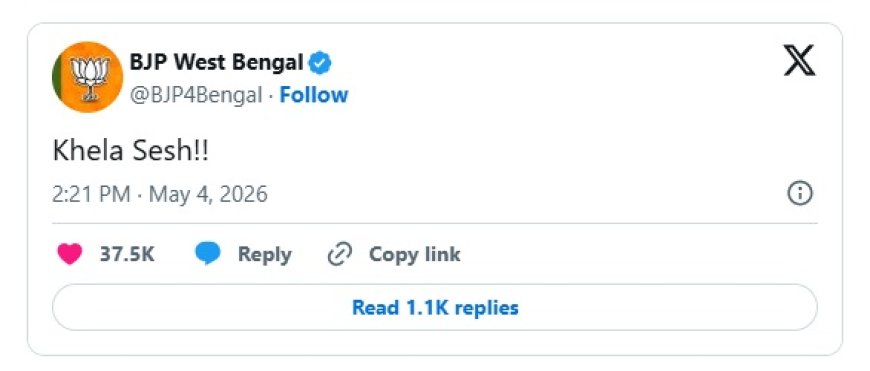
The BJP's West Bengal unit posted this message on social media after Monday's results. 'Khela Sesh' means 'Game Over' in Bangla.
In terms of seats, as of 2 am on Tuesday, the BJP had won 206 of West Bengal’s 294 Assembly constituencies. Many of these are seats it has never won before and where the number of voters deleted during the SIR far exceeds its margin of victory. Clearly, the SIR has proved to be a deciding factor in these elections. Here are four other factors that helped the BJP clinch its first-ever victory in Bengal:
1. Communal polarization
BJP bigwigs such as Sinha have long claimed that West Bengal’s voter rolls needed to be revised because they had “one crore Muslims from Bangladesh” on them. When Banerjee and her party opposed this demands, the BJP attacked them for playing vote-bank politics.
The charge is not exactly new. But efforts to label Banerjee as a leader of the Muslims have not found success in the past. She continued to receive considerable support from Hindu women because of her cash-transfer schemes, for instance.
However, the SIR tipped the scales, leading to unprecedented religious polarisation in West Bengal. Hindutva votaries sought to drum up support for the exercise by conjuring up the ghost of demographic change. If the voter rolls are not purged clean, they claimed, Muslims would soon outnumber Hindus in the state. Muslims make up about 27% of the state’s population, according to the 2011 census.
As irrational as the fear of demographic change may appear, it found purchase in Bengal. In January, Scroll had reported that even Hindus who had to queue up and establish their bona fides as voters because of the SIR voiced support for the exercise.
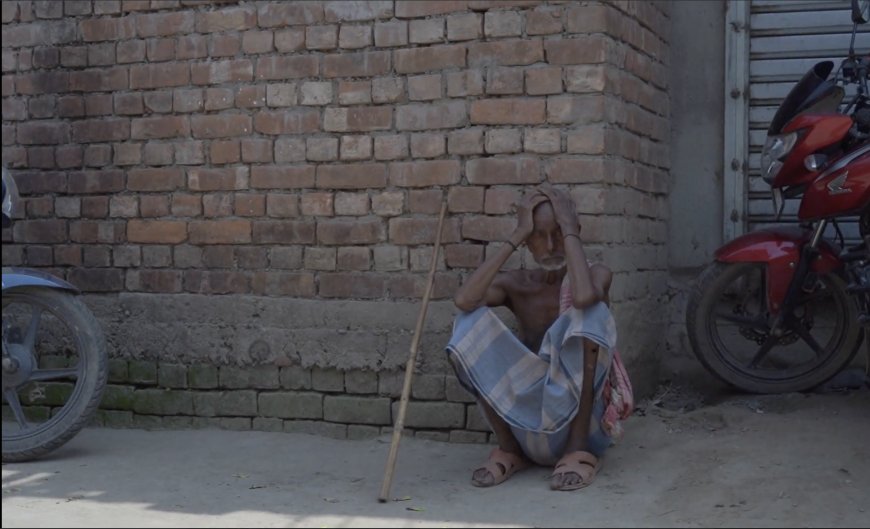
A Muslim resident of West Bengal. Credit: Kritika Pant
Banerjee opposed the voter roll revision tooth and nail in the streets of Bengal as well as in the Supreme Court. Still, the SIR went on and lakhs of people in the state, many of whom are Muslims, saw their names being deleted from the rolls. In Malda and Murshidabad, Scroll found that Banerjee’s opposition to the SIR had won her the support of Muslim voters.
But the BJP, in turn, used that to consolidate Hindu support for itself. “We Hindus should give up our pseudo secularism and learn from the Muslims,” Sharadwat Mukopadhyay, the Hindutva party’s candidate from the Bidhannagar seat, had said to Scroll during the campaign. “We should also vote like them.”
2. Shedding the outsider image
Sharadwat Mukhopadhyay beat Sujit Bose, a minister in the outgoing West Bengal government and a three-term MLA from the seat. Well before he pulled off this upset, though, he had shot to national fame by going around his constituency lugging around a big catla fish.
He was not the only BJP candidate to do so. A host of Hindutva party hopefuls adopted inventive methods in response to the Trinamool’s accusation that the outfit was full of so-called outsiders who did not respect Bengali culture. Prime Minister Narendra Modi, too, put out a video of himself eating jhalmuri at a streetside shop in Jhargram.
Crucially, the BJP’s tactics on this front went beyond food. In 2021, it had deputed Hindi belt politicians such as Kailash Vijayvargiya to manage its campaign in Bengal, giving credence to the Trinamool charge against it. This time, it put state-level leaders such as Samik Bhattacharya and Suvendu Adhikari at the forefront.
The BJP also sought to turn the tables by attacking the Trinamool for picking non-Bengalis to represent the state in the Rajya Sabha. This helped it take the edge off what its opponent was saying.
The Trinamool, on the other hand, had few new things to say. Months ago, it had tried to make an issue out of Modi addressing 19th-century writer Bankim Chandra Chatterjee as Bankim-da instead of using the Bengali honorific “babu” during a debate in Parliament. But the controversy blew over rather quickly.
3. Good old anti-incumbency
Part of the reason why the Trinamool struggled to set the agenda for these elections is that anti-incumbency had been building up against it for a while.
Mamata Banerjee has served as chief minister for 15 years. During this period, she has rarely faced protests as strong as those that were staged all around West Bengal after the RG Kar rape-and-murder case in 2024.
While it was primarily left-wing activists who had hit the streets then, the BJP emerged as the ultimate beneficiary. It fielded Ratna Debnath, the mother of the RG Kar victim, from the Panihati seat. She has now become a first-time MLA.
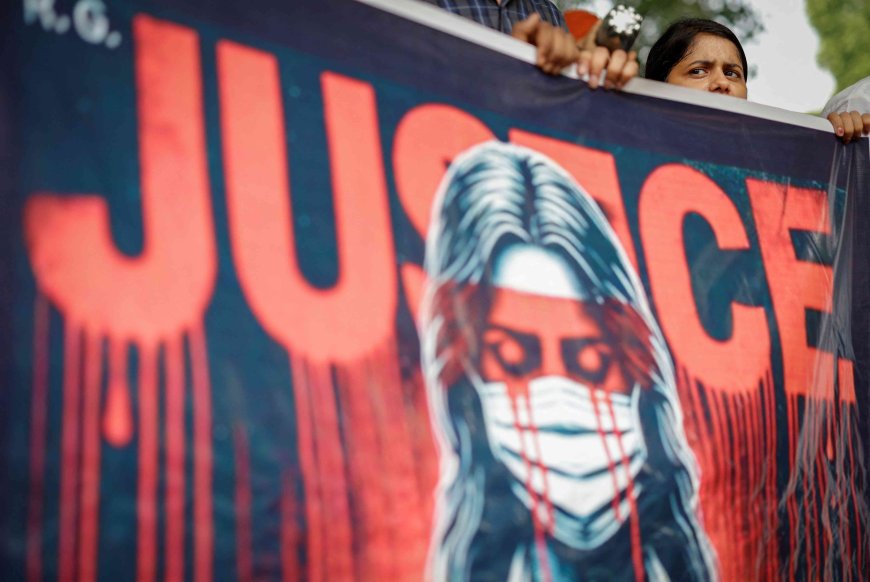
A doctor holding a banner during the RG Kar protests. Credit: Adnan Abidi/Reuters
The RG Kar protests are but one example of how the BJP channelled the mood against the Trinamool. As elections drew closer, it toned down its Hindutva rhetoric and prioritised bread-and-butter issues in its messaging. To do so, it borrowed from Banerjee’s own playbook, echoing her calls for poriborton, change in West Bengal.
In the run-up to the 2011 Assembly elections in the state, when Banerjee first rose to power, she too had asked voters to back poriborton or change after 34 years of Left rule. Now, BJP candidates said in speech after speech, the people of Bengal ought to give their party five years as well.
The BJP also made a concerted outreach for Left votes, asking those sympathetic to the communist parties to support it instead of letting their votes supposedly go to waste. Sujan Chakraborty, a senior leader of the Communist Party of India (Marxist), suggested that this tactic may have worked with some of his party’s voters.
“When people vote with the intention of defeating the Trinamool, the BJP benefits,” he told Scroll on the day that voting concluded in Bengal.
4. Centre’s powers
An understated factor that helps political parties attract voters that are otherwise not its traditional supporters is winnability. That is because many voters are averse to voting for parties that are not seen to have a real shot at power.
As the ruling party at the Centre, the BJP used its control over investigative agencies and security forces to give voters the impression that its victory in Bengal was inevitable.
For example, the Enforcement Directorate carried out multiple raids against the Indian Political Action Committee, or I-PAC, which manages the Trinamool’s election campaigns. The political consultancy firm was badly hit and sent many employees on a 20-day leave just ahead of the first phase of the elections.
Even before that, the Election Commission had transferred 483 West Bengal government officials after the model code of conduct came into effect, according to a Hindustan Times report. The number of transfers in other states and union territories headed for polls was merely 23. This signalled to voters that the Trinamool’s hold over the bureaucracy in Bengal had been broken.
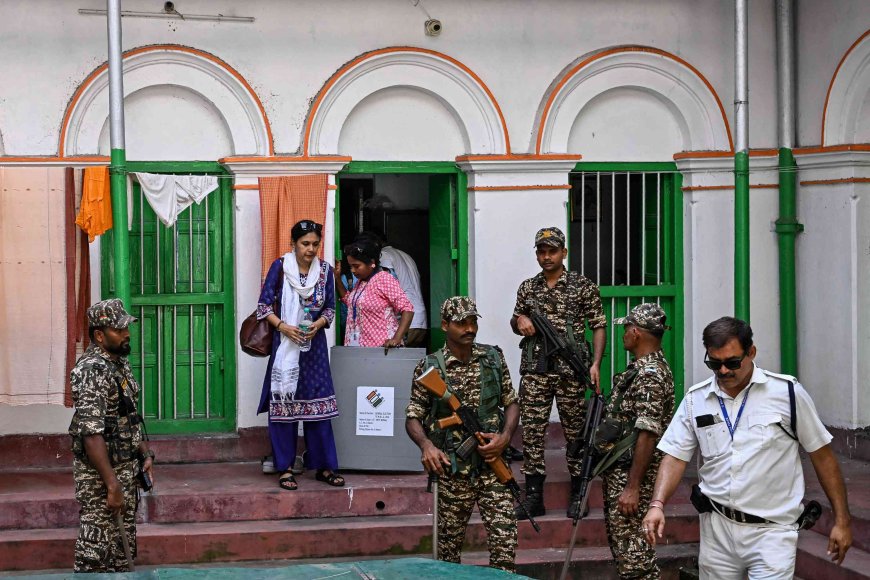
Security personnel and polling officials in Kolkata on April 23, 2026. Credit: Dibyangshu Sarkar/AFP
Similarly, the deployment of an extraordinarily large number of security forces in the state also seems to have worked in the BJP’s favour. One of the problems identified by Sinha, the BJP old hand quoted at the start of this piece, was that many Hindu voters who could vote for his party did not turn up at the polling station.
This, he explained, was out of the fear that local Trinamool strongmen would supposedly hurt them if they showed up to vote. The high voter turnout in Bengal suggests that the heavy security presence may have neutralised this.
This article was originally published in Scroll. It has been republished through special arrangement.