























































The House That Divides Us: Building a Nation from the Rubble of Victory
BNP has to govern not merely as the winner of an election but as the steward of a divided nation. Jamaat-e-Islami has to act as a parliamentary opposition, not as a liberation war revision society. The international community has to support democratic consolidation, not strategic alignment.
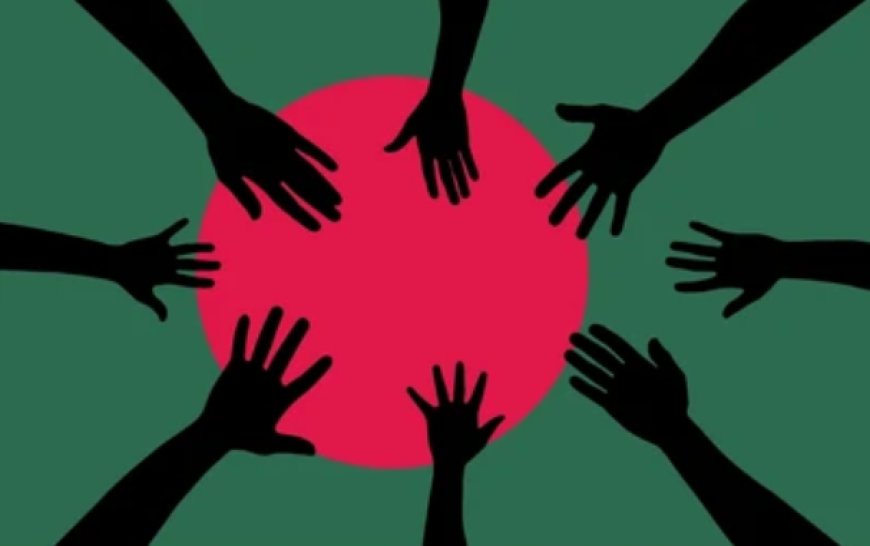
The sound, this time, is not the roar of the crowd. It is the whisper of ticker-tape swept into Dhaka’s gutters. The floodlights of the victory stages have dimmed; the convoys of smiling candidates have retreated behind closed gates. In the morning after the 13th parliamentary election, a strange, heavy silence has settled over Bangladesh -- not the silence of peace, but the silence of a country holding its breath.
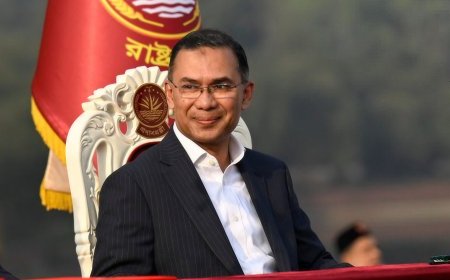
The Bangladesh Nationalist Party has claimed a two-thirds majority, its acting chairman Tarique Rahman receiving congratulations from New Delhi to Kuala Lumpur. The Jamaat-e-Islami-led bloc has secured an estimated 76 seats, planting its Scales symbol firmly in the fertile soil of Rangpur, where it swept five of six constituencies.
And beside the ballots, a second question was answered: 68 percent of voters endorsed the Implementation Order of the July Charter, a referendum that is now legally binding on the government that takes the oath.
We celebrated the fall of a government. We have not yet built a state.
In the weeks before this election, I wrote of Professor Rehman Sobhan’s call for a functional parliament -- the first room, the chamber of return, where enemies might learn to become adversaries.
That room now stands before us, its doors open, its seats waiting. But the question is no longer will you enter? It is what constitution will you write once you are inside?
The Empty Chair and the Unfinished War
Let us begin with what is missing.
The Awami League, the party that led the nation to liberation and governed it for sixteen of the last seventeen years, has been barred from the ballot. Millions of Bangladeshis who voted for that party for decades have not been erased from the electorate; they simply found no symbol of their choice on the paper.
Democracy is not merely the right to say yes or no to a single slate. It is the right to choose who asks the question.
Here we encounter the enduring grip of Carl Schmitt on our political imagination. The German theorist defined the political as the capacity to distinguish friend from enemy. For decades, we have governed ourselves accordingly.
The opponent is not a rival with a competing vision of the national good; they are an existential threat to be neutralized, excluded, driven into the wilderness.
The BNP knows this wilderness intimately; it spent 15 years in it. Now it holds the map, and the question is whether it will lead itself out -- or lock the gate behind it. A functional parliament cannot be built with 300 seats and the silence of millions of voices.
The BNP must decide: Will it legislate as though the Awami League does not exist, or will it acknowledge that legitimacy, in Max Weber’s formulation, depends not merely on legal power but on the belief in that power as rightful?
A government that governs only for its own voters governs only half the country.
The Charter and the Scales
And then there is the July Charter. The referendum has spoken: 68% yes. But what, exactly, did we say yes to?
The Implementation Order voters approved is a remarkable document -- not because it answers questions, but because it frames them. Forty seven of the Charter’s 84 recommendations require constitutional amendment.
A bicameral parliament, a restored caretaker government, a prime ministerial term limit of ten years, enhanced presidential authority in appointments -- these are not minor adjustments. They are a new architecture for the republic.
Yet the BNP has already filed a formal note of dissent on the caretaker government selection mechanism, proposing instead a simple parliamentary majority vote. Three Islamist parties formally objected to the women’s candidate quota; in any case, fewer than 2.5% of candidates in this election were women, far short of the 5% threshold the Charter itself demands. The Charter states that the winning party shall implement 30 agreed reforms.
But when the winning party disagrees with the mechanism, who arbitrates?
This is the paradox of the binding referendum. It binds everyone, but it persuades no one. The Jamaat-led bloc, which holds 76 seats, did not campaign on the Charter. Its voters did not flock to the polls to endorse term limits or senates; they voted for the Scales. Now the Scales sit in opposition, holding a veto over the very constitutional amendments the government must pass.
We have asked a nation to approve a blueprint it has not debated, and we have asked a parliament to implement a contract its largest minority party did not sign.
The Sovereignty Trap
If the domestic architecture is uncertain, the foreign terrain is already mined.
In the quiet corridors of Washington, during the interregnum of the interim government, an agreement was signed. It was presented as a reciprocal trade pact, a shield against punitive tariffs. But the fine print, analyzed with forensic clarity by analysts, reveals something closer to a strategic lock-in.
Bangladesh must facilitate the purchase of fourteen Boeing aircraft. It must pursue 15 billion dollars in long-term LNG contracts. It must align its export controls with United States security measures against third countries.
It may not purchase nuclear reactors or fuel rods from any nation that jeopardizes essential US interests -- a clause that casts a long shadow over Rooppur and any future Russian or Chinese energy partnership.
Digital data generated by 175 million Bangladeshis flows freely across borders without meaningful restriction, while Dhaka is prohibited from imposing customs duties on electronic transmissions.
This is not free trade. It is managed trade, and it was negotiated by an unelected administration with no electoral mandate. The BNP now inherits this architecture. It can comply and accept constrained autonomy.
It can challenge provisions and risk economic retaliation. Or it can attempt to renegotiate -- a path that requires both diplomatic skill and a clear mandate from the people who elected it. The party that campaigned on reviewing unequal treaties must now decide whether the treaty it reviews is one its own predecessor signed.
The Burning and the Healing
Yet constitutions and trade deals, however vital, do not capture the full weight of this moment. For that, we must look not to the parliament building but to a tree in Mymensingh.
On December 18, 2025, Dipu Chandra Das was beaten by a mob, hanged from a tree, and set on fire. His crime, according to his killers, was an insulting remark. The interim government responded with speed and administrative efficiency: 25 lakh taka for a permanent home, 10 lakh in cash to his father and wife, a 5 lakh fixed deposit for his child.
The education adviser called the killing a shame for the entire nation. Twelve individuals have been arrested. But justice is not a sum of money. Compensation does not restore the soul of a community.
Dipu Das was not killed by 12 men; he was killed by a climate of impunity, by the slow erosion of the idea that all citizens, regardless of faith, possess equal claim to the protection of the state.
And Dipu Das was not alone. Through the interim period, the destruction continued. In December, an angry mob wielding excavators tore at the remaining walls of Dhanmondi 32, the house where Bangabandhu Sheikh Mujibur Rahman lived and died. It was the third such attack. The building was already a ruin; the mob simply completed the work. They set fire to a poster of Sheikh Hasina. They chanted Boycott India.
We cannot have a Parliament of Return if minorities fear they will not return home safely. We cannot build a tolerant society if the shrines of our saints -- the physical inheritance of seven hundred years of syncretic Bengaliness -- are desecrated while the state looks elsewhere. Economic prosperity is meaningless without physical security. Constitutional reform is hollow without cultural reconciliation.
The Frozen Verdict
And what of the wounds that predate this transition?
On Bangabandhu Avenue, on August 21, 2004, the Awami League gathered for a rally. Grenades rained down. Twenty four people died. Sheikh Hasina survived, her hearing damaged, her party decimated. The subsequent trial, conducted over 14 years, convicted nineteen people, sentenced 19 others to life, and named Tarique Rahman among the accused in absentia.
On December 1, 2024, the High Court acquitted all forty-nine convicts, ruling the trial flawed and the supplementary charge sheet improperly filed. The government appealed. On September 4, 2026 -- less than seven months from now -- the Appellate Division will deliver its verdict.
This is the frozen heart of our unresolved history. You cannot build a democracy on the cold storage of mass murder. You cannot ask the victims of one era to accept the acquittal of their killers while the victims of the next era demand the extradition of theirs. Justice is not a partisan instrument; it is the baseline of social trust.
The BNP now holds the apparatus of prosecution. It must decide: Will it pursue the appeal, or will it allow the acquittal to stand? Will it seek to bring Sheikh Hasina back from New Delhi -- politically explosive, domestically destabilizing -- or will it permit her continued exile as the least damaging option? There is no clean choice.
There is only the responsibility of power.
The House That Divides Us
I return, at the end, to the room.
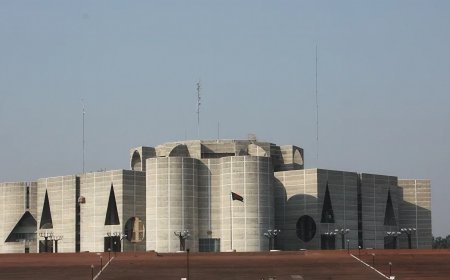
The Jatiya Sangsad Bhaban stands on schedule. Its chambers are prepared. Its committees await their chairs. The architecture for democratic repair exists, embodied in stone and glass. What is missing is not a blueprint but a choice.
A bicameral parliament is a house with many rooms. If we lock the door to the Awami League room, if we brick up the windows of the secularists, if we soundproof the chamber of the minorities and the opposition, the house will not be quiet. It will be haunted. The ghosts of 1971, of 2004, of 2024, of 2025, of every lynching and every demolished shrine and every frozen case file -- they do not require a vote to take their seats.
We asked our leaders to enter the first room. They have arrived. The question now is whether they will furnish it as a home for all of us, or whether they will simply redecorate the prison.
Professor Sobhan lit a path with his cautious optimism. He pointed away from the dazzling spectacle of referendums and toward the grounded, difficult work of legislative debate.
That work now begins. It requires the BNP to govern not merely as the winner of an election but as the steward of a divided nation. It requires Jamaat-e-Islami to act as a parliamentary opposition, not as a liberation war revision society. It requires the international community to support democratic consolidation, not strategic alignment.
And it requires us -- citizens, voters, survivors -- to demand more from our democracy than the rotation of which party wields the monopoly of legitimate force.
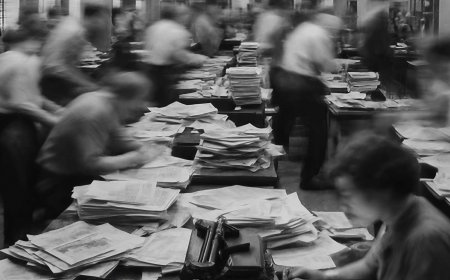
The sound builds once more. Not the roar of the rally, but the low hum of deliberation. The shuffle of papers. The murmur of committee hearings. The voice of the opposition, recognized by the Speaker.
This is the sound of a nation arguing with itself to find a way forward. It is the sound we have avoided for forty-five years. It is the sound we can no longer live without.
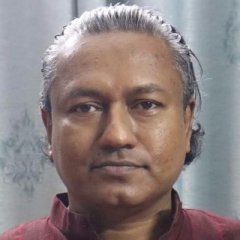
Zakir Kibria is a Bangladeshi writer, policy analyst and entrepreneur based in Kathmandu, Nepal. His email address is [email protected].