







































![A Ledger of the Soul: Navigating the Allah-Bhagavant Nexus in a 19th-Century Puruṣākāra Jñāna Caupara [Gyan Chauper]](https://counterpointbd.com/uploads/images/202608/image_430x256_6a93baa3b09a7.jpg)





















Is Jamaat Coming?
Arithmetic still points to a BNP-led alliance winning, with a Jamaat-led alliance more likely to land as the principal opposition. The caveat is that Bangladesh has not had credible elections since 2008, so any confident prediction about voting behaviour is just that: An informed forecast, not a guarantee.
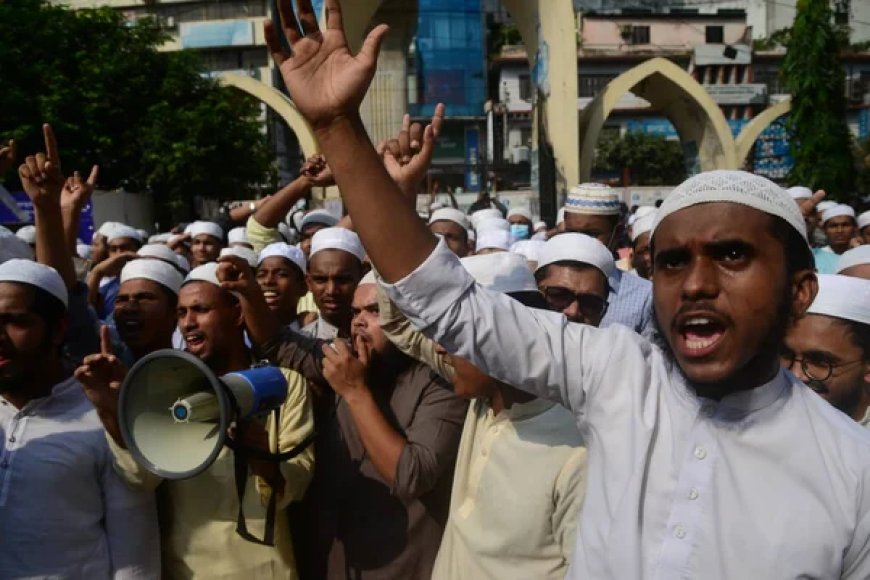
Bangladesh’s first-past-the-post system sets a high bar for Jamaat and, by extension, its coalition partners. Even though Jamaat is poised to secure a popular vote share far higher than at any point in its electoral history, converting that support into a parliamentary majority will be difficult.
The BNP and its allies, however, should neither grow complacent nor take comfort in the neatness of that arithmetic. Voters have a habit of crushing forecasts.
Irrespective of where one sits on the political spectrum, one question has moved from gossip to serious analysis: Whether the 2024 mass uprising has created an opening for what would have seemed unthinkable even a couple of years ago.
The idea, if not yet the likelihood, of a Jamaat-led alliance winning enough seats to form a government has become a live and unavoidable topic. A party that opposed the very birth of the nation it now seeks to govern has, as many infer, cast its webs within the interim government and now sits closer to the levers of state power, and to the electoral preparedness that follows from it, than at any point in its history.
That proximity feels closer than most would have anticipated when the AL regime was ousted.
Campus Victories No Proxy
Jamaat’s advantage right now is momentum. After August 2024, it began claiming ownership of mobilizing a large share of the ground force that helped sustain street agitation against Sheikh Hasina’s regime. In the period that followed, coalitions aligned with Jamaat’s student wing, Shibir, won thumping victories in a series of university student-body elections.
Those results point to two dynamics. First, Shibir-aligned candidates gained support by campaigning on social welfare issues. Second, an anti-establishment, anti-hegemonic, and anti-Indian mood has taken hold among younger voters and is increasingly being directed at the BNP.
Shibir, despite facing a plethora of challenges in conducting open politics during the AL era, remained active under the radar over the past decade, continuing to socialize its philosophy and recruit talent via well-planned, strategic outreach outside the full glare of public view.
Campus victories, however, do not translate cleanly into similar parliamentary outcomes for a simple arithmetic reason: A student-body election aggregates students from across Bangladesh into one electorate within one institution. In a national election, that same population is distributed across many constituencies.
Dhaka University has approximately 45,000 students. Even if a significant plurality of those students lean in the same direction and vote for Jamaat, those votes do not appear in one geographic location on election day. They disperse across the map, diluting their impact in any single constituency and increasing the risk of vote-splitting.
Wins in student-body elections should not be ignored, but they are best read as an indicator of evolving preferences among educated youth rather than as a guarantee of a Jamaat victory.
Two-Track Communications Strategy
Another factor working in Jamaat’s favour has been its campaign execution. Jamaat began organizing its campaign workers earlier than the BNP and, in many constituencies, has done so with stronger coordination between its Dhaka-based leadership and the grassroots.
The most notable development has been the mobilization of Jamaat’s women’s wing, alongside a door-to-door outreach push aimed at persuading women voters to support the party.
That is a clever strategy in retail politics, one that is likely to increase both support and turnout, particularly among undecided and swing voters. It also targets a voting bloc Jamaat has historically treated as an afterthought: Women, who make up roughly 50 percent of the electorate.
In urban settings, Jamaat has avoided Islamist rhetoric and instead positioned itself as a better alternative to the BNP: Less entangled in extortion, more serious about tackling corruption, and ideologically more moderate than in the past, claiming that it can operate within the confines of a liberal democracy while being non-committal on whether it wants to establish Shariah law.
In rural areas, Jamaat has tapped into overt Islamist appeals, promising Islamic morality in society and suggesting that voting for Jamaat carries spiritual reward. This dual communications strategy amounts to two distinct sales pitches aimed at two voter profiles.
Deceptive and immoral: Yes. Strategic and intentional: Undeniably.
One pitch targets educated and politically engaged voters and asks for support on the basis of governance competence and administrative aptitude, presenting Jamaat as a custodian of the spirit of the mass uprising and, as such, better positioned to reform a broken state apparatus.
The other targets voters more receptive to Islamic doctrine or Shariah law and asks for support as a matter of religious duty, treating Islam not as a private matter of faith but as a governing answer to social problems framed, at their core, as moral.
Social-media campaigning has become the other pillar of this cycle. Jamaat’s digital network has been operating with intent and at scale. It has circulated short, emotionally charged clips anchored in anti-Indian messaging, pushed half-truths to brand the BNP as anti-reform, and framed Jamaat as an ethically honest institution.
That same apparatus has been working round the clock to normalize misinformation and disinformation through bot armies, fake photo cards, and narrative flooding, making it harder to separate verified information from propaganda in a digitally illiterate society.
A consequence has been a disconnect between Jamaat’s leadership, which is mostly measured and restrained in public, and a broad segment of supporters online and on the ground that adopts a more hostile posture. That hostility surfaces through religious gatekeeping and open confrontation with Bengali culture, as well as with those advancing secular or progressive ideas of society.
First-Past-the-Post System
Recent polling has fueled a public perception that Jamaat has a path to winning enough seats to form government, though surveys in Bangladesh face four practical constraints.
First, polling teams cannot reliably reach many communities.
Second, samples skew toward easier-to-access urban and digitally connected voters in a country where internet penetration stands at about 47 percent.
Third, respondents do not always answer candidly.
Fourth, at times, the incentives or political leanings of survey organizers shape what is asked, how it is asked, and what is ultimately published.
Read collectively rather than in isolation, surveys have placed support for Jamaat and the BNP closer than many expected, with the BNP typically ahead by one to two percentage points in national popular vote share.
These are point-in-time readings, not political projections, but the consistency of the signal is enough to puncture the idea that the BNP should take victory as a given. Jamaat appears to hold a reasonable edge among younger voters, a trend the BNP cannot afford to dismiss.
Jamaat’s biggest obstacle remains the first-past-the-post system. Each of the 300 constituencies elects one MP, and the seat goes to whoever gets the most votes, even if the margin is razor thin. The national vote share does not convert into seats in a proportional way.
A party whose support is spread efficiently across many constituencies can win a disproportionate number of seats with slim victories, while another can post a strong national vote share and still win far fewer seats if its support is uneven across the country, concentrated in a limited set of areas, or repeatedly finishes second.
The three most credible elections in Bangladeshi history illustrate the point.
In 1991, the BNP won 30.81 percent of the popular vote and secured 140 of 300 seats, while the AL won 30.08 percent and secured 88 seats. A margin of just 0.73 percentage points in national vote share produced a 52-seat gap in Parliament.
In 1996, the AL won 37.44 percent of the vote and 146 seats, while the BNP won 33.63 percent and 116 seats. A 3.81 percentage point margin became a 30-seat difference.
In 2001, the BNP won 40.97 percent of the vote and 193 seats, while the AL won 40.13 percent and just 62 seats. A margin of 0.84 percentage points translated into a 131-seat advantage.
Arithmetic still points, writ large, to a BNP-led alliance as the front-runner for the largest bloc in Parliament, with a Jamaat-led alliance more likely to land as the principal opposition. The caveat is that Bangladesh has not had credible elections since 2008, so any confident prediction about voting behaviour is just that: An informed forecast, not a guarantee of reality.
The 1991 Precedent
A large share of the electorate, including millions of first-time voters, will be making decisions in an environment defined by a mass uprising and the brutal killing of at least 1,400 citizens.
Many still cite the BNP’s unexpected victory in the 1991 election as a case study in how perception and reality can diverge. The election took place after the political uprising that toppled General HM Ershad’s autocratic regime. The AL expected to win, and most observers expected it, too.
Even then, the popularity gap analysts perceived between the AL and the BNP was narrower than the gap most experts now assume separates the BNP from Jamaat.
Social media muddies today’s picture. If online discourse is treated as a rough proxy for popular support, it can make Jamaat look as if it is outpacing the BNP, even though most conventional analysis still puts the BNP ahead.
The BNP’s winning formula in 1991 was Begum Khaleda Zia. Her individual popularity, built through the anti-Ershad movement of the 1980s, gave the party a wave it could ride. Jamaat does not have a Begum Zia to personify its appeal, and that remains a crucial constraint.
Currently, the BNP has two advantages that reinforce each other: Sympathy after Begum Zia’s death is one. Tarique Rahman’s return is the other. Campaigning as the BNP’s new Chairperson could turn that into momentum if he comes across as disciplined, serious, and Prime Ministerial.
His core pitch is leadership. He can present himself as the only plausible contender for the top job, with the implicit argument that Jamaat does not have a Prime Ministerial candidate of his stature at a time when Bangladesh absolutely needs unifying statesmanship.
1991 offers a warning. Pre-election certainty is rarely valid in politics. Jamaat is betting on that uncertainty. It is counting on an outcome that will surprise what is currently being treated as the default expectation.
The other wild card is the AL voter. Will AL supporters turn out in large numbers, and if they do, where will their votes go? One widely discussed pathway is tactical voting: Some AL voters may back Jamaat candidates to send a message that, without the AL in the arena, Bangladesh has been taken over by an Islamist regime.
The other is a lesser-of-two-evils calculation that is more strategic in nature and perhaps more likely. Most AL voters may vote for BNP candidates because they feel closer alignment with the BNP than with Jamaat, particularly on issues tied to 1971.
Turnout will be the most decisive factor in ensuring that the election passes the test of credibility. High participation is expected, including among AL voters, because the country appears eager to hand over the reins of the ship of state to an elected political government.
Bangladesh needs a stable, elected government with a strong mandate that can complete a full five year term to rebuild and repair a still dysfunctional state apparatus. It also needs peaceful transfers of power to become routine, repeated over multiple election cycles, so that politics stops revolving around permanent uncertainty and mass uprisings do not become a regular feature of national life.
Islamist politics in Bangladesh has gained ground, and its pull seems to be strengthening and will continue to strengthen over time: A symptom of a global shift in which many young people are increasingly drawn to right-wing politics.
Many voters now seem less inclined to scrutinize Jamaat’s role in aiding and abetting genocide against their own people, or its stated ambition to steer a constitutionally secular country in an Islamist direction, as heavily as earlier generations did.
At the same time, establishment actors, including the media and business elites, are openly coalescing around Tarique Rahman as the Prime Minister-in-waiting. Even so, a wider undercurrent across the electorate suggests that a BNP victory would not come with unqualified endorsement, but with support that is cautious, conditional, and tied to performance.
Bottom line: A victory for the Jamaat-led alliance in the February 2026 election is a possibility, but not necessarily a probability. Over the longer term, if the AL is blocked from making a political comeback and, ultimately, an electoral comeback, the path remains open for a Jamaat-led Islamist coalition to emerge as the only viable alternative to the BNP and to come to power.
Mir Aftabuddin Ahmed is a Canada-based Public Policy Columnist with more than 140 published articles across Bangladeshi and Canadian media and policy outlets. He currently serves as a Policy Development Officer with the City of Toronto. He can be reached at [email protected]. The views expressed are his own.