I left Bangladesh in the year 2000.
But like most expats, I never really left. Whether we work in the Middle East, study in Europe, Australia, or North America, whether we carry foreign passports or remain paperless, our identities and concerns remain deeply tied to Bangladesh.
For too long, Bangladeshi youth have remained disengaged and hopeless. They have felt betrayed, abused, and misused by the political establishment. Across decades, all major political parties have treated youth as political currency. It is they who face the bullets. It is they who bleed on the streets. It is they who stand at the front of every procession, energized by rhetoric, enraged by injustice, and engulfed by violence.
From the birth of the nation through every national reckoning, youth capital has been spent. And after every conflict, when the oppressor falls, it is the youth who are abandoned.
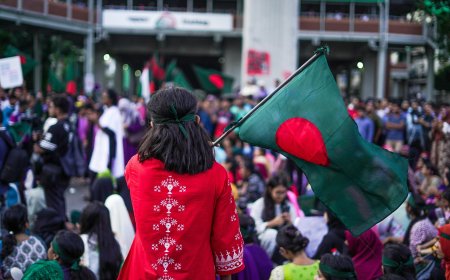
In July 2024, the youth rose again. But this time, something was different. They are no longer willing to be used as currency. They are standing on their own, free of special interests and independent of political business syndicates. They have organized themselves into political, social, and cultural entities. Inqilab Mancha is one of them, but it is not the only one.
When the devastating news of Hadi’s passing spread across the nation, I felt paralyzed. It felt like a personal loss, like losing a family member. I asked myself why the death of a stranger could cause such grief.
The answer was simple. Osman Hadi represented a rare blend of faith, justice, humility, and courage. He reflected the fundamental aspirations of ordinary people. Through him, a new political desire emerged, rooted not in ideology but in dignity. A new political settlement has begun to take shape, and it is here to stay.
Some dismiss this as transient excitement. I believe it is transformational.
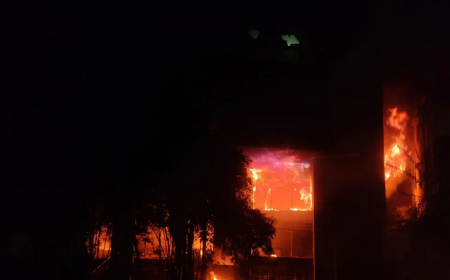
Transitions bring instability, and the interim government is governing in precisely such a moment. Its security failures are real and visible. But we should not obscure the deeper reality: power is shifting. For the first time in decades, it is not the ruling elite but ordinary citizens who are asserting how the nation should be governed. Where formal justice is slow or absent, disorder rushes in to fill the vacuum. This is not an endorsement of chaos or mob violence, but a diagnosis of a system in transition.
I never met Hadi. Yet I felt compelled to bid farewell to someone who felt closer than family. As I stepped out of my CNG to attend his janaza, I found myself swept into a current of humanity. Madrassa students, university students, laborers, shopkeepers, executives -- all merged into one mass, chanting:
“Dilli na Dhaka -- Dhaka, Dhaka!”
“Tumi ke, ami ke -- Hadi, Hadi!”
“Nara-e-Takbir -- Allahu Akbar!”
I was not alone. I always had this family. I just didn’t know it.
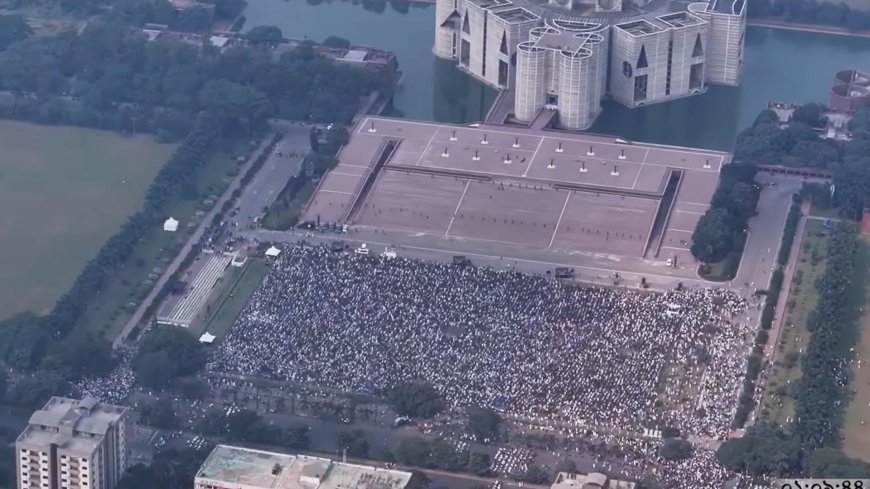
An estimated 1.4 million people gathered. I could not see the beginning or the end of the crowd. It felt less like a gathering and more like a human current, pulling people in from every direction. Microphones were useless. The collective murmur drowned everything. People stepped off buses, CNGs, rickshaws, and private cars, paying their own way just to be there.
Dhaka had never seen this level of genuine, voluntary participation. And I do not say that lightly. Raised in a political family that organized national campaigns, I know what it costs to manufacture crowds. Friends managing upcoming elections regularly remind me how much is spent to bus people in, how leaders compete to display bigger processions through money.
But this was different. This was a gathering of millions where every participant came by choice. Change is not coming. It has already arrived.
Today, people do not identify with policy documents when the same parties endorsing them continue to nominate corrupt, violent extortionists. They see through the hypocrisy. They recognize policy promises as eyewash when real power remains concentrated in patron-client syndicates.
The signal is clear: Change your brand of money-driven politics. Abandon hypocrisy. Or people will abandon you.
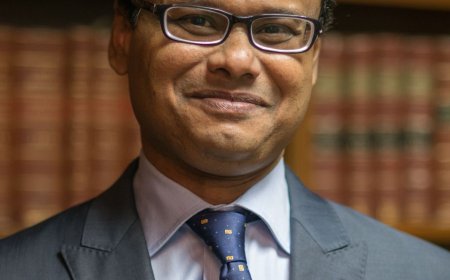
Mohammed Mia is an investment executive and community leader focused on democracy, economic empowerment, and US-Bangladesh engagement. A co-founder of UBUI, he brings two decades of experience across global finance, civic leadership, and diaspora-driven institution building.