
























































The New Fault-Lines in Bangladeshi Politics
The axes of Bangladeshi politics have shifted dramatically. Where do the political parties line up in the new dynamic?
Many years ago, Bill Clinton described the fundamental American political fault line as one being an argument over the 1960s -- those who thought the socio-cultural changes of that decade were a net positive were Democrats.
When I started following Bangladesh politics, about a quarter century ago, I thought the similar fault line for us was 1975 -- if you thought Bangladesh took a turn for the worse as that pivotal year ended, by the late 1990s you were probably an Awami League supporter.
This schema was already out of date by the time I started writing regularly and seriously, during the 1/11 regime. By then, 1975 was a distant memory for most.
At that time, many speculated India and Islam might be the things future politics would revolve around, and I didn’t differ.
Counterpoint Editor Zafar Sobhan had a particular take on it that I liked. Writing well before the culture wars of 2013, he noted that political fault lines in Bangladesh remained around socio-cultural norms and markers -- identity being one way to describe it.
Those subscribing to a Bengali identity, as demonstrated through an affinity for Tagore for example, were likely to gravitate towards Awami League. Those subscribing to more Islamic norms might gravitate to Jamaat and other Islamist parties. And those favouring a westernized synthesis of both found themselves in the BNP.
Well, the Hasina despotism made all that redundant. And the Long July has made Hasina a non-factor in future politics -- whatever one might privately believe, it is hard to see a serious political force in Bangladesh that champions the Hasina regime.
What then are the political fault lines in today’s Bangladesh? Where might the key players sit? And how might things evolve?
After Hasina fled, Nayel Rahman (a social media commentator) made an observation that I found to be very astute, and I build on it below.
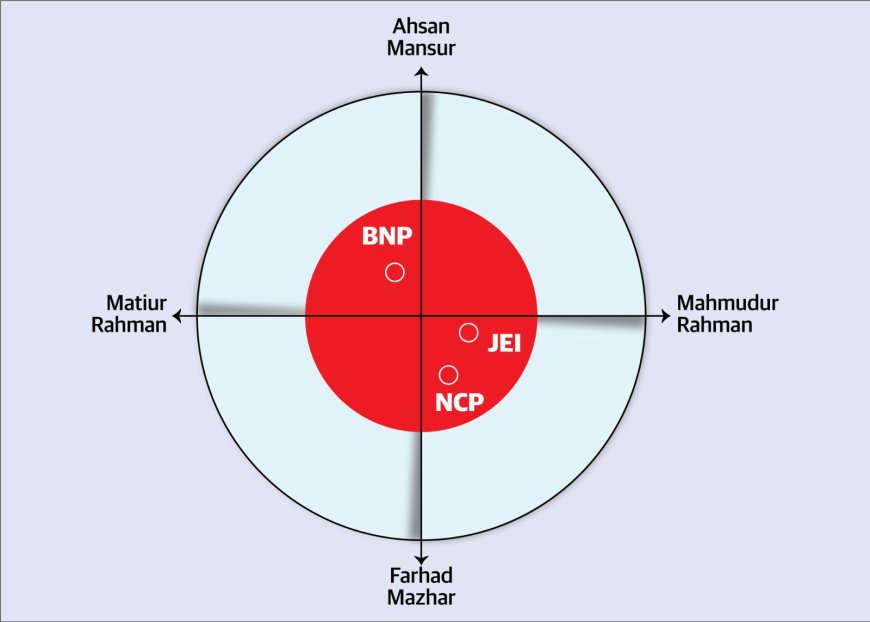
Imagine a 2-axis, four quadrant diagram.
On the horizontal axis, we have the old Muslim vs Bengali, Shapla vs Shahbag cultural identities, with one change -- the Bengali-Shahbag cultural politics is shorn of any fealty to the cult of Mujib.
The left flank here is symbolically represented by veteran editor Matiur Rahman, while the business executive turned politician turned editor Mahmudur Rahman is the champion of the right.
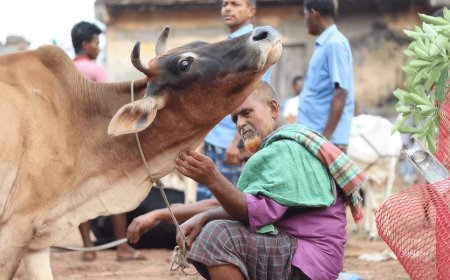
If you were excited by the slew of cow slaughters that randomly seemed to spring up everywhere last winter, you are on the Mahmudur Rahman side of the axis, while if you are mortified by it then Matiur Rahman is your man.
Of course, the cow slaughter parties are just one manifestation of the cultural cleavage, we can talk about gender, minority communities, heterodox lifestyle, views around history, and all sorts of things here, recognizing fully that this simplified schema misses multitude of complexities that make up each one of us. Still, I think the simple schema provides a decent approximation of today’s Bangladesh.
Of course, this horizontal axis of identity politics/history/culture wars means the left-right divide in Bangladesh is not along economic lines but around identity and culture. One cannot overstate this crucial aspect of our politics.
In addition to the left-right horizontal axis, there is also a vertical axis based on how we want to rebuild the country that has been gutted by Hasina. Economic policy is part of this, but it is more than just the economy, and covers the entire approach to how we organize the polity. And the stress is on how rather than what -- on the latter, there is a general consensus around food security, poverty alleviation, and jobs.
On the south side of the vertical axis we have the poet-polemicist Farhad Mazhar, symbolizing those who think a radical revolutionary reconstruction of the republic is necessary. On the other side we have Ahsan Mansur, the Bangladesh Bank governor, symbolising neo-liberal technocracy.
Again, a lot of nuance is missed in the simple framework. For example, there is no standard template of revolution, just as there is no uniform path of technocratic governance. But again, the simple axis does a good approximation of the divide.
So, we have a diagram such as the following.

What is the red circle in the middle? It is, by construction, where the majority of Bangladeshi voters are. It is the politics of synthesis that Ziaur Rahman tried to build. It is what Faruk Wasif calls the Bangladeshponthi politics.
Electoral politics is the process through which parties try to find the median voter. Just as the best place to place ice cream stalls in a crowded strip of beach in a hot summer day is bang in the middle, so it is in electoral politics that parties over time tend to gravitate towards the middle.
As things stand as we approach the election, the stylized depiction of Bangladesh politics is that the frontrunner, BNP, is approaching the middle from the north, positioning itself as the natural party of governance.
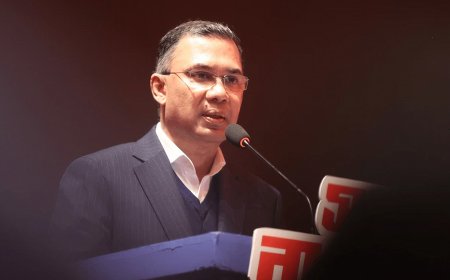
As the only party with solid governance experience, its message is one of stability and order. Its candidate list includes dozens of experienced MPs. And this is exactly what Tarique Rahman stressed in his maiden public appearance since January 2007: He wants peace and stability, and he has a plan for it.
The message to the voters is clear, trust us as you know us.
The party wants to fight the election as a contest about jobs, daal-bhaat, pocketbook issues, and not about the identity/culture/history.
Of course, other parties cannot really hope to match BNP on its preferred terrain. They will undoubtedly dig up BNP’s record of misgovernance. There are already accusations of old school patronage politics.
We will return to BNP politics in a future piece. Let’s turn to the smaller parties now, who are in a bind. They cannot credibly promise that they will run a better government than BNP with the current administrative and governance machinery. And yet, after a year of unrest and instability, they are afraid of promoting anything too radical.
That is, BNP has a lock on the Ahsan Mansur voters, and others aren’t sure that they want to appeal to the Mazhar mob after the violent attacks on the country’s two largest dailies and iconic cultural institutions on December 18-19.
Indeed, even before that violence, Jamaat and its Islamist alliance partners had tried to tone down any demand for outright Shariah law, preferring to talk about secular issues such as proportional voting or referendum on constitutional reform.
Meanwhile, the contest along the horizontal, Mati-Mahmud left-right axis is not what one might naively expect.
There are two factors that are at play: the absence of Awami League and the rejection of any Indophile program.
Once upon a time, Mati-voters (if not the man himself) were reliably Awami League supporters. But that party is not running in this election. There might be individual former Leaguers running on some other ticket, and there may someday be a new party catering to that voting bloc. But there is no such party right now.
That is, there is a vacuum, which the BNP is attempting to fill. The party wants to capture much of the Matiur voters without giving up ground on its share of the Mahmudur crowd, where it faces tough competition from Jamaat.
Curiously, even Jamaat is trying to assuage the Mati-voters’ apprehensions, if not actually win some of their votes. This is why one of the first acts by the newly elected student council leaders of Dhaka University was to pay homage to the intellectuals who were martyred in 1971. This is why Jamaat is fielding a Hindu candidate. This is also why the Jamaat is in an electoral alliance with the National Citizens Party.
Meanwhile, the India factor looms large over our politics, but again, not in the way one might naively expect.
Once upon a time, there were intellectuals, civil society leaders, and businesspeople, associated with the Matiur voting bloc in general and the Awami League in particular, that were open to -- if not openly championing -- closer relationship with India. Mahmudur voters and associated intellectuals or businesspeople meanwhile backed BNP, which was Indosceptic if not downright anti-Indian.
After New Delhi’s open backing of the Hasina regime right up to the afternoon August 5, 2024, and given the continued presence of Hasina and her goons on Indian soil since then, it is difficult to see anyone in the Matiur bloc hankering for a pro-India party today. That ground has shifted dramatically.
However, the electoral effect on the previously Indophobe parties isn’t clear. The BNP, for example, isn’t running against a pro-India Awami League, so it doesn’t need to stress the India factor.
Jamaat of course would like to highlight their anti-Indian credentialism. But they face the danger of going too far -- for example, directly threatening your neighbour’s territorial integrity may not be smart politics!
That is, as we approach the election, if no one is pro-Indian, then running on an anti-Indian platform may not have the same salience as many might naively believe.
There has been a lot of concerns, justifiably, about the rise of a fundamentalist right in the wake of Hasina’s hasty flight. However, as we approach the election, from a certain point of view, both BNP and Jamaat may be drifting left, at least compared with where each had been in past elections.
I will return to the two larger parties contesting this election, and the party that is barred from doing so, in future pieces ahead of the election. One party, sadly, has utterly failed to navigate the faultlines of our electoral politics and finds itself on the brink of annihilation within a year of its launch -- the NCP.
The party received more goodwill and fanfare at its inception than any other in independent Bangladesh -- and that includes two parties fronted by two military strongman at the peak of their power.
The party claimed to be a staunchly centrist one with respect to the left-right identity and cultural issues. It had also claimed to be moderate, when it comes to the vertical axis.
But claiming to carry the mantle of the Monsoon Revolution, with the July aspirations being its stated raison d’etre, it would naturally be to the south of the BNP on the Mansur-Mazhar axis.
To the extent that the older, larger party and its new challenger both claim to represent the same space in terms of identity politics, a BNP vs NCP politics could have been around the philosophical approaches to the way we want to rebuild Bangladesh. No one had expected NCP to defeat BNP in the coming election.
But had the party presented itself as a credible alternative, not just to BNP or its candidates, but to its entire way of doing politics and running the country, we might have experienced a transformational change in our politics over the coming years.
Unfortunately, this is now no longer on the cards. And there are three reasons why.
Arguably, the most interesting thing about the party when it was formed was that for the first time in our modern political history, going back to the dawn of the 20th century, there was a political party that was not centred around a towering individual.
In fact, it is hard to think of such a party anywhere in our region. This was always going to be hard to pull off.
In the event, the coterie of Dhaka University alumni -- all male, all Bengali Muslim, all with facial hair -- failed to present themselves as an inspiring, inclusive bunch. And that is in spite of having the glorious foundational story of kicking a despotic, murderous prime minister out of the country. That's the first reason.
Not only did Nahid Islam and friends fail to hold on to the goodwill they received, they had failed in the basic, boring, nitty gritty task of politics. Much of politics involves things like forming grassroots committees, volunteer outreaches, door knocking, town hall style meetings and such like.
This is far less glamorous than standing up to a tyrant. But the stuff of Long July doesn’t happen all that often. Sadly, the NCP leaders never appreciated this. Instead, they spent most of their time trying to re-enact July. That's the second reason.
In the process, they had failed to break through outside the social media bubble and a handful of seats. Poll after poll found them with less support than what Jatiya Party had in the elections between 1991-2008.
Their student affiliates failed to win any student council elections. They were looking at a real possibility of lacking any parliamentary representation after February.
Would that have been the end of the road for NCP? Not necessarily.
Parliamentary presence would have been good for both the party and the country if they were keen on building a politics around fundamental, structural reforms of the republic.
However, one can also build that politics outside parliament. For example, they could have campaigned for “yes” in the July Charter implementation referendum, and built their politics on the proposed reforms. They could have fleshed out their 24 Points. They could have built their party from the ground up.
After all, BNP was not in the parliament in the 1980s or the past decade. And Sheikh Mujibur Rahman did not pursue his Six Points on the floor of the parliament.
Evidently the NCP leaders did not see things that way. They didn’t dare to run without the support of the larger parties. That's the third reason.
And now, having chosen to be in alliance led by Jamaat, apparently without sufficient consultation within the party, Nahid and his friends have doomed NCP for oblivion.
Even if one or two individuals can get elected, their future is far more likely to be in Jamaat than NCP as it exists.
Can there be a new political party that emerges as a dominant opposition force after the election? That remains to be seen, but is an intriguing possibility. Either way, it is clear that the upcoming elections are not the end, but merely the beginning.
Jyoti Rahman is Executive Editor of Counterpoint.