
































![A Ledger of the Soul: Navigating the Allah-Bhagavant Nexus in a 19th-Century Puruṣākāra Jñāna Caupara [Gyan Chauper]](https://counterpointbd.com/uploads/images/202608/image_430x256_6a93baa3b09a7.jpg)




















Do Games of Thrones Ever End?
Nothing in recent geopolitical trends suggests pressures on Bangladesh’s economy are going to get simpler. Everything points to a need to accept that simply returning to the status quo will be insufficient. The economy must exceed both performance and expectations of the past if the nation is ever to hope to catch up with its competitors.

Both the late Begum Khaleda Zia and the overthrown Sheikh Hasina were unexpectedly thrust in the limelight at a young age by the assassination of close family members.
As women, both faced the obstacle of having to earn their own spurs within the patriarchal world of Bangladeshi politics. The former had been made a widow in her thirties, while the other only survived the murder of her parents and three brothers due to the timing of an overseas trip in her twenties.
Both succeeded in building personal followings and becoming prime minister. After the end of military rule in 1990, both led governments that could claim various successes, whilst also overseeing administrations that ended in ignominy.
President Ziaur Rahman did not hold the same post of PM as his wife, but for all practical purposes they both held the top job in Bangladeshi politics. Similar has happened in other countries like Argentina.
If the BNP wins the coming election and Tarique Rahman is made prime minister, it will be the first time someone has got to the top of a nation’s political leadership in the wake of both of their parents.
The global fame of the Nehru and Bhutto families made South Asian politics ubiquitous with political dynasties. But they occur in many other places. Cambodia, Laos and the Philippines today are all led by children of past political leaders who hold the same high office.
A 2024 study reported in Politico found that over 12% of MPs in Belgium had a parent with the same job. In Japan, the proportion of hereditary politicians known as seshū giin is even higher.
In Canada, over three decades after Pierre Trudeau won four general elections to serve as PM, his son Justin managed to win three in a row before stepping down last year to spend more time filling gossip columns.
Given recent events, US voters do not need to invent hypothetical scenarios to create worries for themselves. If they did, they could consider that the late Senator Robert F. Kennedy who was assassinated in 1968, was the father of 11 children and today over thirty descendants have him as a grandparent.
To get an adrenaline rush, Americans can ask a bookmaker for odds on Donald Trump’s youngest son Barron, standing for the US Presidency against someone with the surname Kennedy in the 2040s.
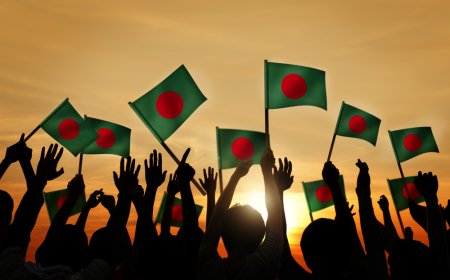
Bangladesh’s general election on February 12 will be the first time since 1986 that neither Khaleda Zia nor Sheikh Hasina has been on a ballot paper for national elections. Truly a watershed moment.
Yet opinion polls and commentators mostly expect a BNP victory with Jamaat-e-Islami bagging its biggest ever share of the vote to become the official opposition. After the euphoria of 2024 and the Interim government’s pronouncements of reform and change, the predicted result is merely the other half of a decades long AL/BNP duopoly in electoral politics. Albeit to a family member from a different generation.
Since 1990, for much of the population most of the time, it has made little difference whichever of the AL or BNP was in government. Progressive promises have always been politically popular in Bangladesh. Helpful policies have sometimes been proposed and even implemented by those in power.
But at the macro level investments in improving education, skills and productivity have never been made at the transformational levels achieved by competitor nations like Vietnam.
Both parties in government have tended towards ideology lite and converged on similar policies and patterns of behaviour. For all the drama and debate generated, the big picture barely changes.
Corruption stays endemic, patriarchy and misogyny keep prevailing, and rule of law and personal freedoms remain easily undermined. Ordinary people have no choice but to prioritize getting on with their lives.
Economic growth in Bangladesh largely happens despite, not because, of Bangladesh’s dysfunctional systems of politics and governance. The prohibition against AL running in the election together with the opening of doors to Jamaat by and during the Interim government, raises a real possibility of the "secular patriot" ideals traditionally proclaimed by leaders in Bangladesh suddenly being overturned.
If that happens, the big two traditional parties need to finally admit that though for fifty years they loudly espoused themselves as defending (their) versions of secularism, democracy and nationalism, they both heavily underdelivered in putting such constitutional ideals into practice. Sometimes undermining them altogether.
The bitter culture wars both have fought against each other over (relatively) small differences have achieved nothing but diminishing a national sense of shared pride in a common history.
Perhaps the most pertinent takeaway from the leaked recordings of recent remarks by a US diplomat, was his confidence that in practice Jamaat’s policies on the economy could turn out to be more like business as usual. A bit like the big two, then. In power, expediency trumps ideology seems to be the embassy assumption.
Culture wars over historical narratives have been used to cover the cracks left by past politicians in failing to get to grips with the real needs of Bangladesh’s people and economy. For its part, the IG is playing the same game by hoping to add a sheen to its tenure (on paper at least) by holding a referendum based on recommendations made by its over-optimistically named National Consensus Commission.
Nothing in recent geo-political trends suggests pressures on Bangladesh’s economy are going to get simpler. Everything points to a need to accept that simply returning to the status quo will be insufficient. The economy must exceed both performance and expectations of the past if the nation is ever to hope to catch up with its competitors.
At the age of 60, having never been elected as an MP before, it will be a steep learning curve for Tarique Rahman if as polls predict, he follows in his parents’ footsteps.
Niaz Alam is the Dhaka Tribune London Bureau Chief.