






























































The End of an Era and the Politics of Mourning
From a modest housewife to a widowed national leader who rose to the highest political office in the country, Begum Zia’s life was a testament to resilience and moral fortitude.

After a prolonged illness -- largely aggravated by years of deliberate political persecution and vindictive incarceration under the regime of Sheikh Hasina -- Begum Khaleda Zia, wife of late President Ziaur Rahman and Bangladesh’s first female Prime Minister, breathed her last in the early hours of December 30, 2025.
She was a three-time Prime Minister whose death closes a defining chapter in the nation’s political history -- one marked by personal tragedy, relentless struggle, and an uncompromising battle for the restoration of democracy and fundamental rights.
From a modest housewife to a widowed national leader who rose to the highest political office in the country, Begum Zia’s life was a testament to resilience and moral fortitude.
Her long incarceration and political marginalization did not diminish her stature; rather, they cemented her legacy as a symbol of resistance against authoritarianism. Taken in its entirety, her life and sacrifice will remain inerasably etched in the collective memory of the nation.
Begum Zia was among those rare personalities who commanded love and affection across political, religious, and social divides. Without theatrical populism, she became the cynosure of the hearts and souls of her countrymen. Her quiet dignity, endurance, and steadfastness resonated deeply with ordinary citizens.
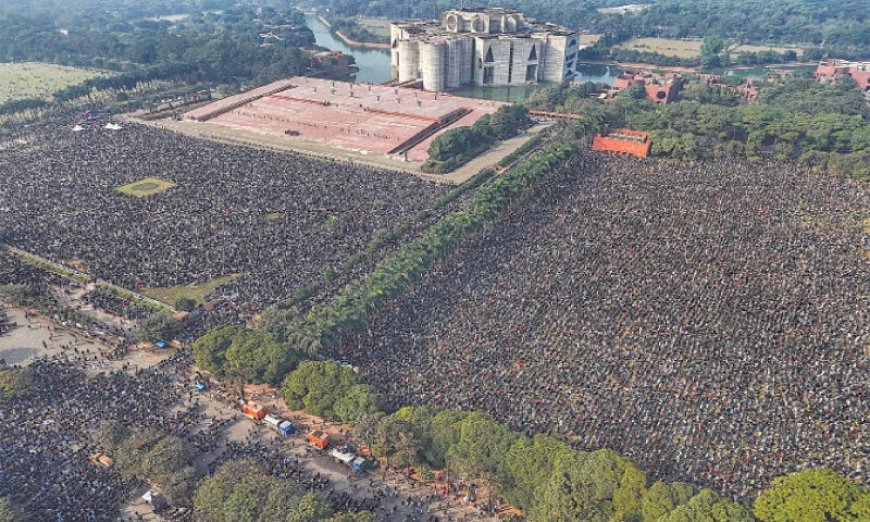
Her funeral -- arguably the largest ever witnessed in Bangladesh -- drew an unprecedented number of mourners, along with high dignitaries from a fractured and embattled neighbourhood. In a remarkable moment, supporters of disparate political parties stood together on a single platform to pay their last respects.
Such an optic had not been witnessed since the funeral of President Ziaur Rahman on June 2, 1981. Some have even claimed it to be among the largest funerals in world history.
History shows that certain deaths transcend personal loss and assume national and even regional significance.
Begum Zia’s passing was one such moment. The presence in Dhaka of high dignitaries from the original six SAARC member states to convey condolences to Bangladesh -- particularly to Mr. Tarique Rahman, the eldest son of the Zia family, Acting Chairman of the Bangladesh Nationalist Party (BNP), and the likely next Prime Minister -- spoke volumes about the shifting political undercurrents in the region.
Among these visits, the presence of India’s Minister for External Affairs, Dr. S. Jaishankar, generated considerable public and media speculation -- an outcome that was hardly unexpected. Some interpreted the visit as an olive branch from India, signalling an attempt to thaw the currently strained bilateral relationship.
During his stay, Dr. Jaishankar met Bangladesh’s Adviser for Foreign Affairs, Law Adviser Dr. Asif Nazrul, and National Security Adviser Dr. Khalilur Rahman.
Separately, the Indian External Affairs Minister also met the visiting Speaker of Pakistan’s Parliament -- an interaction no less significant given the adversarial relationship between the two countries.
While Bangladesh’s Foreign Adviser urged journalists not to read anything beyond condolence diplomacy into the Indian minister’s visit, it appeared to many -- including this author -- that there was more at play than met the eye.
The letter of condolence from Prime Minister Narendra Modi, handed over by Dr. Jaishankar to Mr. Tarique Rahman, was particularly striking -- both in its language and its departure from diplomatic convention. Traditionally, such messages from a Head of Government are addressed to their counterpart in the receiving state. In this case, however, the message was directed to Mr. Rahman, and notably, there was no meeting between Dr. Jaishankar and Bangladesh’s Chief Adviser. Taken together, these gestures conveyed more than sympathy; they signalled India’s apparent lack of interest in engaging meaningfully with the current Interim Government.
With a general election scheduled within the next six weeks -- after which the Interim Government will be dismantled and an elected government installed -- India’s posture appears calculated. On one hand, it chose to bypass the Interim Government; on the other, it extended a diplomatic overture to the emerging leader of Bangladesh’s political future.
This intent was made explicit in Prime Minister Modi’s message, which read: “I am confident that her ideals will be carried forward under your able leadership of the Bangladesh Nationalist Party, and will continue to serve as a guiding light to ensure a new beginning and the enrichment of deep and historic partnership between India and Bangladesh.”
While this is, undoubtedly, a handsome gesture towards Mr. Rahman, Indian policymakers must recognize that symbolic overtures alone cannot mend a fractured relationship.
There exist deeper, structural issues -- rooted in past policies, unequal engagement, and strategic myopia -- that continue to divide the two countries. When it comes to repairing bilateral relations, a simple truth remains: if you break it, you must also be willing to fix it.
I conclude with a personal observation. Amidst the spectacle and diplomatic choreography, one could not miss the dignified poise of Mr. Tarique Rahman as he received foreign dignitaries -- bearing himself with the composure and restraint befitting a national leader.
Equally noteworthy was the quiet presence of his daughter, Barrister Zaima Rahman, who remained by his side throughout. Her role should not be dismissed as merely ornamental.
Her calm demeanour, silent interventions, and attentive gestures suggested the subtle emergence of a new political actor -- perhaps heralding the arrival of another leader on Bangladesh’s evolving political horizon.
The author is a freedom fighter, a retired Major, retired Secretary and former Ambassador.