





























































The 2026 Election Puzzle
For all its organizational discipline, ideological clarity, and grassroots networks, Jamaat-e-Islami has spent five decades confined to the margins of Bangladeshs political mainstream -- not because it lacked ambition, but because the stage was always owned by others.


The 2024 July Revolution has created new opportunities for Jamaat-e-Islam Bangladesh (JIB), the countrys main Islamist political party, to secure a substantial number of seats in parliamentary elections. However, in the 13th National Parliament Elections, JIB and its alliance across the 297 (3 are on hold) electoral seats won nearly 77, while the Bangladesh Nationalist Party (BNP) and its alliance won around 212.
In a roughly 91% majority-Muslim country, why did the party fail to win even one-fourth of the seats in parliament?
The Fragmentation Paradox
The absence of cohesive coordination among Islamist-leaning groups diluted Jamaat’s ability to maximize seat-level advantages. Before the election, the Jamaat-e-Islam party formed a coalition including the National Citizen Party (NCP) and other popular Islamic political parties. However, alliance fragmentation and independent contestations in the weeks leading up to the election split vote shares in several constituencies.
The Jamaat-e-Islam party also failed to bring all the Islamist parties and Islamic movement groups under one umbrella. Even these Islamist parties and movement groups criticized Jamaat- e-Islam drastically for its activities and practices of Islam. For example, Bangladeshs most influential and powerful Islamist group, Hefazat-e-Islam (HeI) Ameer (supreme leader) Muhibbullah Babunagari, just a week ago of the election, said that voting for Jamaat-e-Islam is not permissible for Muslims and is haram, warning that Islam and faith would be undermined if the party came to power.
Hefazat-e-Islam is not an Islamist party in the traditional sense. Although some of its leaders have Islamist affiliations, its strength lies in its institutional architecture as a networked organization of madrassas teaching orthodox Islam.
BNP Advantage and AL Vote Bank
The BNP had maintained grassroots structures even through years of political marginalization. After the July Revolution, it moved quickly to reactivate and expand these networks. Jamaat, by contrast, spent the eighteen months between the revolution and the election failing to establish a nationwide grassroots presence. With the exception of a few regions, no functioning party committees emerged. In the demanding labour of election campaigning -- door-to-door outreach, local issue mobilization, get-out-the-vote operations -- the BNPs organizational head start proved insurmountable.
The vote bank of the Awami League (AL) and its grassroots members also leaned towards the BNP. The majority of people previously aligned with the Awami League supported the BNP, and even the AL political members joined the BNP and campaigned for it’s in this election.
Gender Contradiction
In addition, Jamaat faced difficulties broadening its demographic appeal. While Jamaat e-Islam has put forward a manifesto focusing on reform, women’s safety from harassment, and clean politics, the party is not running a single female candidate. The party’s leader denied the leadership of a woman to the party as it was un-Islamic.
A post on Rahman’s X account then compared women’s work to prostitution, before it went viral and was deleted with claims he had been hacked. Comments he made last year also resurfaced, denying the existence of marital rape and describing rape as “immoral women and men coming together outside marriage”.
Moreover, last year, the alliance of Islamist parties forced the government to reject proposals of a women’s commission on equality. “Equal rights would push women into competition with men in a way that disadvantages them,” said Mamunul Haque, secretary general of the hardline Islamist party Khelafat Majlish, speaking at the time.
Even the JIB party’s policies also proposed reducing women’s working hours from 8 to 5, with the government subsidizing the lost income so women can spend more time at home. However, according to the International Labour Organization, women make up to 44% of the country’s workforce, the highest proportion in South Asia, and paid work is a right fiercely guarded by women across economic strata.
Bengali Islam
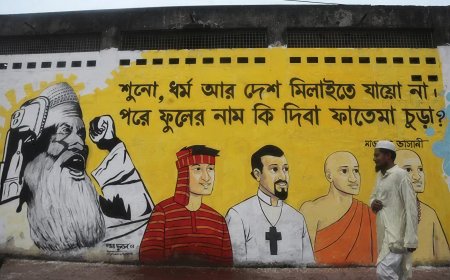
Historically, the people of Bengal followed a range of local cultural traditions and world religions, including Islamic Sufi traditions, which deeply influenced Bengal’s culture, politics, economics, and society. Bengali culture, society, and ideas further evolved with the changes in various political arrangements in Bengal, including long-term colonial influence. Historians contend that Bengali mass conversion to Islam was possible due to Muslims accepting or supporting local cultures and practices, which later gave Bangladesh both a cosmopolitan and, to some extent, a heterodox character.
Since the 2024 July mass uprising, Bangladesh has witnessed an unsettling escalation in attacks against mazars -- tomb-shrines and dargahs that for centuries have functioned as cultural, spiritual, and communal anchors across South Asia. However, accusations have increasingly pointed toward major Islamic groups as being behind these acts of vandalism, as they criticized and threat to demolish mazar culture as it goes against the Islamic ritual.
Ghosts of 1971
Jamaat has not entirely escaped its past. The opposition of Bangladesh’s 1971 independence from Pakistan and the historical collaboration with Pakistan in the genocide during the Liberation War also played a significant role in this votes failure.
Moreover, after the July 2024 Uprising, the Jamaat-e-Islam student wing dishonored the national anthem and honored Golam Azam -- who opposed Bangladesh’s independence -- on various social media platforms and their official website.
Where the BNP Had Booths, Jamaat Had Hopes
For all its organizational discipline, ideological clarity, and grassroots networks, Jamaat-e-Islami has spent five decades confined to the margins of Bangladeshs political mainstream -- not because it lacked ambition, but because the stage was always owned by others. Since the countrys founding in 1971, the political landscape has been dominated by two towering forces: The Awami League and the Bangladesh Nationalist Party (BNP).
These two giants have defined the contours of power, alternated in government, and absorbed the lions share of electoral loyalties. Jamaat, by contrast, has never been more than a supporting actor -- a junior partner whose fate depended on which of the two major parties deigned to offer it a seat at the table.
Since the July Revolution, the party has been unable to establish a nationwide grassroots organization in the one-and-a-half years since the July Movement. It is rare for a so-called committee to be formed, except in a few regions. On the other hand, the BNP had already established its presence at the grassroots level and, after the revolution, quickly regained its organizational strength, giving it an advantage.
Even when the BNP faced internal revolts and independents bled its vote bank, Jamaats coalition failed to capitalize. Across dozens of constituencies, anti-BNP independents split the opposition vote while Jamaat ran its own campaigns in isolation.
What did Jamaat Gain?
The 77 seats Jamaats coalition secured represent not failure but realism. That is no small feat for a party whose previous best parliamentary showing was just 18 seats in 1991. Now, for the first time, Jamaat-e-Islami will enter parliament as the main opposition party.
Moreover, while Jamaat and its alliance do not command a sufficient number to form a government in the lower house, they are expected to secure around 40 seats in the upper house cabinet. This is a positive development for them, as from now on, any important bill or law will require a two-thirds majority to pass in the upper house.
Md. Tariqul Islam Tanvir is an Erasmus Scholar in International Master in Central & East European, Russian & Eurasian Studies at University of Glasgow.