























































Beyond Fault Lines: Bangladesh's Intolerance Problem
What if Bangladesh's problem isn't the divides themselves? Secular versus religious. Bengali versus Muslim. Shahbag versus Shapla. Aspiration versus stagnation. What if the real problem is our inability to tolerate disagreement at all?
I've been reading two powerful pieces in Counterpoint that have gotten me thinking, perhaps in ways their authors didn't intend.
Counterpoint BD's own Jyoti Rahman offers an elegant framework in "The New Fault-Lines in Bangladeshi Politics." Two axes: One cultural (Bengali-Shahbag versus Muslim-Shapla) and one governance (revolutionary rebuilding versus technocratic reform).
Asif Saleh's "An Angry Young Country" digs deeper. He argues that the deepest fault line isn't the cultural rift at all; it's between a society that aspires and a system that no longer feels responsive. Rising inequality turns into rage.
Two excellent reads. Both have made me think hard. Which, at my age, is not always a good thing. I tend to overthink and then spiral into contrarian positions just to be difficult.
But the more I've thought about it, the more I've wondered: Are these really fault lines, or just symptoms of something deeper?
What if Bangladesh's problem isn't the divides themselves? Secular versus religious. Bengali versus Muslim. Shahbag versus Shapla. Aspiration versus stagnation. What if the real problem is our inability to tolerate disagreement at all?
In a healthy democracy, you don't have "fault lines" around disagreement itself. You have debates. Competing visions. Electoral contests. Then you accept the outcome and try again.
Matiur Rahman and Mahmudur Rahman would just be edtiors with different perspectives. Maybe they'd argue on the same TV talk show. Maybe they'd pointedly avoid each other at the next wedding invitation. They'd just be two people who disagree, not two sides treating disagreement as a declaration of war.
The reason these become fault lines is simple. They turn into deep, dangerous, potentially fracturing divides because we treat political opponents as existential enemies who must be crushed.
If we could genuinely accept opposing views, would we even call these fault lines? Or would we just call it democracy?
The Pattern We Keep Ignoring
We keep seeing the same pattern over and over again in our political history. With each generation, we see new "fault lines." And every generation is partly right. The ground does shift.
But do we ever ask why these shifts keep producing the same outcome?
Winner takes all politics. Revenge cycles. And anyone on the other side gets treated like an enemy of the state.
After independence, our politics was about liberation legitimacy and accountability. Who belonged. Who didn't. And who could ever be forgiven.
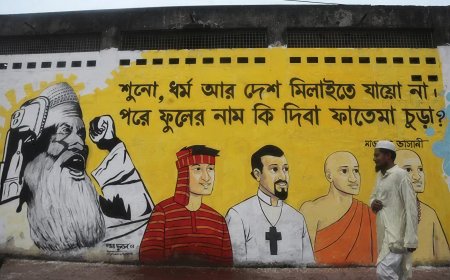
In the 1980s and 90s, it became secularism versus Islam. As if Bangladesh couldn't contain both Tagore and the mosque. Even though we've been doing that for centuries.
In the 2000s and 2010s, we started fighting over 1971 all over again, this time through competing narratives. You either stayed on script or you were treated like the enemy.
And now we're back at it again. Culture. Governance. The economy. Same movie, new cast.
Notice the pattern? The content changes. The structure remains the same.
No matter the issue, be it history, culture, economics, or governance, we frame it as a binary requiring absolute fidelity. We create tribes. We demand loyalty. And we turn dissent into betrayal.
Look, I understand. I'm a computer scientist. We were trained to think in binaries. On or off. One or zero. But even we eventually learned that real life isn't binary.
None of this is uniquely Bangladeshi. Every diverse democracy has cultural tensions. Economic inequality. Competing historical narratives. Governance debates.
The difference is whether a country has institutions and norms that allow disagreement without turning it into a declaration of war.
We haven't built those. Not yet.
What Intolerance Looks Like
This isn't about personal rudeness. It's not about refusing to share biryani with your ideological opponents, though that would be a tragedy of its own kind.
I'm talking about systemic intolerance. The kind that becomes institutional muscle memory.
Come election time, we don't really "lose." We get robbed. Every time. Sometimes the accusation is justified. Often it isn't. But the deeper pattern is the same. We can't accept that voters might genuinely choose the other side.
It shows up in how we treat opposition. In a functioning democracy, the opposition is supposed to be loyal to the country while opposing the government. In Bangladesh, opposition is treated as an enemy of the state by default. A foreign agent. A threat.
And this isn't any one party's problem. It happens no matter who's in power. We're very egalitarian that way.
It also shows up in how we talk about identity. You must be either Bengali or Muslim. Either 1971 or 1975. Either Shahbag or Shapla. As if Bangladesh can't be more than one thing at once.
This either/or framing isn't just intolerant. It's historically inaccurate. Bangladesh has always been syncretic, diverse, and plural. Our intolerance is the anomaly, not our diversity.
And because we can't tolerate dissent, we don't know how to contain it. Parliament becomes either a rubber stamp or a boycott zone. Courts become weapons, not referees. Media becomes propaganda, not a forum. Police become enforcers, not protectors.
When institutions can't hold disagreement, something else steps in. Violence. Intimidation. Silence.
This is our default setting. And it's why every new fault line turns into an earthquake.
What It Would Take
Fine. If intolerance is the disease, what's the treatment?
This isn't about being nice. It's not about group hugs and singing Amar Sonar Bangla together while holding hands. Though I admit, it would make for great Instagram content.
This is about building institutions that can hold disagreement without collapsing.
Start with one goal: make disagreement survivable. Make it safe to lose. Make it normal to oppose. Make it possible to disagree without being crushed.
An opposition that can credibly win next time doesn't need to burn everything down this time. A court system that protects dissent means you don't need street violence to be heard. Media that can challenge power means corruption has somewhere to hide besides in plain sight.
This isn't utopian. It's basic democratic infrastructure.
But none of this works unless we accept one basic idea: Bangladesh can hold competing visions of itself without falling apart.
That a Tagore-loving secularist and a devout Muslim can both be authentically Bangladeshi. That you can question narratives without dishonoring martyrs. That disagreement doesn't equal disloyalty.
Radical ideas, I know.
A Final Thought
Jyoti Rahman and Asif Saleh have diagnosed important symptoms. Real symptoms. The axes of conflict are real. The economic frustration is real. The identity tensions are real.
But if we only treat symptoms, we'll keep producing new fault lines every generation. Future analysts will write equally brilliant pieces about whatever new binary emerges. And we'll all nod sagely and say, "Yes, this time it's different."
It's not different.
The disease is intolerance. The chronic inability to grant political legitimacy to people we disagree with.
Until we name this and address it directly, we'll keep analyzing new fault lines while the ground continues to shift beneath our feet.
There's good news, though. Intolerance isn't genetic. It's learned. It's institutional. It's cultural. Which means it can be unlearned.
We will always have fault lines. The real question is whether we keep turning them into earthquakes.
And if this sounds contrarian, fine by me. That's the beauty of tolerance. You're allowed to disagree with me. You can think Jyoti Rahman and Asif Saleh nailed it, and I'm completely wrong.
That's the point.
Dr. Zunaid Kazi is an AI visionary and entrepreneur who has spent over 30 years turning complex ideas into intelligent systems