































































Khaleda Zia: Power, Suffering and the Politics of Endurance
When the history of modern Bangladesh is eventually written with the clarity that distance allows, Khaleda Zia will not appear only as a former prime minister or as the chairperson of a major political party. She will appear as a woman who challenged inherited assumptions about power in a society unprepared for her presence.

There are moments in a country’s political life when the fate of an individual becomes inseparable from the emotional rhythm of the nation itself. Bangladesh entered such a moment quietly, anxiously, and then irreversibly.
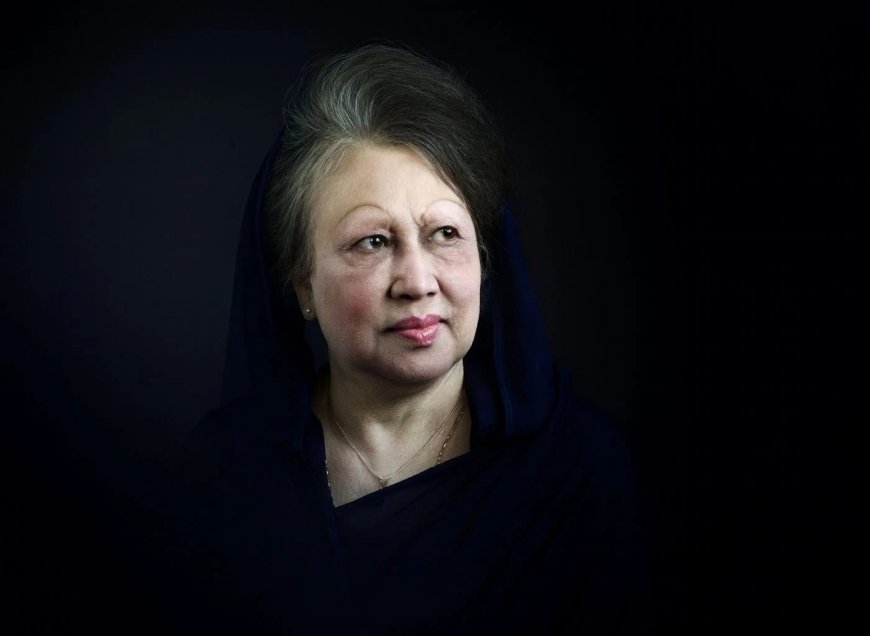
On Tuesday morning, December 30, at 6am, Begum Khaleda Zia died at Evercare Hospital in Dhaka while undergoing treatment. She was 80. The news, confirmed by BNP Standing Committee member Salahuddin Ahmed to the BBC, arrived not as a shock, but as a heavy finality.
For weeks, the country had been holding its breath. When that breath was finally released, it carried grief, memory, argument, and an uneasy sense that a long chapter of Bangladesh’s political story had closed.
For more than a month before her death, Khaleda Zia had been receiving treatment for kidney and heart complications, along with a renewed bout of pneumonia. Her condition had been declared critical, prompting party leaders, activists and ordinary supporters to gather outside the hospital day after day. Anxiety travelled quickly through the BNP ranks and far beyond them. Rumours flooded social media, some hopeful, some cruel, all revealing how deeply her physical condition had become entangled with the country’s collective nerves.
At the time of her death, her son and BNP acting chairman Tarique Rahman, his wife Zubaida Rahman, their daughter Zaima Rahman, and BNP Secretary General Mirza Fakhrul Islam Alamgir were present. The image of a political life ending not on a stage or in office, but in a hospital room, surrounded by family and medical equipment, has since lodged itself into the public imagination.
Whether admired or rejected, Khaleda Zia shaped an era. Even in death, she resists reduction into a single political verdict. For decades, she was framed either as a rival to be defeated or as a stabilizing force to be defended, depending on political allegiance. With the passage of time, and now with the finality of her absence, a more layered truth asserts itself.
She was a woman navigating a political world that was not built to accommodate her. She entered that world not through gradual grooming, but through personal tragedy, the assassination of her husband, President Ziaur Rahman. Such moments often produce retreat or silence. She chose endurance.
The rise of a young widow to national leadership in the early 1980s was never a simple narrative. It unfolded in a political culture where authority remained stubbornly masculine, guarded by institutions and habits that resisted disruption. Her emergence unsettled that order. At a time when the sight of a woman directing mass political mobilization was still an anomaly, she stood at the centre of rallies, negotiations, and resistance. Her presence did not instantly transform gender hierarchies, but it cracked open a door that had long seemed sealed. For women who would later enter politics, her journey became a reference point. It did not guarantee equality, but it made exclusion harder to justify.
Her resistance during the years of military rule is now retold almost as political folklore. The hartals, the marches, the confrontations with security forces, the repeated house arrests intended to restrict her movement. Each episode carried symbolic weight far beyond its immediate context. It was not only a struggle for power, but a struggle over who was allowed to occupy political space. Her refusal to retreat reshaped the political imagination of a generation that had never before witnessed a woman stand at the heart of national upheaval. Scholars would later describe that period as a form of gendered resistance, one that challenged authoritarianism not only through slogans, but through presence.
Her time in government, like that of any leader in Bangladesh, was complicated and contested. There were decisions that delivered progress and others that deepened controversy. No administration in this country escapes the burden of unresolved contradictions. Yet within the broader arc of state-building, her governments oversaw shifts that left lasting social imprints.
Among them was the expansion of educational opportunities for girls during the 1990s. This was not an isolated policy, but part of a wider recognition that gender disparity in schooling was a structural obstacle to national development. Over time, that investment reshaped classrooms, universities and workplaces. Many women who later entered professional life did so on foundations laid during that era.
Beyond policy, Khaleda Zia’s presence altered public life in less measurable ways. She embodied the idea that leadership could be carried by someone who did not fit the country’s traditional mould of authority. That idea matters even more in a present where misogyny circulates freely through digital spaces and women in politics are subjected to relentless hostility. Her political survival through decades of turbulence remains a reminder that women’s leadership is not symbolic participation, but a force capable of reshaping history.
The final decade of her life unfolded under a different shadow. Illness, legal entanglements and political marginalization gradually pushed her away from active public engagement. For years, she suffered from multiple complications, including liver cirrhosis, diabetes, arthritis, kidney, lung and eye problems.
She was diagnosed with Covid-19 in May 2021 and later required treatment in a coronary care unit due to breathing difficulties.
In June 2024, a pacemaker was implanted in her heart. Doctors also treated her liver through a porto systemic procedure, with specialists brought from abroad. Her heart condition remained severe, with three blocks and an earlier ring insertion further complicating her health.
These medical struggles unfolded alongside legal battles that many viewed as inseparable from political hostility. In February 2018, during the Awami League era, a court sentenced her to five years in prison in the Zia Orphanage Trust corruption case. She was later sentenced in another corruption case as well.
Over time, her imprisonment shifted from prison cells to special arrangements and hospital wards. Eventually, she was released on special conditions by executive order and moved to her Gulshan residence. Following the political upheaval of August 2024, she was fully released from all sentences by presidential executive order on August 6.
It is difficult to disentangle her declining health from the politics that surrounded her confinement. For many, the line between justice and judgment blurred beyond recognition. The perception that basic fairness had been compromised contributed to a growing sense of unease, not only within her party, but across society. Her quiet endurance during this prolonged period became, in itself, a political statement. She spoke less, appeared rarely, yet remained present in the national consciousness as a symbol of how power can pursue its adversaries long after active rivalry has faded.
The political shift of August 5 did not occur in isolation. It was the result of accumulated grievances, unrest, state violence, enforced disappearances, student protests and a deepening mistrust that cut across generations. Within that landscape, Khaleda Zia’s prolonged suffering became emblematic of the broader costs of political vendetta. Her imprisonment and illness contributed to an atmosphere in which injustice felt personal, embodied in a frail figure whose fate seemed tied to the moral direction of the state.
Her death has now revived questions that extend beyond party lines. To some, she remains a leader whose era has ended. To others, she stands as a symbol of democratic aspirations that once animated the republic. There is also a quieter response, less ideological, that sees her as an elder stateswoman whose prolonged suffering has become part of the nation’s conscience. Her passing reminds Bangladesh that even figures who appear politically indestructible are ultimately bound by human fragility.
Her legacy resists simplicity. It stretches from the streets where she led resistance against military rule, to the corridors of government where her decisions shaped millions of lives, to the courtrooms and hospital wards that defined her final years. It is a legacy woven with courage and misjudgment, resilience and vulnerability, ambition and loss.
In many ways, it mirrors Bangladesh itself. A country that demands strong leadership yet subjects its leaders to unforgiving cycles of elevation and destruction. A country that speaks passionately about democracy while struggling to protect its institutions. A country that seeks vision from its leaders but rarely forgives their human limitations.
The hospital room where Khaleda Zia spent her final days has become a symbolic space where the past and present of Bangladesh briefly converged. Her frailty reflected the fragility of the political culture she helped shape. Her silence echoed the uneasy calm that often follows long periods of turmoil. With her death, that silence has deepened into reflection.
When the history of modern Bangladesh is eventually written with the clarity that distance allows, Khaleda Zia will not appear only as a former prime minister or as the chairperson of a major political party.
She will appear as a woman who challenged inherited assumptions about power in a society unprepared for her presence. She will appear as a figure who expanded the boundaries of what women could imagine for themselves in public life. She will appear as a reminder that leadership often demands endurance far beyond the rhythms of elections and office.
And she will appear as a measure of how a nation remembers those who shaped it, not only through victories, but through the long, human cost of political life.
H. M. Nazmul Alam is an Academic, Journalist, and Political Analyst based in Dhaka, Bangladesh. Currently he is teaching at IUBAT. He can be reached at [email protected].