






























































Lessons from Mother Mary Comes to Me
Mother Mary Comes to Me reminds us that real activism is not performed but lived. And only this kind of activism -- rooted in courage, contradiction, and conviction can move us forward

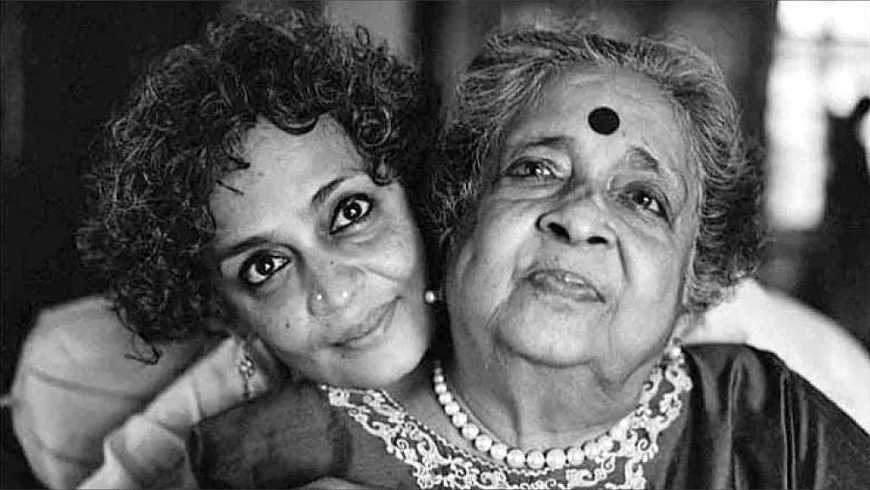
Mother Mary Comes to Me, the Booker Prize Winner Arundhati Roy’s latest book reminds us that activism isn’t idealistic, and neither is it perfect. Real activism is courage without guarantees of rewards. It can cost family relationships, reputation, security -- and sometimes, life itself.
Yet history shows that even when activism ends in personal loss, it can ignite shifts far larger than the individual who dared to resist.
This truth struck me while reading this book. It is not simply a memoir about a complex mother-daughter relationship; but a study of what it means to live a life that refuses obedience.
In Mary Roy’s choices -- often harsh, at times even cruel -- we encounter a form of activism that is uncompromising, deeply personal and even hereditary.
If we look at Arundhati’s life, her resistance towards critique of large infrastructure projects and her stand against the Indian Government, especially on Kashmir, are a few examples that might be attributed to her mother, as she eloquently mentions, "My Shelter and Storm."
The Radical Legacy of Mary Roy
The book is unsettling because it refuses tidy narratives of activism. “Mrs Roy,” as Arundhati Roy calls her -- emerges not just as a mother, but as a radical force shaped by struggle. She left an abusive marriage when endurance was expected, raised her children alone despite severe financial constraint, and founded a progressive school without financial security.
She fought a fearless battle with her own family and secured equal inheritance rights for Syrian Christian women. In Mary Roy vs State of Kerala (1986), the Supreme Court of India ruled that once the Indian Succession Act, 1925 came into force, the Travancore Christian Succession Act of 1916 could no longer govern inheritance for Syrian Christians in Travancore.
As a result, Christian daughters were legally entitled to equal inheritance rights, the same as sons -- bringing an end to a regime that had long reduced women’s claims to token amounts or excluded them altogether.
But Arundhati Roy does not romanticize her mother. Mary Roy was both fierce and principled, and at times cruel and unpredictable. The author even mentions leaving her family during her university years, due to sheer unkindness and disrespect she received from her mother.
This tension forms the memoir’s political core. Mary was a flawed human being, yet her activism was persistent and lived through daily choices. She personally supervised her students’ lessons, including bathing and hygiene, and ensured the school’s ethos reflected her vision.
She chased the architect she wanted who could build a perfect school, demanded quality education, and often pressed parents to invest in their children’s future -- demonstrating that activism is rooted in practical, everyday life.
Women’s Activism Before It Was ‘Managed’
The feminist scholar Seuty Sabur documents in Civil Society and Citizenship in India and Bangladesh (2021) that early women’s activism was embedded in anti-colonial resistance, the Language Movement, and nationalist struggles.
Women claimed public space not as beneficiaries, but as political actors.
The Begum Club exemplifies this courage as it aligned with the Language Movement, protesting for the release of political prisoners in 1962, protecting minorities during the 1964 riots and ethnic cleansing, and staging demonstrations during the Indo-Pak War of 1965.
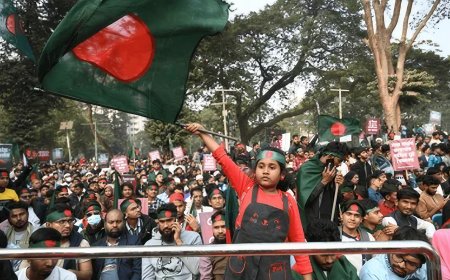
When police attacked a procession of female students on January 19, 1969, women revolted spontaneously against the Ayub Regime -- without political instigation.
By occupying public space, they made women’s presence unavoidable, laying the foundation for post-independence women’s movements.
This history matters because it reminds us that activism was once understood as risk.
Over time, activism has been professionalized -- translated into projects, indicators, and deliverables.
Sabur calls this the de-radicalization of Bangladesh’s women’s movement. NGOs multiplied, donor priorities dictated agendas, and activism increasingly shifted from confrontation to management. The result is not the absence of activism, but its containment.
Rokeya, Mary Roy, and the Cost of Voice
Mary Roy’s life offers a counterpoint. She did not wait for legitimacy. She acted because injustice made inaction impossible. Her politics extended beyond classrooms to courts. And sometimes -- as the recent death of Hadi reminds us -- it ends in life itself.
Yet what remains is not only grief, but a legacy of moral clarity -- one that insisted on building a more just world rather than tearing it apart.
History shows that such losses often catalyse ideological shifts that outlast individual lives but can return to haunt us, once in a while if the issue has lived on for generations.
The derogatory remarks recently directed at Begum Rokeya by a university professor were not merely personal insults; they attempted to discipline feminist imagination itself. Rokeya remains threatening after decades because she imagined women as thinking citizens rather than obedient subjects.
Mary Roy belongs to the same lineage. So do the women who protested in 1969. So does every woman who refuses silence today. Abuse, as Mother Mary Comes to Me makes clear, is not only physical.
It is social, structural, and emotional -- maintained through fear, respectability, and the policing of dissent. Bangladesh knows this reality well: laws exist, campaigns exist, yet stigma continues to govern women’s lives.
Holding Activism
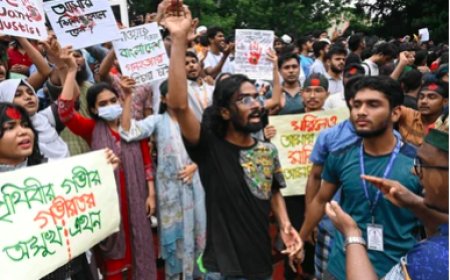
The lesson from Mary Roy, Begum Rokeya, and the women chronicled by Sabur is clear: Activism is messy, risky, and deeply human. The 16 Days of Activism cannot be reduced to banners, hashtags, or panels.
They must be held -- beyond December 10, beyond funding cycles, beyond comfort.
This is the work that counts: Defending women’s voices when they are mocked, refusing silence when silence is rewarded, and accepting that activism may demand sacrifice -- but can still reshape conscience.
Mother Mary Comes to Me reminds us that real activism is not performed but lived. And only this kind of activism -- rooted in courage, contradiction, and conviction can move us forward.
Tasmiah T. Rahman works at Innovision Consulting and is pursuing a joint PhD program between SOAS University of London, UK, and BRAC University on the political economy of development. Her views are her own.