































![A Ledger of the Soul: Navigating the Allah-Bhagavant Nexus in a 19th-Century Puruṣākāra Jñāna Caupara [Gyan Chauper]](https://counterpointbd.com/uploads/images/202608/image_430x256_6a93baa3b09a7.jpg)




















Is Jamaat a Bangladeshi BJP? Not Quite.
India’s political field has bent under pressure but has not collapsed. Meanwhile, Bangladesh’s political field is far more fragile.


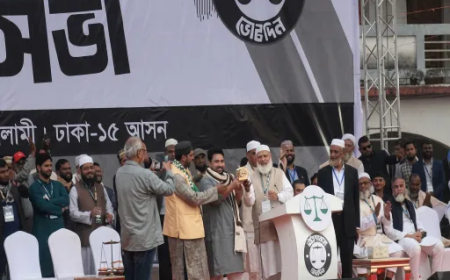
Comparisons between India under the BJP and a hypothetical Bangladesh under Jamaat-e-Islami are increasingly common.
On the surface, the analogy appears intuitive: both represent majoritarian religious politics operating within formally democratic systems, both show authoritarian tendencies, and both claim moral legitimacy rooted in faith and nationhood.
Yet this comparison, while tempting, obscures a fundamental asymmetry.
A Jamaat-led totalitarian state would not merely resemble a BJP-led one in a more extreme form; it would represent a categorically different -- and far more totalizing -- political project.
The distinction begins with the nature of the religious traditions from which these movements emerge. Hindu nationalism, even in its most assertive political form, draws from a civilizational tradition that is internally plural, decentralized, and historically tolerant of contradiction.
Hinduism lacks a single canon, a unified clergy, or an agreed-upon social blueprint. As historians such as Romila Thapar have long argued, Hindu identity has functioned as much as a cultural and civilizational umbrella as a theological doctrine. This matters politically.
Even under an aggressively majoritarian BJP, domains such as popular culture, markets, consumer life, art, and everyday social practices have continued to operate with relative autonomy.
Women’s participation in the workforce, cinema, fashion, literature, and entrepreneurship -- though contested and often policed -- has not been structurally reversed. The BJP’s project has been one of hierarchisation and exclusion, not total homogenization.
Radical Islamist politics, by contrast, is standardizing by design. Its ideological core seeks to collapse difference -- between men and women, believer and non-believer, public and private -- into a single moral, legal, and social order.
Where political Islam has achieved decisive power, from post-1979 Iran to Taliban-controlled Afghanistan, the outcome has not been merely social conservatism but the systematic narrowing of cultural, intellectual, and economic space. Pluralism is not subordinated; it is delegitimized. The goal is not dominance within diversity but the abolition of diversity itself.
This distinction produces radically different consequences at the level of state and economy. India under Modi has paid real social and institutional costs: Erosion of minority protections, intimidation of dissent, politicization of independent institutions.
Yet it has not experienced civilizational or economic rupture. Capital continued to flow, industry expanded, and the state remained intelligible to global markets. India’s growth story -- uneven, exclusionary, and morally compromised -- remained structurally intact.
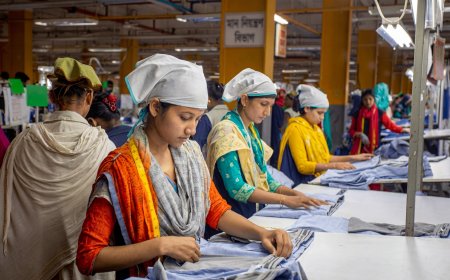
Bangladesh would not enjoy similar insulation. A Jamaat-influenced state would impose not only social but direct economic costs. Bangladesh’s export-driven economy, particularly the garments sector, rests on women’s mass participation, cultural flexibility, and international legitimacy.
Any ideological project that restricts women’s mobility, expression, or visibility strikes at the core of the country’s economic foundations. This is not speculative or alarmist; it is structural.
Unlike India, Bangladesh cannot afford even partial withdrawal from global norms without severe consequences.
Political lineage further deepens the divergence. The BJP, despite its extremist edges, has long operated as a mainstream actor within India’s constitutional framework. It governed states, led coalition governments, and participated in competitive electoral politics for decades prior to 2014.
Its authoritarian turn represents a degeneration of a system it once broadly accepted.
Jamaat, by contrast, has historically functioned as a conditional political actor in Bangladesh -- periodically banned, electorally marginal, and reliant on alliances rather than mass legitimacy.
Its relationship with democracy has been instrumental rather than foundational, treating elections as a pathway to power rather than a principle to be defended.
Finally, there is the question of political resilience. Even after a decade of BJP dominance, India’s opposition has not been extinguished.
Congress -- despite its deep historical failures -- has regained momentum, regional parties remain powerful, and electoral competition, though skewed, persists. India’s political field has bent under pressure but has not collapsed.
Bangladesh’s political field is far more fragile. Institutions are weaker, opposition space is narrower, and social cleavages are easier to harden into permanent exclusions.
In such an environment, a totalizing ideological force does not merely dominate -- it overwhelms.
The conclusion, then, is not that BJP rule is benign or defensible. It is that different forms of illiberalism produce different end states.
A radical Hindu party in power generates an exclusionary, hierarchical authoritarianism that still leaves significant social and economic pluralism intact.
A radical Islamist party in power generates a far more comprehensive, civilization-wide project -- one that seeks to reorder society itself.
Surface parallels with India circa 2012 may be analytically useful. But the endpoints are not symmetrical. Confusing the two risks dangerously underestimating what is truly at stake.
Muhaimen Siddiquee is a brand and communications professional with a strong interest in culture, politics, and history. An IBA graduate, he applies insights from consumer behaviour to understanding shifts in society and historical changes.