










































![A Ledger of the Soul: Navigating the Allah-Bhagavant Nexus in a 19th-Century Puruṣākāra Jñāna Caupara [Gyan Chauper]](https://counterpointbd.com/uploads/images/202608/image_430x256_6a93baa3b09a7.jpg)





















How Bangladesh Betrays Its Tea Garden Workers
Tea workers exist and spend their entire lives on lands that they do not and will not own, unable to build assets or escape the plantation system.
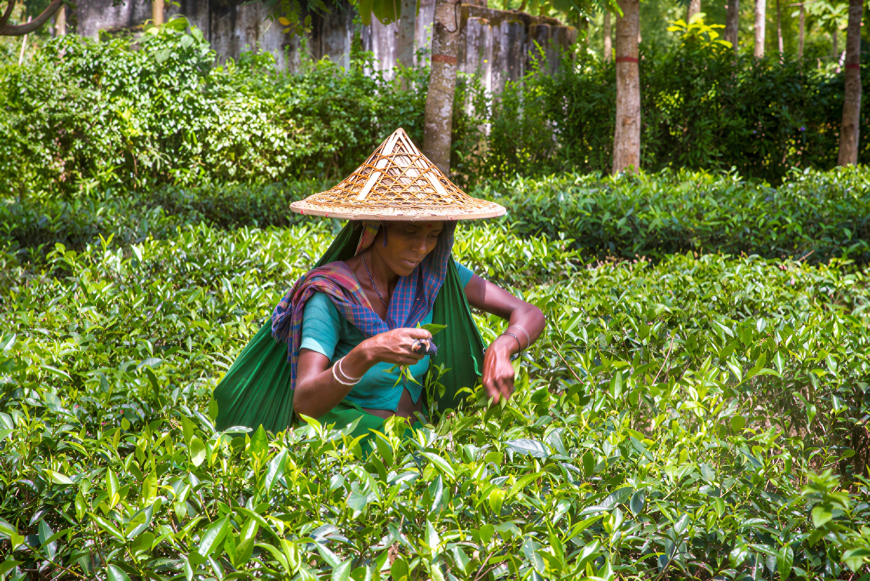
This did not happen yesterday, and it certainly did not happen by accident. The tea workers in Bangladesh did not just get left behind, developmentally speaking, through some cruel twist of fate. They were purposefully placed, in a position of subservience, first through colonial coercion and later through systematic neglect that survived independence with remarkable efficiency.
Their ancestors were brought to the tea gardens under false promises and force, cut off from their land, their language, and any meaningful choice over their futures, and then when independence arrived and governments changed and flags were replaced, the structure itself remained stubbornly intact. The empire left, but the estate stayed. The whip went, but the hand stayed.
Generations were born into labour they neither chose nor could leave, and when poverty endures this long and this consistently, it stops being an accident and starts looking like design.
The unforgivable thing about this crisis, however, is how easily it has been allowed to continue. The interim government knew what was going on, as did everyone else who chose to pay attention. The wage protests happened in broad daylight. Hunger made its presence known blatantly. Reports of unpaid salaries circulated for weeks, sometimes months, while families inside the gardens rationed meals and waited for relief that never came.
Committees were established, statements released, and time went by. A 5% raise was proposed during a year where food inflation had grown well beyond any wages adjustment could possibly mitigate -- and this was progress. It was not reform, of course. It was an offense. When a government fails to act for the most powerless workers in the country despite knowing the facts, it ceases to be neutral and reveals clearly whose side it has chosen.
We need to say this clearly because we tend to talk around this: Tea workers are not the setting for postcards, for the tourism promotional campaign. They are not part of a nostalgic rural aesthetic meant to soften our conscience. They are living, breathing human beings who work dawn till dusk, day after day, season after season, their bodies absorbing the cost of labour that keeps an industry alive.
They bear the weight of the colonial legacy that has never loosened its hold, although the language of exploitation has been softened and filtered through age. Their ancestors were brought to this country through the use of force. Today, they find themselves here through economic compulsion and social abandonment. This is our collective failure.
However, the take-home wages spell out the truth. Tk 178 a day, or less than two dollars, places the Bangladeshi tea workers among the lowest-paid labourers performing such physically demanding work anywhere in the world. Tk 178. This is the amount expected to cover food, shelter, healthcare, education, and every other requirement of a dignified life in this ever-rising economy.
Women, who constitute the backbone of the plucking force, talk freely about hunger that goes on for days, rations that are finished even before the weekend, or children pulled out of schools since there is no money to keep them there.
The needs of tea garden workers, as any person would see as reasonable, meet a response that oscillates between silence and tokenism. The interim government has promised a meager annual raise of 5%, starting from 2024, so small by inflation that it barely registers as relief, and even that promise has remained largely unimplemented.
Tens of thousands of tea farm laborers of the National Tea Company went without pay altogether, their families living off of credit on the promise of maybe as the harvest stalled and political leaders looked elsewhere.
There is neither legal nor moral justification for this state of affairs. The Constitution of Bangladesh speaks clearly about dignity, labour, and the freedom from exploitation, and the Labour Act has defined the terms of employment, housing, and welfare.
The moment profit comes in, these protections evaporate, as if what is holding them in place would disappear in an instant should some estate manager decide to weigh the costs of labour against the revenue. Laws are on paper, but enforcement disappears inside the gardens, where oversight is weak and accountability weaker still.
This imbalance is starkly exposed in the quota system: Workers must pick at least 23 kilograms of tea leaves each day just to be marked present, and failure results in their wages being cut or completely withheld. These quotas operate without adequate safety protections, without sufficient breaks for food or rest, and often without formal contracts that protect workers' rights.
Almost 93% of the tea workers have no official employment letter, making them vulnerable to arbitrary dismissal, manipulation of wages, and other abuses without any avenue for seeking justice.
The narrative of benefits provided in lieu of meager wages falls flat when subjected to scrutiny. Housing, rations, and health facilities frequently cited as compensation, but studies by Transparency International Bangladesh paint a far bleaker picture.
Many workers live in fragile homes without electricity, clean water, or proper sanitation, and medical care often means paying out of pocket or going without treatment altogether. If this is welfare, it is welfare stripped of substance and dignity.
Questions then arise about the institutions meant to intervene. Trade unions exist, but they are often weakened or compromised or set aside, in the face of imbalance and political force.
Successive governments have spoken eloquently about the need for inclusion and justice but hide behind reports and committees when action is required. Tea workers do not shape urban voting blocs, do not own media platforms, and do not command attention beyond moments of crisis, and this invisibility has consequences.
Shahid Qadri has written about the poor as the “wounded heart of the nation.” The tea workers of Bangladesh definitely constitute that narrative. Freedom is meaningless if large sections of society live without dignity, as has been reminded of us by Tahmima Anam, and yet these words remain confined to literature festivals and opinion pages, rarely carried into the rooms where policy is written and power exercised.
At the root of this problem lies the question of land. Tea workers exist and spend their entire lives on lands that they do not and will not own, unable to build assets or escape the plantation system. Without ownership, they remain tied to estates that underpay them and control their futures, as repeatedly documented by organizations such as the Business and Human Rights Centre.
Now, what is required is action, not another study or mere censure. The wage should be linked to the cost of living, not to arbitrary quotas. There should be consequences for non-compliance with labor laws. Formal contracts and transparent wage systems must be put in place. Land rights for these workers must be addressed if the cycle of bondage is to be broken.
Every cup of tea poured into a guest’s hand, every box purchased for Eid, carries within it the labour of a human being whose rights have been systematically denied. It is not an act of charity that tea workers are requesting. It is accountability.
And for that, the time for excuses is over.
Azeema Anhar Humaira is an English Language Instructor at ULAB and member of the Counterpoint editorial team.