






























![A Ledger of the Soul: Navigating the Allah-Bhagavant Nexus in a 19th-Century Puruṣākāra Jñāna Caupara [Gyan Chauper]](https://counterpointbd.com/uploads/images/202608/image_430x256_6a93baa3b09a7.jpg)




















Return from Exile
Tarique returns to Bangladesh as the indispensable man of Bangladeshi politics, the fulcrum of its democratic transition, the lynchpin of its liberal politics, and the prime minister in waiting.
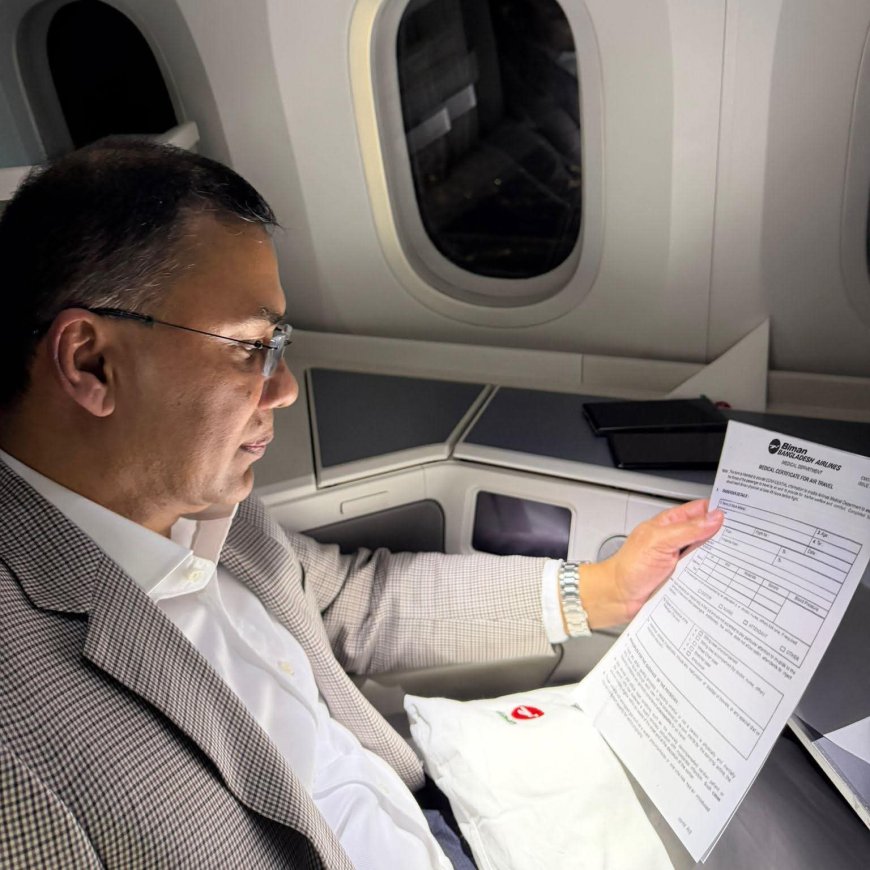
Tarique Rahman left Bangladesh having signed a warranty that he would never participate again in Bangladeshi politics.
He returns to Bangladesh as the indispensable man of Bangladeshi politics, the fulcrum of its democratic transition, the lynchpin of its liberal politics, and the prime minister in waiting.
With his party, Bangladesh Nationalist Party (BNP) expected to romp to a 200+ seat majority in the upcoming February 2026 parliamentary election, the Bangladeshi scion who had been sentenced a life sentence in absentia by ousted dictator Sheikh Hasina's kangaroo courts will become the most powerful man in Bangladesh as soon as he sets foot in what will soon again be Zia International Airport.
Bangladeshis are desperate for a strong leader.
Sheikh Hasina was a paradox of weakness and tyranny: too weak to govern through democratic mandate, too rapacious to share the spoils of power, and too dependent on her foreign patrons to chart an independent course for the nation.
Her regime was propped up by Indian intelligence services and the Indian Ministry of External Affairs, which shielded her from international condemnation while her domestic security agencies conducted a reign of terror through torture, abduction, enforced disappearances, and extrajudicial killings.
Bangladeshis have now had enough of leaders who mistake brutality for strength. They want a leader who is genuinely strong: one who can take decisions that will anger vested quarters, pursue much-needed reforms without flinching, and restore dignity to a nation that has been humiliated for too long.
The Zia family has been synonymous with Bangladesh's democratic aspirations for half a century. Ziaur Rahman saved Bangladesh from chaos after August 1975 and restored multi-party democracy to a nation that had nearly succumbed to one-party rule.
Khaleda Zia became the champion of parliamentary democracy, leading the movement that toppled the Ershad dictatorship and twice winning free elections.
Yet Tarique Rahman, once in office, stands poised to accomplish what neither his father nor his mother was able to do: design a caretaker government system which will hold free and fair elections and help transition power peacefully to a successor government.
In a country where power has been seized through coups, clung to through manipulation, and relinquished only through upheaval, this would be a historic landmark that would easily be his own crowning achievement.
But Tarique Rahman would do well to remember that political mandates, however vast, are always fleeting.
He now stands where Sheikh Mujibur Rahman found himself in 1972: the liberator returned, the undisputed master of the nation, the man who could do no wrong, who would soon betray the same democratic principles he had spent his whole life working towards.
He stands where Rajiv Gandhi found himself in 1984, swept into office on a wave of sympathy and hope, only to see his government consumed by scandal and crisis.
He stands, more recently, where Donald Trump found himself at the beginning of his second term in January 2025, armed with a mandate for transformation but facing the grinding reality of governance.
Problems arise, choices must be made, and the very popularity that brings leaders to power is depleted by the exercise of that power. No mandate, however large, is immune to the entropy of governance.
The wisest thing Tarique Rahman can do, even as he ascends to power, is to think seriously about succession.
President Biden's political legacy was undone not by his record in office but by his refusal to identify and anoint a successor, clinging to power even after his disastrous debate performance against Trump exposed the reality that time had caught up with him.
By the end of her tenure, the greatest source of friction between Sheikh Hasina and the Indian establishment was not policy or posture but her stubborn refusal to identify a successor, leaving New Delhi uncertain about the future of their investment in her regime.
Leaders who refuse to plan for succession do not project strength; they betray insecurity.
Tarique Rahman should understand that grooming successors, building institutions that outlast any single leader, and preparing the next generation of leadership is not an admission of weakness but a demonstration of confidence in oneself and in the durability of one's vision.
Tarique Rahman begins his stewardship of Bangladesh with a vast reserve of goodwill from all Bangladeshis, from those who remember his father's sacrifices, those who know only the legend, as well as those who have benefited from Khaleda Zia’s pro-growth and pro-empowerment policies.
Ziaur Rahman was not yet forty when he began guiding the destiny of Bangladesh. Khaleda Zia was only forty-five when she started her first term as prime minister.
Tarique Rahman will potentially start his first term of office at sixty.
He has waited longer, endured more, and perhaps learned lessons that only exile can teach. The page is blank before him. It is now up to Tarique Rahman to write the next chapter of history in glorious, golden ink.
Ehteshamul Haque is a lawyer who focuses on technology transactions. He teaches corporate law at American University.